ART COLLECTION
Works in our Collection include modern art by Monet, Renoir, Sisley, Degas, Gauguin, Manet, Childe Hassam, Ramon Casas, Toulouse-Lautrec, Emile Bernard, Seurat, Munch, Modigliani, Marquet, Picabia, Dali, Fernand Léger and Bernard Buffet. It also includes classical works by Carracci, Velasquez, Pourbus, Rubens, Kneller, David, Delacroix, Ingres, Charles Le Brun, Mignard, Elisabeth Vigée Lebrun, Gilbert Stuart, Thomas Lawrence, Thomas Phillips, Léon Gérôme, and Horace Vernet among others.
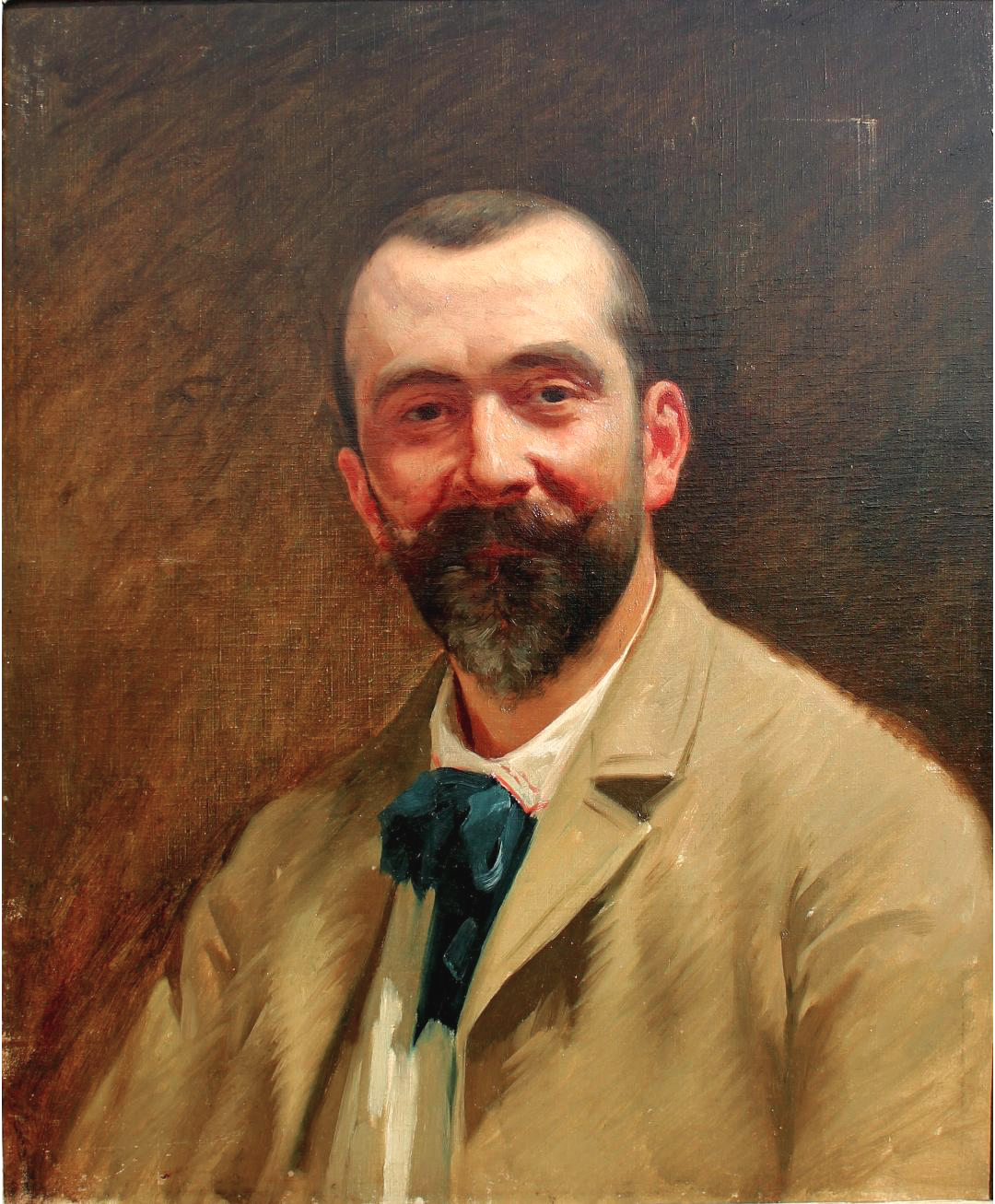
Self-portrait in boating attire
Claude Monet self-portrait revealed by mirror image
This painting was first identified as a portrait of Claude Monet using recent facial recognition software. This was exclusively with period photographs as reference sources. It was then confirmed that the image is a reverse mirrored image of the sitter. This brings us to the very obvious conclusion that this is a self-portrait painted by the sitter of his mirror reflection.
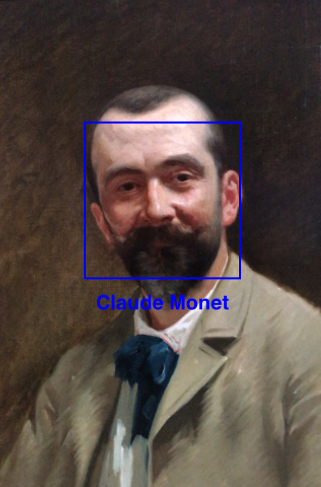
Identification by facial recognition
Luxand FACES computerized facial recognition software was used to verify the identity of the sitter. It was fed a database of early Daguerrotypes and later photographs of Claude Monet that were used to create the reference parameters for image analysis and recognition This screenshot of the software in operation shown to the right clearly identifies the sitter as being Claude Monet.
Self-portrait from MIRRORed IMAGE
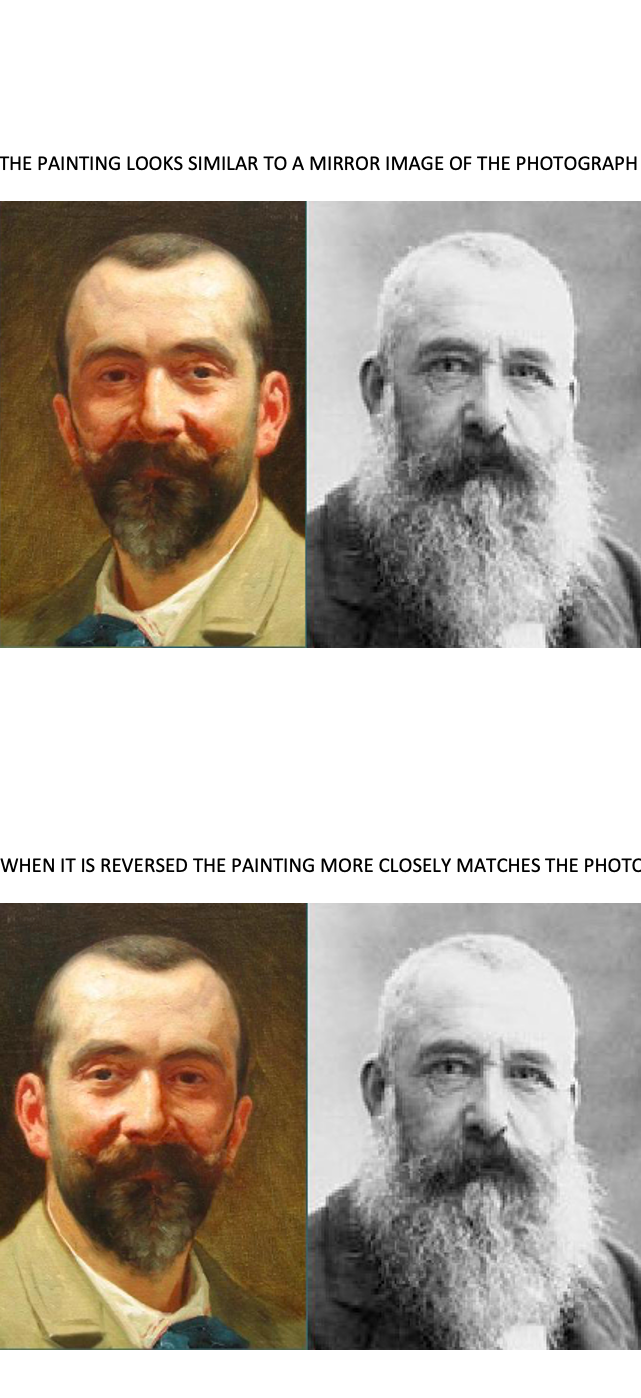
Image comparisons
In the top set of images we see Monet's painted portrait next to a photograph of Monet at an older age. The painting to the left shows Monet as he saw himself in his reflection in a mirror. His facial features are on the opposite side of their position in the photograph. The thicker of his two eyebrows, the right one, is on the left side in the painting. His left nostril which was anchored higher is on the right side in the painting. He even seems to tilt his head to the opposite side for the pose. The bottom set of images shows the painted portrait flipped horizontally. This reverts the backwards, reversed image painted in a mirror to the usual direction others would see him in. We can now note compairing both images that his features are now perfectly matched and on the same side of his face. These clear asymmetries point to our painting not being a portrait seen through another painter's eyes, but indeed a self-portrait painted from his reflection in a mirror. We can also verify that the form of his ear cartilage matches. His features in the self-portrait appear somewhat larger due to painting close to the mirror to better see details.
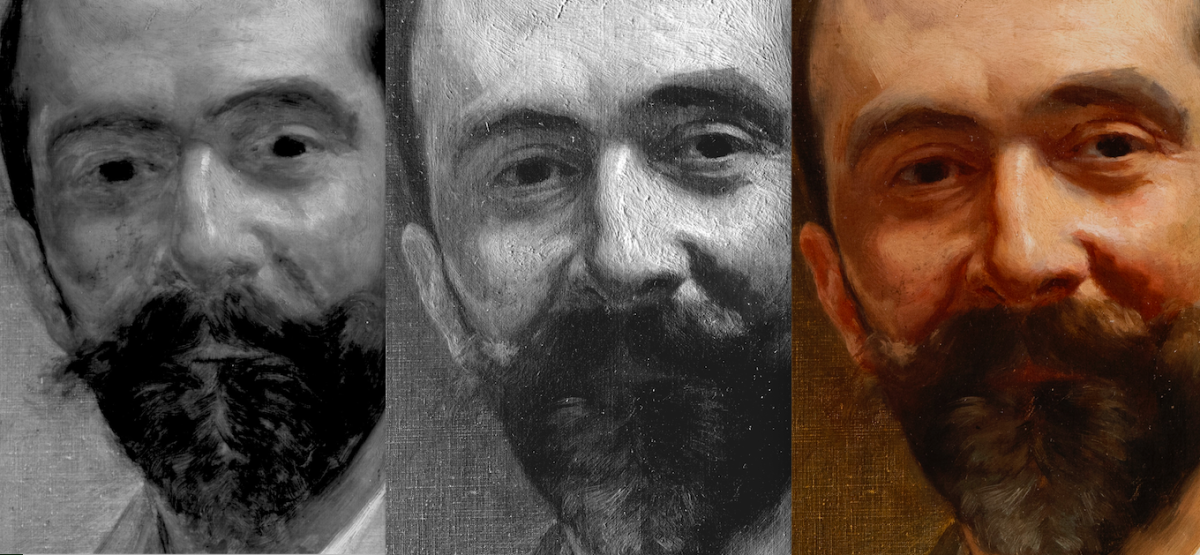
Scientific photography
Infrared, side lighting, natural light
To the left we see our Claude Monet self-portrait by infrared photography, revealing the preparatory drawing beneath the final painted artwork. The center view shows the painting in black and white lit by lateral side-lighting. The right image shows our painting in natural daylight. We will note that in the initial drawing he seems more gaunt, possibly pointing to a lapse of time between this pose and later ones. Or perhaps he later sought to enhance his appearance in the final painting, not only adding a smile with puffed out cheeks, but also painting himself from closer up for greater detail. This resulted in slightly larger facial features due to the change of perspective.
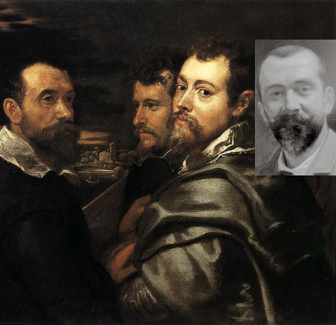
Influence of Dutch masters
In 1871 Monet returned from England and Holland where he had evaded enrollment in the Prussian war. He visited Amsterdam museums and was likely struck by the mastery of Flemish painters. Here we can see a rendition of his self-portrait in black and white compared to a self-portrait of Rubens with his friends in Mantova. The Dutch masters possibly had an influence on Monet at his return to France, when he started painting in his floating workshop. For a time he may have modeled his grooming, this self-portrait, and to an extent his painting style, after the Dutch masters.
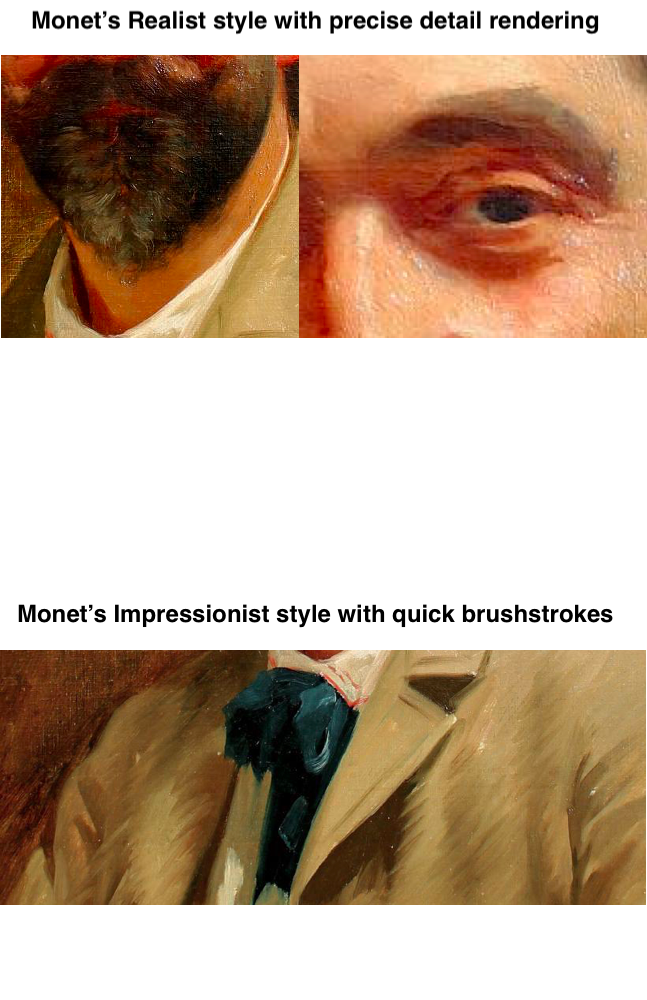
Painting combining artistic styles
Stylistic analysis
In the details of his face we can notice that Monet chose to paint his own features with strict academic realism. He purposefully forfeited his penchant for less faithful if more inspired impressionist work to more perfectly record his smiling expression. This work disproves theories that his choice of blurred portrayals was due to either a lack of academic training or faulty vision when young.
That makes it an iconic work of the painter, rendering in the most faithful
truth the man as he saw himself, at a landmark time when he was finally
recognized as a master of painting. He also discretely presents in this
painting certain personal 'signature' features. The work harbors multiple
characteristic elements that are indissociable from his other impressionist
paintings, while also reflecting his recent exposure to the Flemish Masters.
In the rendering of his clothing however Monet allowed himself the freedom to paint his blue tie and the folds of his jacket with his usual Impressionist brio that brought him to fame.
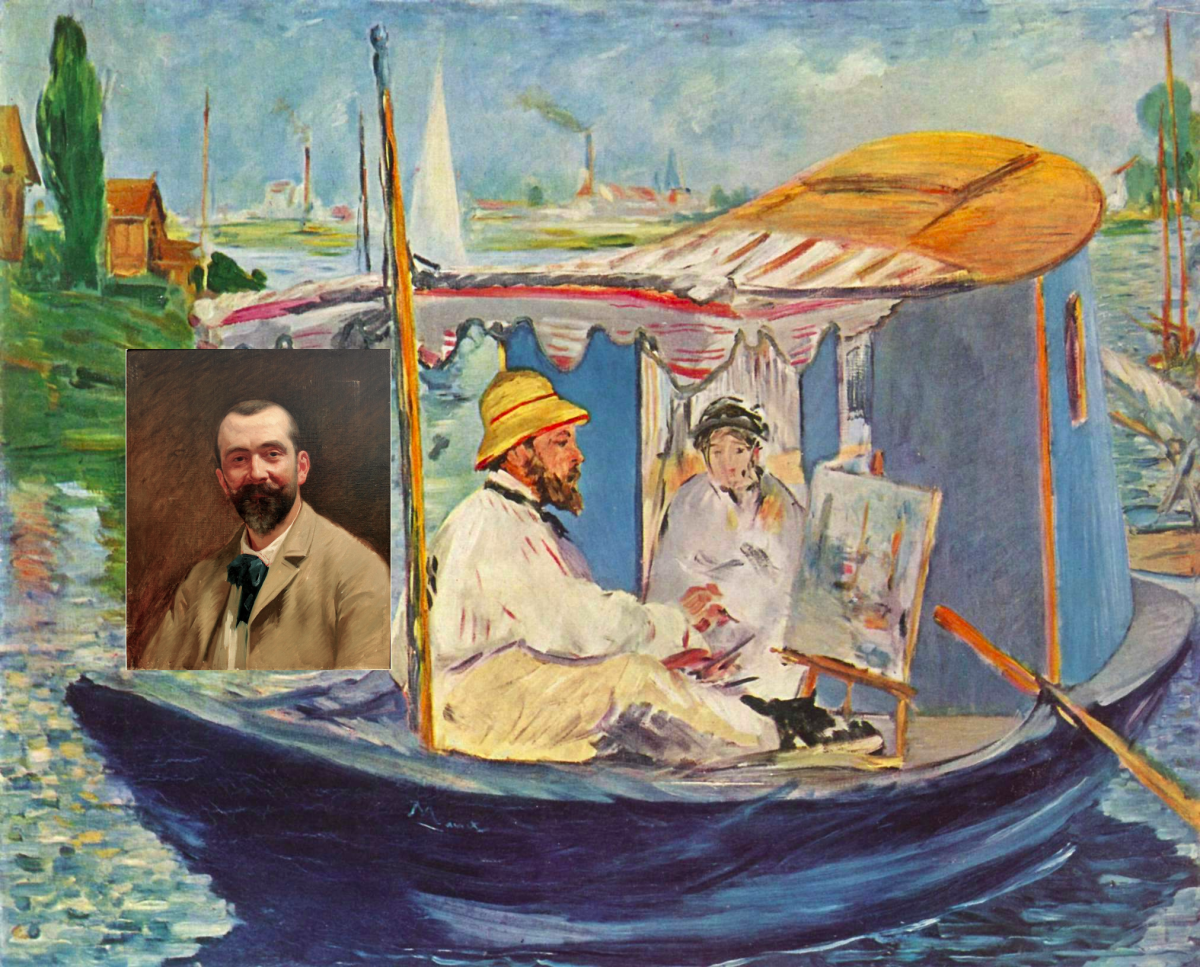
Summer Suit for painting on A Boat
Clothing seen in a Manet painting
Monet wears the same white shirt with red piping as well as the same blue tie. His jacket could be from the same suit as Monet's trousers on the boat. While they seem a much lighter tint are, they viewed outdoors in direct sunlight The jacket was painted indoors in dim indirect lighting. The work by Manet was painted in 1874, and Monet's beard was roughly the same length and cut as in the self-portrait. This helps date our work as Monet's beard was seldom trimmed and usually much longer and fuller.
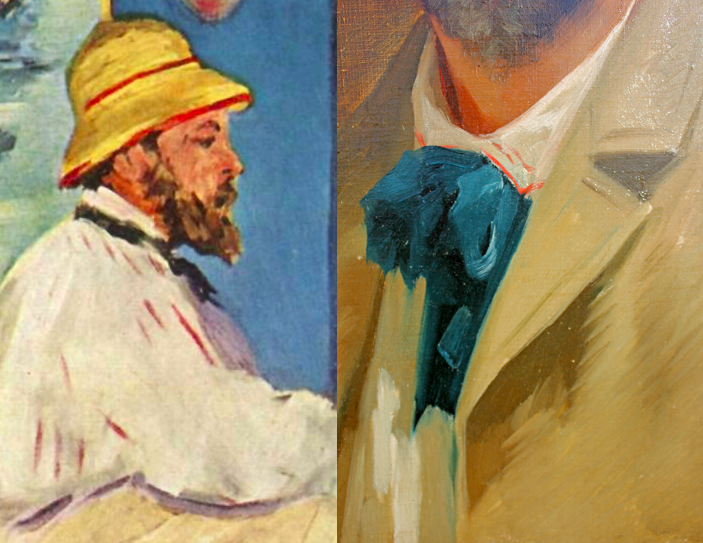
Similar boating attire
Blue tie, red piping in shirt and tan suit
There was a brief period of time in 1874 when Claude Monet's beard was relatively short and groomed. We can therefore date the two paintings similarly.
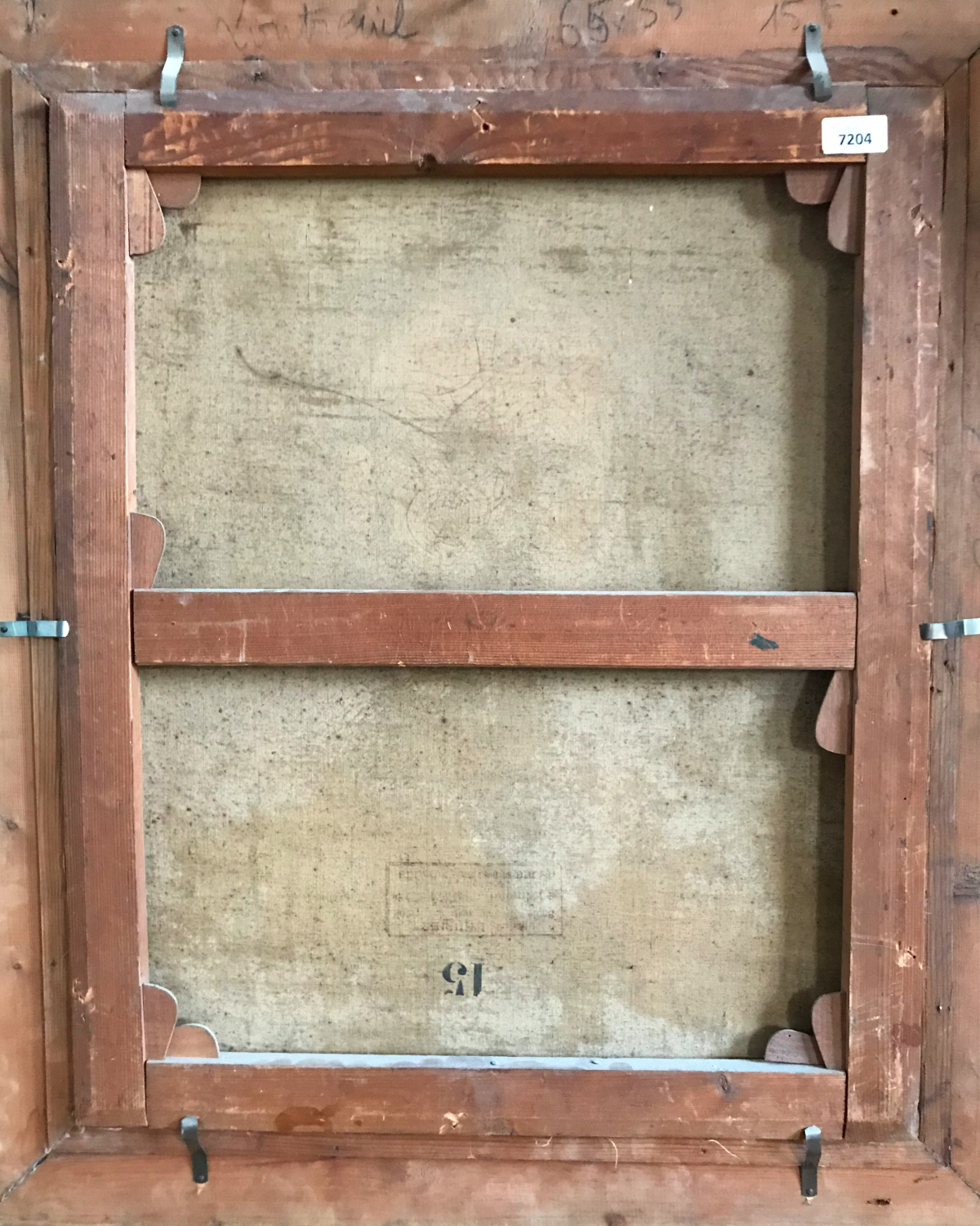
Original chassis and unlined canvas
This work was painted on a Figure 15 format chassis on a prepared canvas that was never relined. It remains in well preserved original condition. This painting has been subject to an expert study of
the pigments, the canvas and the brushstrokes. Its chassis is presumed to be
the original one. The
partially erased manufacturer markings have been deciphered and was made in Paris. Closer examination of the back of the canvas shows the outline of the portrait in reverse from a sketch drawn by the artist prior to painting. Technical image analysis and specialized photography of the painting show that the artist first drew a preliminary version in charcoal, repenting for the head position and the ear shape. It was found beneath by special photography underneath the painted surface. A request for assistance was made with the C2RMF laboratories at the Louvre. Their recommended laboratory concluded upon scientific analysis and stylistic references that work this is indeed a painting by Monet. The work is available for inspection by legitimate parties.
ART COLLECTION
LATEST ADDITIONS TO OUR COLLECTION
Small portrait of Claude Monet
Small portrait of Claude Monet
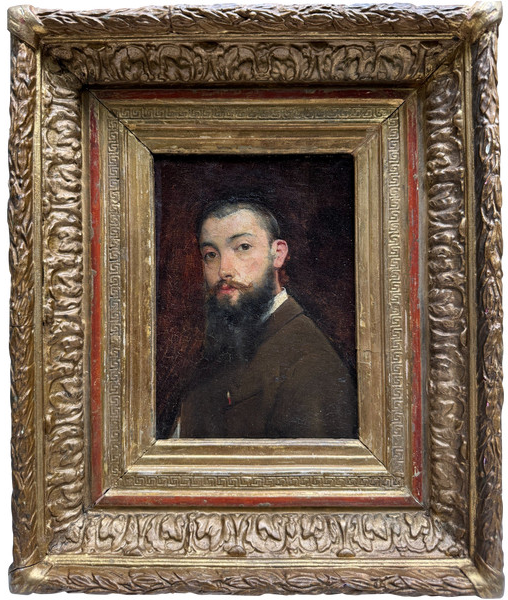
This small portrait's youthful features point to it dating to circa 1865. The unusual expression of Claude Monet evokes a portrait painted by a colleague with whom he was not on the warmest terms. We see in his harsh glance the grumpy disposition he was often characterized as displaying. This sharply drawn painting with exacting precision reminds of the work of Edgar Degas, although at this stage of analysis it is too early to conclude.
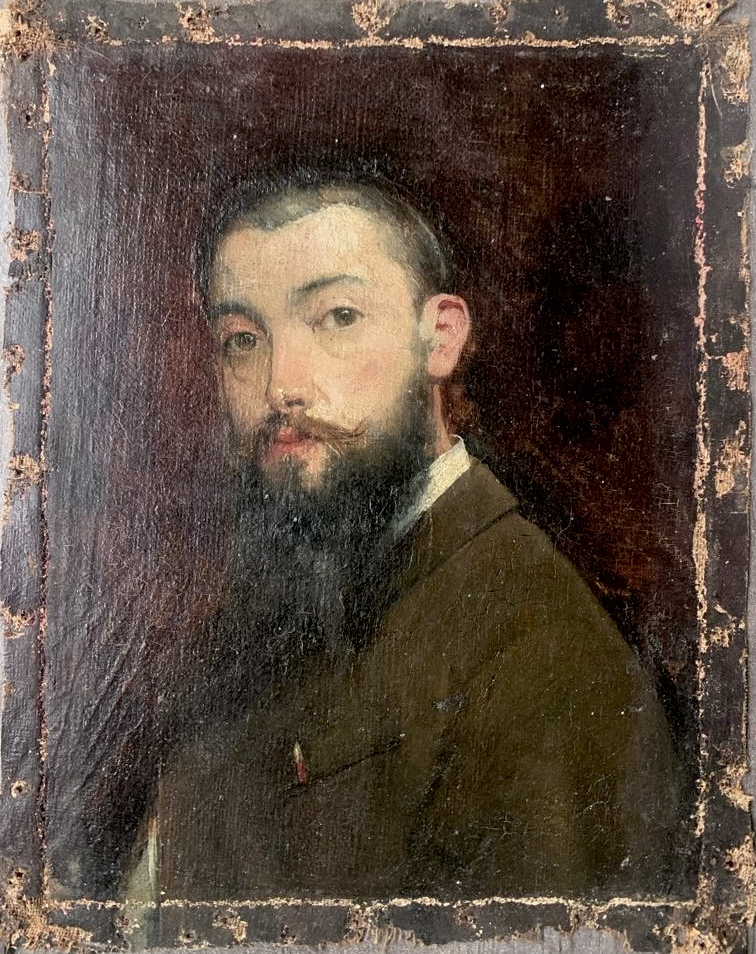
A recent discovery needing Restoration
Anonymous portrait of Claude Monet
The original canvas was cut down in size and placed onto a smaller stretcher, probably the action of an unscrupulous merchant seeking to fit it into a smaller frame he happened to have. Currently it has been unfastened from the undersized stretcher and awaits full restoration being repositioned onto a larger 2 Figure format stretcher. Updates will be posted.
Sitter identification
Anonymous portrait of Claude Monet
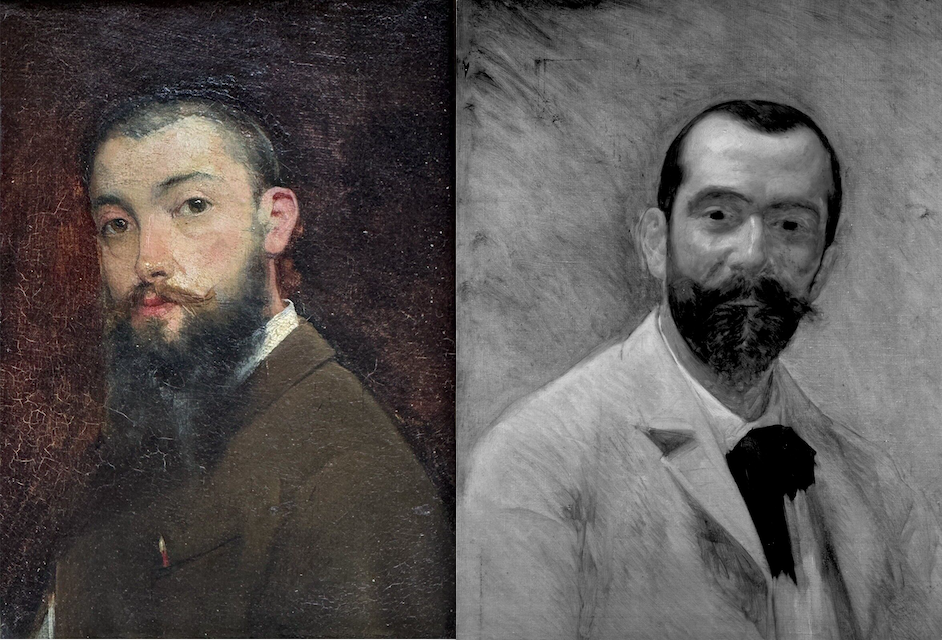
We can note when comparing this small portrait with an infrared photograph of the underlying preparatory drawing of our larger self-portrait seen above, Claude Monet seems to be around ten years younger in the small portrait. We purposely reversed the infrared photograph of our self-portrait to show Monet as he would have been seen by others, not himself, more specifically how he was seen by the artist who painted this portrait.
ANOTHER ADDITION TO OUR COLLECTIONBernard Buffet Self-Portrait
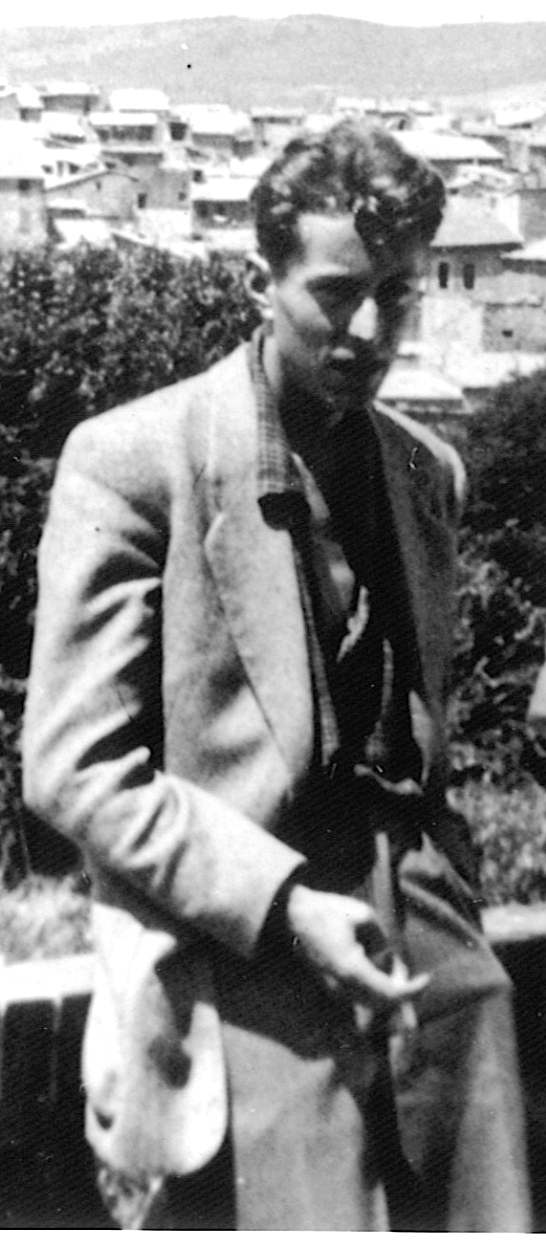
Bernard Buffet was a child prodigy already gaining notoriety at age 13. He studied art braving the WWII Paris Occupation curfew, risking his life to learn how to paint. We can see him later, as a young man in this photograph taken when he was visiting French author Jean Giono in the South of France with his companion Pierre Bergé, who promoted him through his network of contacts as he later did for his next companion Yves Saint Laurent. The years of privation from food rationing can be seen in his thin lanky physique as well as in his post war artistic melancholy. Bernard Buffet is one of the rare artists to widely utilize self-portraits in much of his work, as in his well-known clowns popular among collectors. He was a member of the Insoumis art movement, of painters refusing to submit to the mandates of contemporary modern art, rejecting Cubism, Surrealism and Symbolism. Their work was nonetheless an offshoot of Expressionism, taken with a zest of freedom.
Physiognomic Comparison
Reversed image
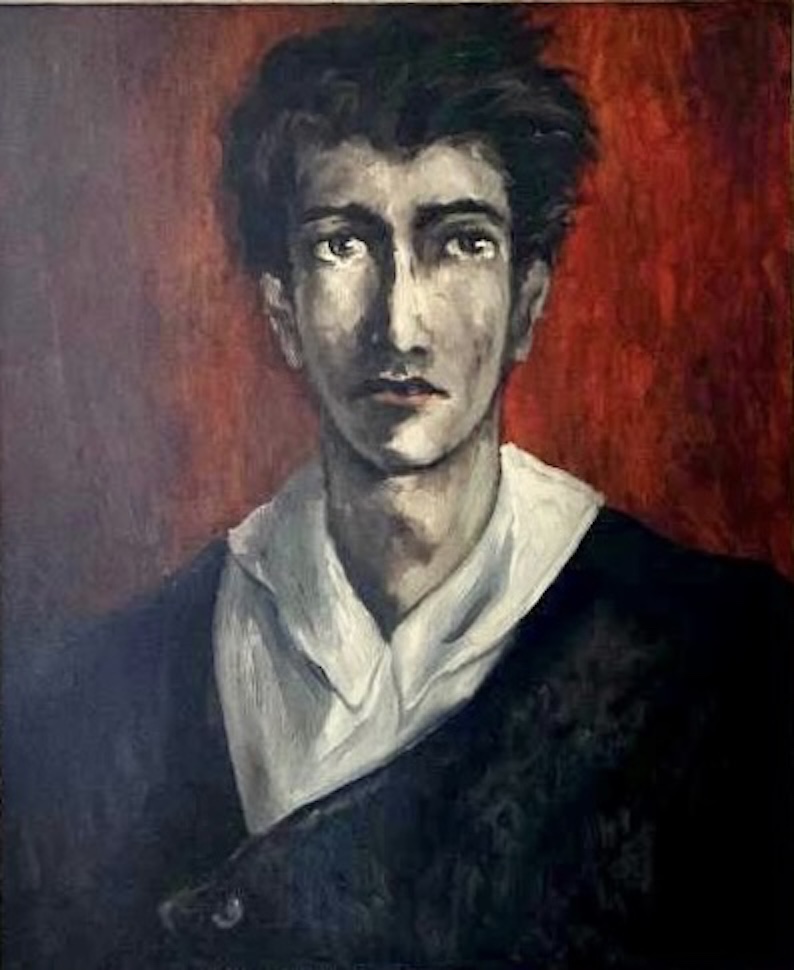
This early self-portrait was painted circa 1946 when he still had long hair and was finishing art school. Bernard Buffet's face was fairly asymmetrical, making it relatively easy to determine whether it is a portrait by another artist or painted by the sitter himelf using his reflection in a mirror.To be specific,Bernard Buffet's Adam's Apple was more pronounced on the right side of his throat, an less prominent on the left. However, in this painting the bump is more visible on the opposite side. Also, his right eye was slightly higher than the left, again here it is the reverse. Finally, his right cheek was more linear than the left one that was more convex.. These are each placed on the opposite side. pointing to the obvious conclusion that it is indeed a self-portrait.
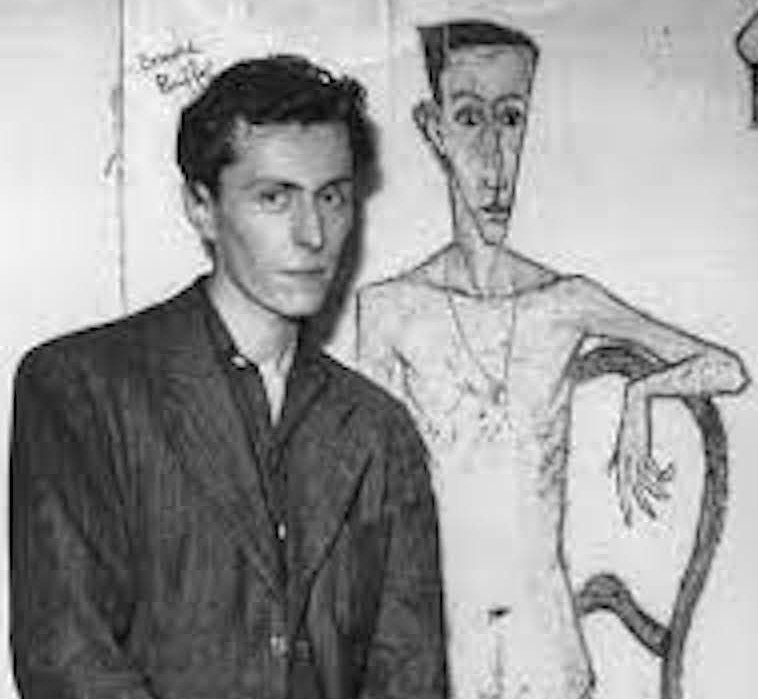
Physiognomic Comparison
Sitter identification
We can see the likeness also in this photograph next to his controversial work Les Fleurs du Mal titled after Baudelaire's poem. We can note that his elongated traits are not entirely exaggerated. Here his hair is shorter, later in life he would grow a beard. He was seen at his beginnings as a potential rival of Picasso. Much later his fame waned. At the end of his career he was shunned by those who had lauded him for decades, bringing so deep a despair that he took his own life.
A FURTHER ADDITION TO OUR COLLECTIONSalvador Dali Self-Portrait
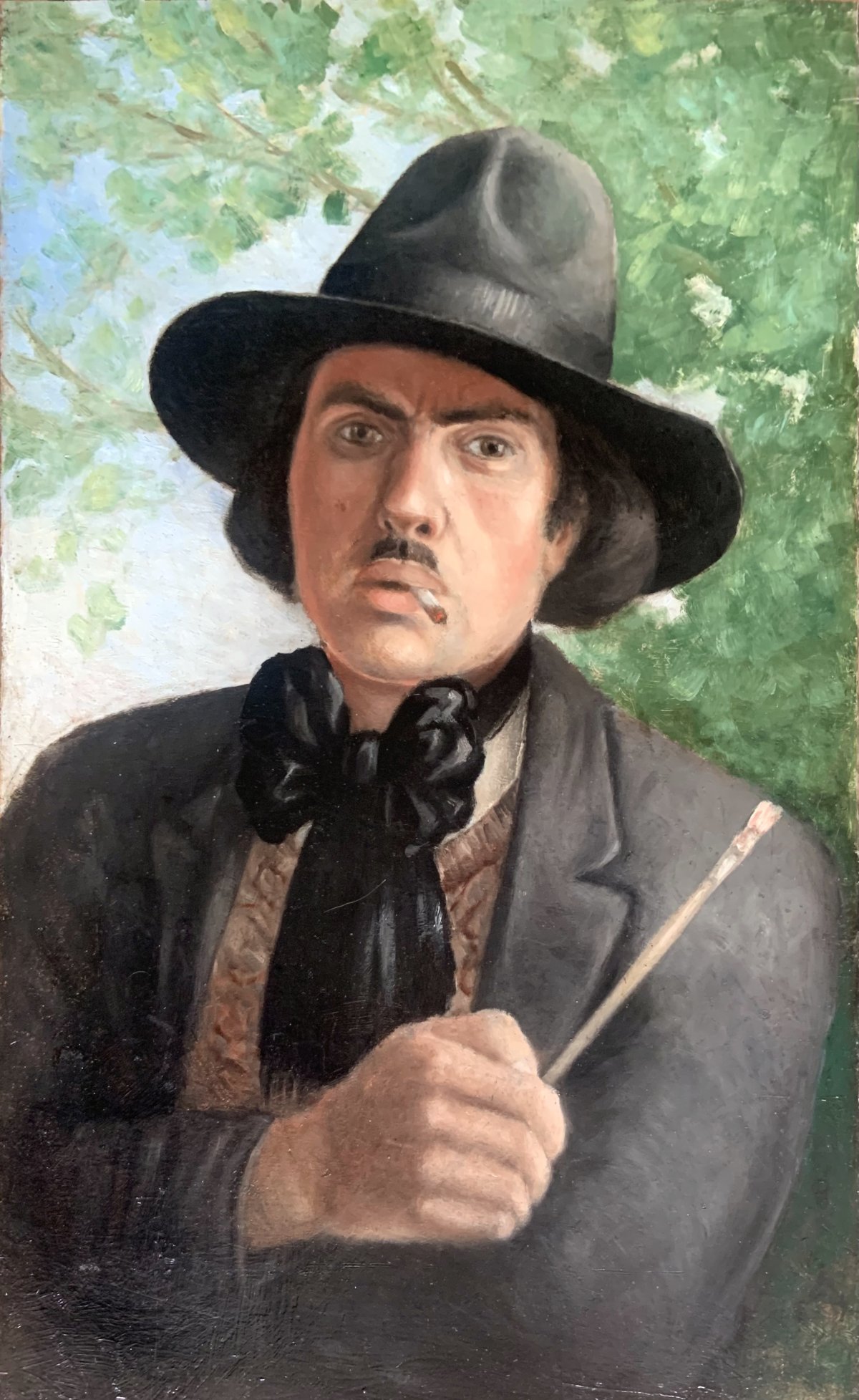
This recently .acquired oil on wood panel awaits restoration. It has however swept through the past century relatively unscathed. We can see a young Salvador Dali, without the long mustaches that characterized him later in life. Although he was a member of the Surrealist movement it appears that this work was more Dadaist in spirit. He portrays himself dressed up like a traditional Parisian artist. Before arriving in Paris he was thrilled that Juan Miro had told him he was a better painter than all the artists in Paris put together. We can note that he portrays himself here as the archetype of bohemian artists. He sports a dark suit, embroidered vest, lavalliere necktie and felt hat, much like those worn by the painters in Montmartre.
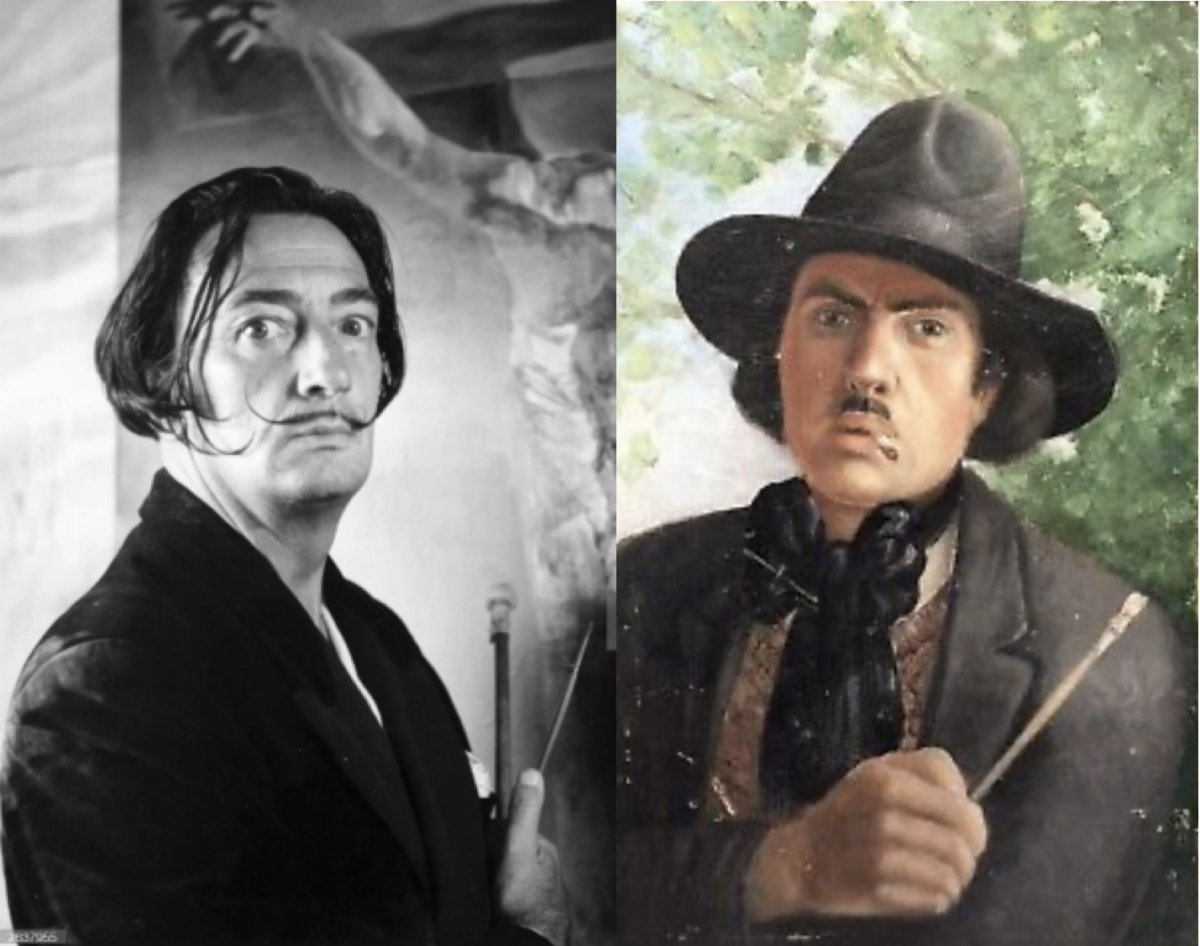
Physiognomic Comparison
Sitter identification
Despite the several decades separating these two portrayals we can see the likeness. He had a unique cranial shape and features that distinguish him from other artists of his time period. While he is portrayed in our painting holding a paintbrush in what appears to be his right hand, it would be the left. His cigarette shown in the left corner of the mouth would naturally have been to the right.
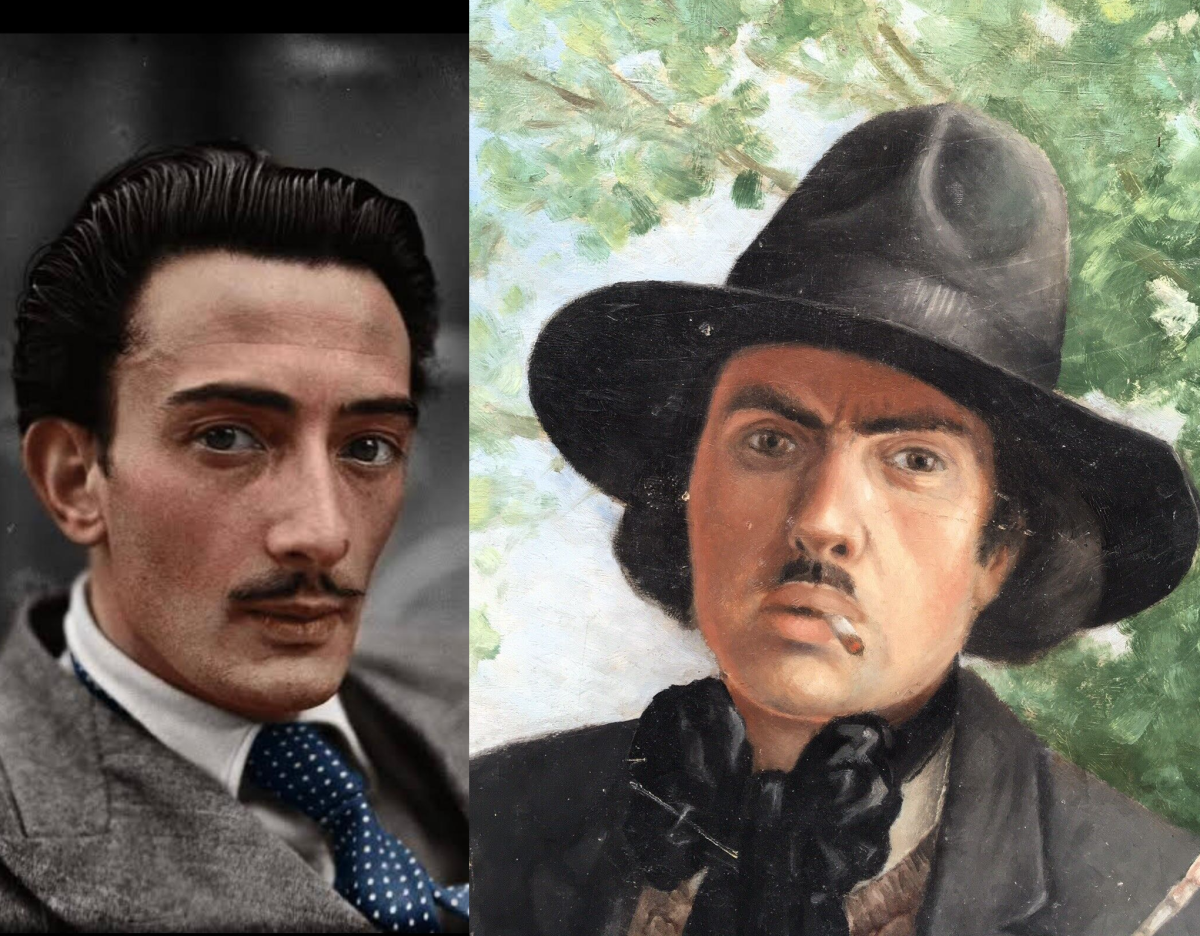
Physiognomic Comparison
Further facial analysis
These portrayals are much closer in date, Dali has a slightly different mustache and sideburns. However we can see his eyes and dramatic brow line are identical. The colorized photograph has been horizontally flipped to correctly place his minor facial asymmetries to match the portrait painted from a mirrored image.
IMPORTANT ADDITION TO OUR COLLECTIONEdouard Manet Self-Portrait
This relatively small oil on wood panel was likely painted during Edouard Manet's travels. This can be noted by the presence of a rotating earthly globe on the desk in counterpoint to the background that he took care to illustrate past a heavy curtain. He sits in a circa 1830 French restoration period armchair indicating that this office area is somehow connected to France. It appears to be perhaps upholstered in green velvet, as was traditionally done. Given his garnished hairline it could have been be during his early travels to Brazil in 1849. However, his young age at the time and his letters written at that period make this improbable. It would more likely have been painted on the French or Italian Riviera during his travels to Italy at the age of 21 in 1853. It bears a small signature.
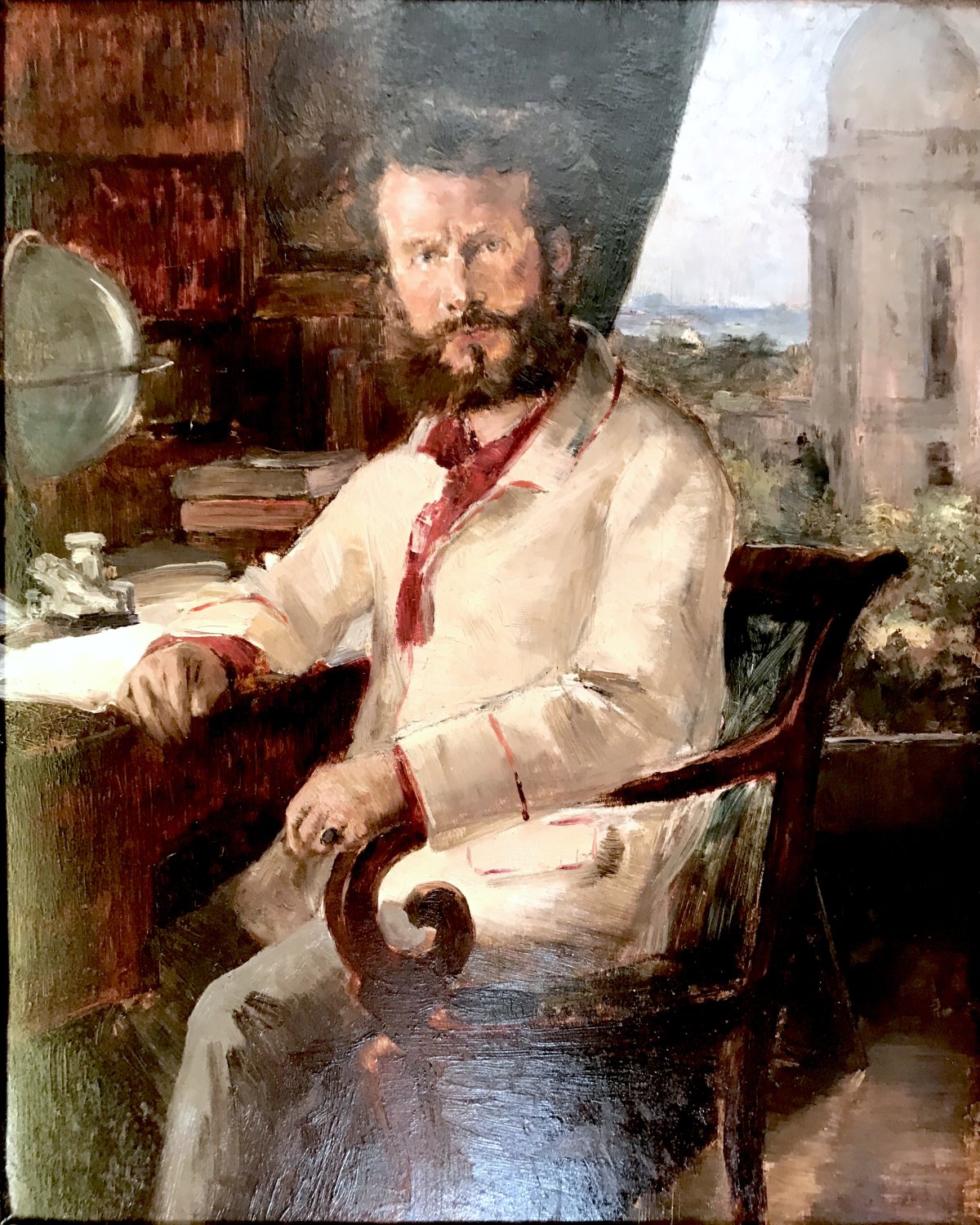
Stylistic analysis
Manet's artistry
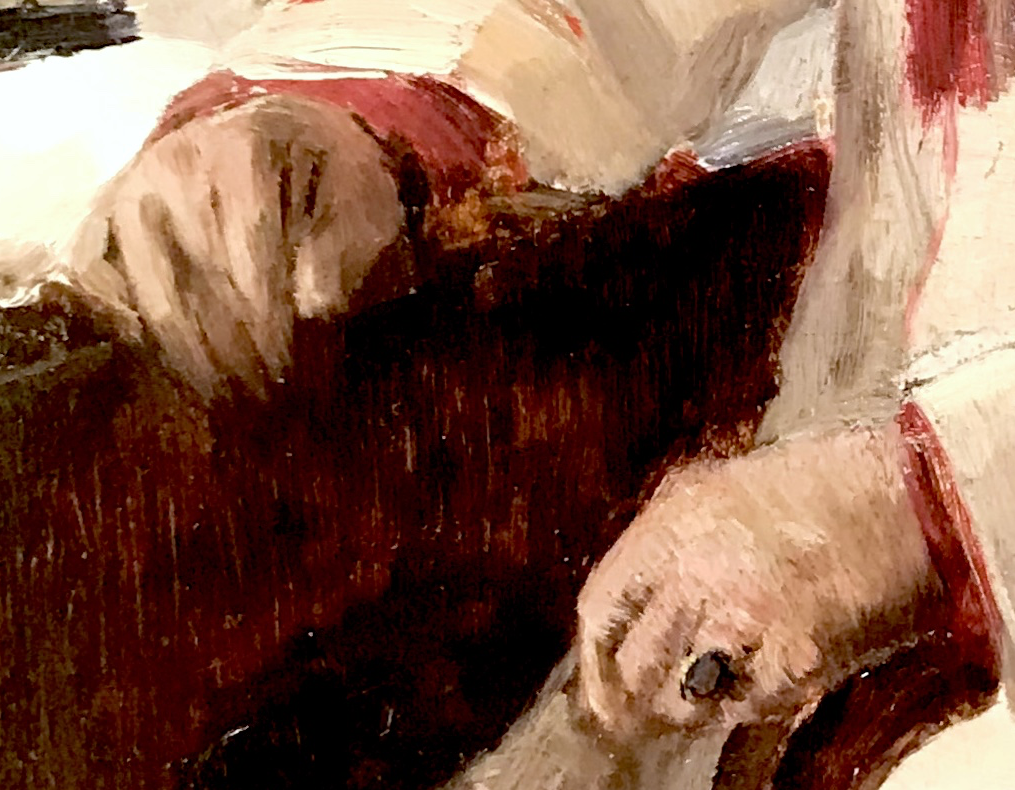
We can recognize the swift sketched lines of Manet in this rendition of the hands. From the intensity of the quick brush strokes of this rapidly painted memento of his travels, we can denote a great mastery that few artists have ever possessed. He appears to wear a traditional French chevalière ring on his annular. finger.
Physiognomic Comparison
Manet still quite young
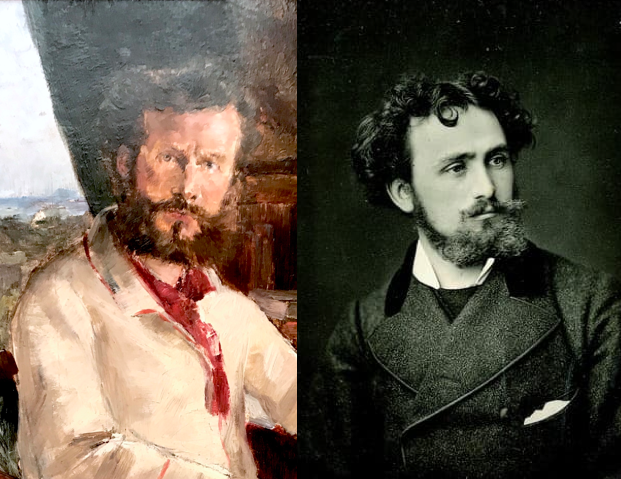
Aside from the photographer's artistic note, curling a lock on his forehead, Edouard Manet sports the same mustache, beard and hairstyle in these portraits. Differences are minor, such as a slightly fuller beard in the painting. For comparison purposes we horizontally flipped the image of the self-portrait to match his traits in the same view, one no longer reversed by a mirror.
STylistic analysis
Several decades apart
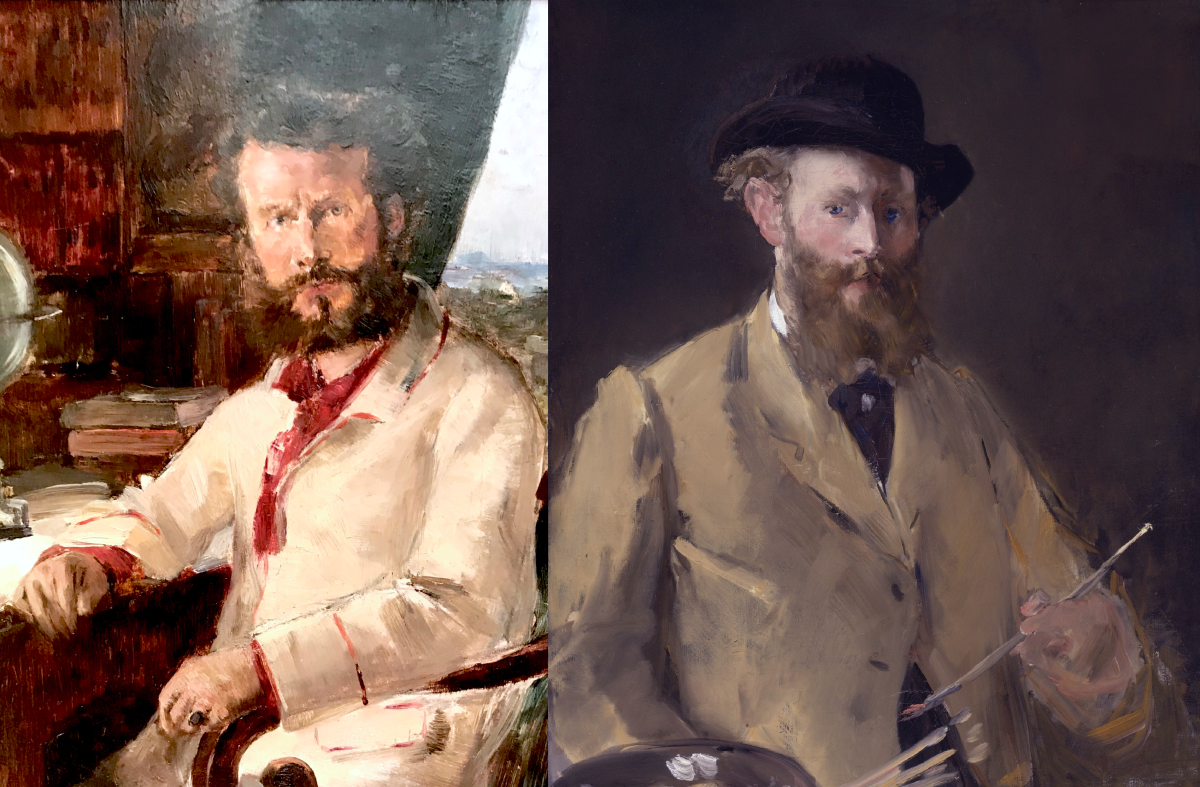
We now compare our Manet self-portrait to one he painted in 1879, Self-portrait with a palette. We can note in this later work his assurance and relaxed bearing as by then he had already fulfilled his vocation. We did not reverse either image. They are self-portraits both from mirrored images, the reverse image respective to how others saw this artist and how he appeared in photographs.
RECENTLY ADDED Alfred Sisley Self-Portrait
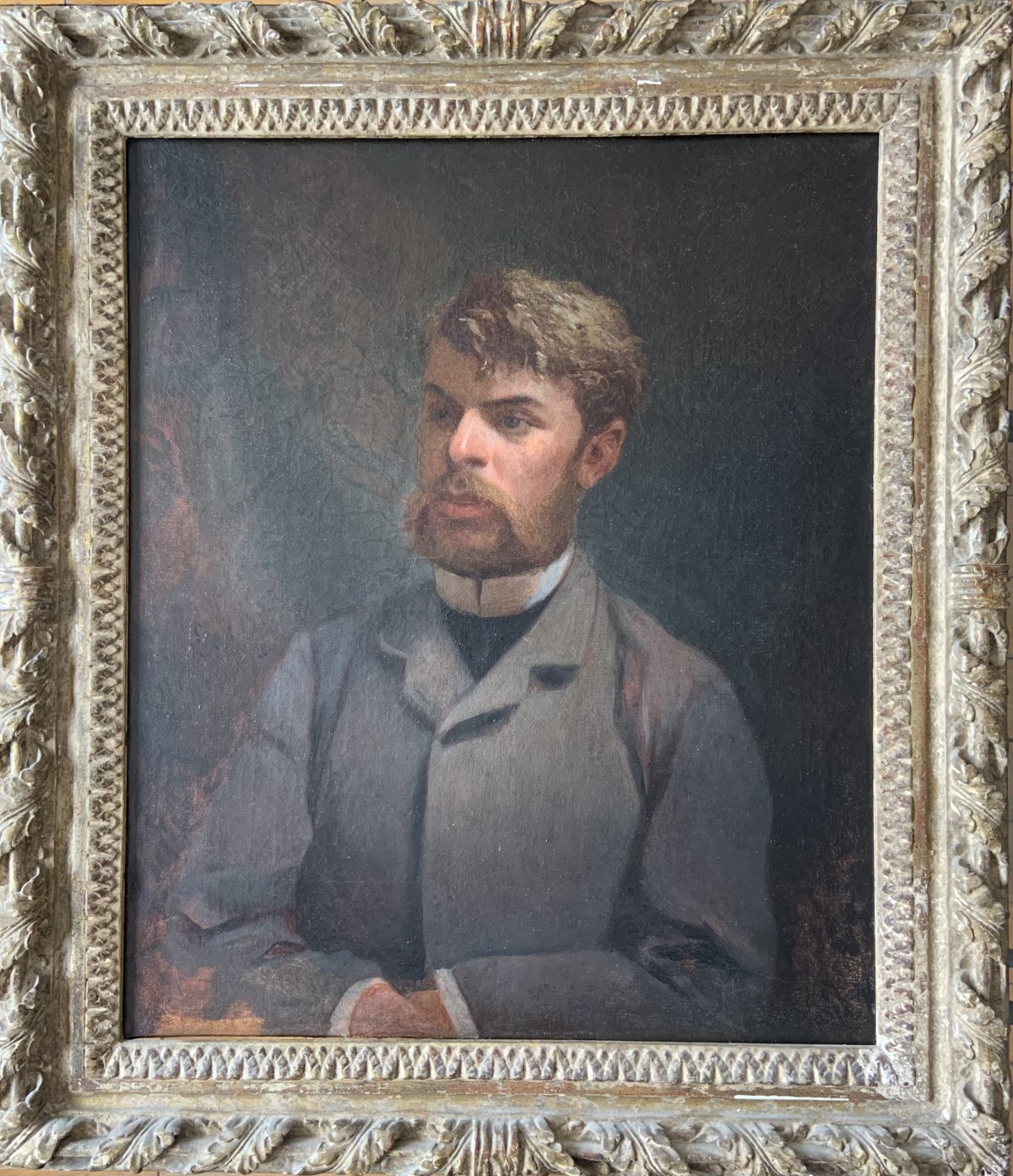
This freshly received oil on canvas was awaiting restoration. It has since been professionally restored by a highly competent specialist. This is an early self-portrait of Impressionist painter Alfred Sisley in his starting years before being trained in art school. This can be ascertained by his clothing, still in London's British fashion with a high buttoning waistcoat and a closed collar starched shirt. We can also note his very youthful traits indicating his age at tthat time. It was not well preserved but only suffered minor accidents. This painting is one of the rare portraits painted by Sisley who almost exclusively painted landscapes. Most of his early production was pillaged and destroyed in his workshop during the Franco-Prussian war making this piece a survivor of those events, He was approximately 20 years-old when he returned to France from London in 1861, to study painting, The back fo the canvas stretcher bears dark pencilled inscription "Paris" indicating it was most likely painted at the time when he started his journey as an artist at the workshop of Gleyre where he met fellow students Monet, Bazille and Renoir. These four painters would found "Impressionism".
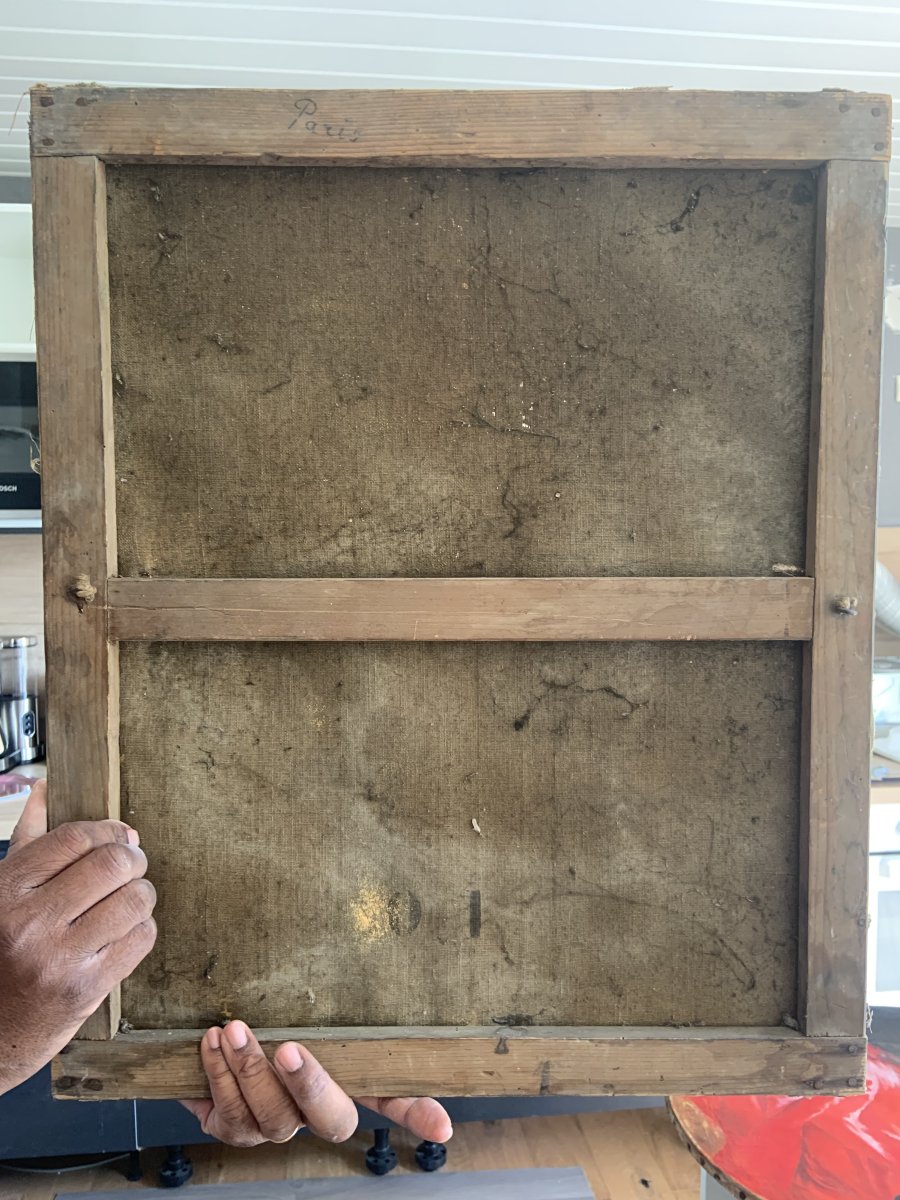
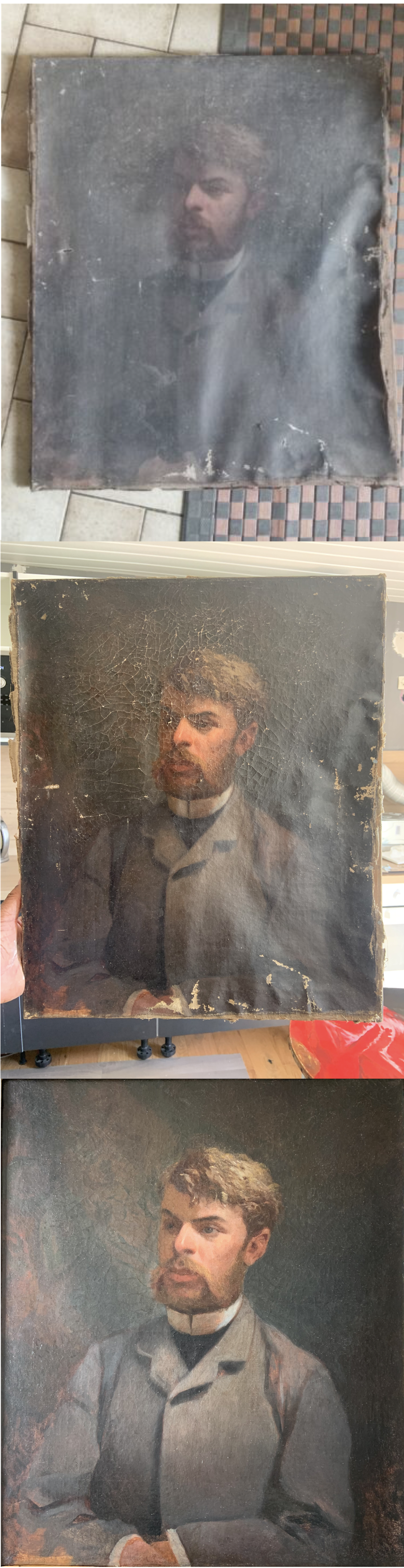
erasing 160 years of neglect
Resuscitation of a painted work of art
This work was found in pitiful condition at a secondhand shop in the city of Lyon. It was then purchased by us in its second stage condition, after a summary cleaning. We have since had this work professionally restored insofar as possible to its original condition, never repainting over existing pigments and only completing small missing zones just enough to enable proper visual reading of the artwork. This painting has now been restored using entirely reversible techniques and it is preserved by a final varnish protecting its surface from further degradation. It has also been restretched to smooth out the canvas on its stretcher retaining when possible the orignal nails. This is an example of the type of expert work carried out to restore oil paintings whenever we find them in poor condition. Many important works that were unloved and found in inappropriate settings can be offered for sale or even at times disposed of summarily. It is sad to have to come to the conclusion that "One man's trash is another man's treasure". The Valorism Institute considers art of the very highest value among all human undertakings. In this light no limits are placed on our painstaking efforts to bring such works back to life and to the future appreciation of art lovers.
Traces of SISLEY's signature
A likely self-portrait
This painting has a somewhat hesitant style that does not seem to be the strong point of the artist. In fact he was known to rarely paint portraits, perhaps annoyed at his failure to reveal with his paintbrush the complexities of the human soul. We thus see a rather conventional portrait painted with hesitation, such as rightly expected of the work of a beginner. It has several merits however, that of showing the early technique of the artist as well as clearly casting his facial features as a very young man. Its historiographic value is therefore quite high as it portrays the outlook upon himself of one of the founders of the Impressionist movement at the very time he decided to become an artist.
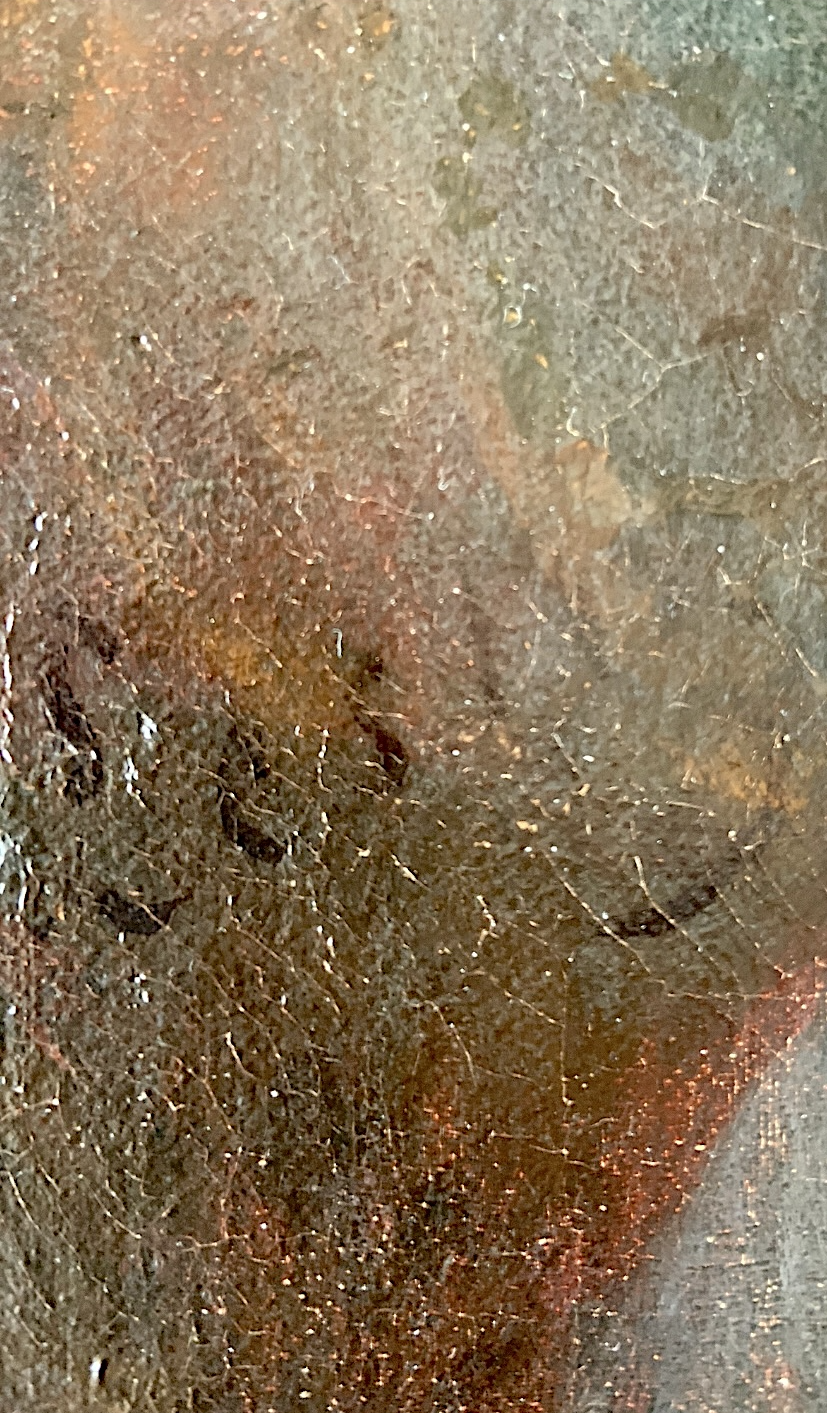
Sisley's early signature
While the lower right half of the S and the last three letters are partially erased we can nonetheless see this signature in the same pigments used for the background. This allows us to presume that this is indeed a self-portrait, Sisley's relatively symmetrical facial features preventing easy identification of him as the author by a reversal of his physiognomy. We can note his typical diagonally positioned writing as well as the very curved shape of his letter y.
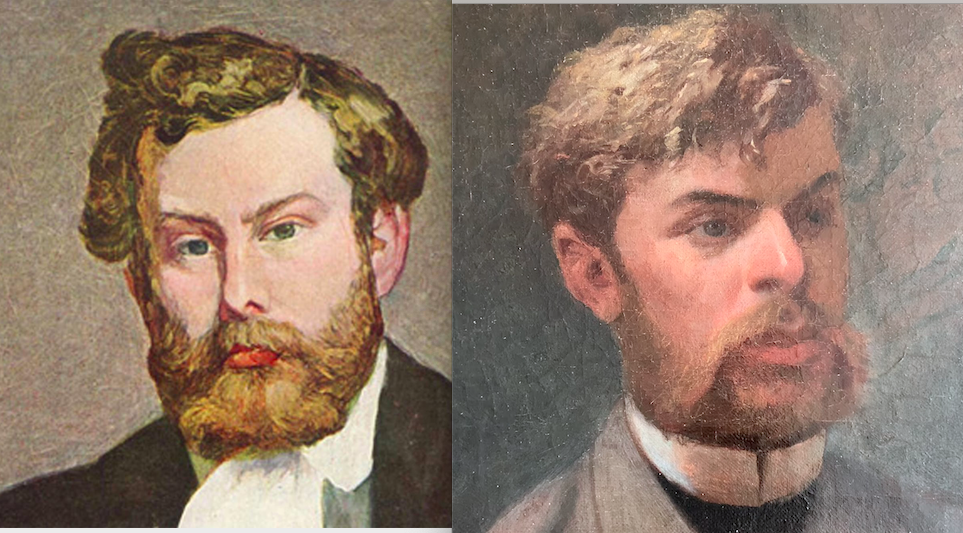
Physiognomic Comparison
Sisley painted by Renoir
One element of symmetry we can assess is the parting of his hair on the left side. For this reason, we reversed the image of the face in our portrait for the purposes of a visual comparison with his face as portrayed in a painting by Renoir. In addition to a perfect match of all his features we can notice that his hair is also identical down to the curly locks directly above his forehead. Although his pose is looking slightly downwards in the portrait by Renoir, from this side by side comparison we can establish that it is indeed a very early self-portrait by the artist. In the Renoir portrait his beard is slightly fuller and more squared off, and his hair is also slightly longer. It shows him adopting a less British and somewhat more relaxed French style thanks to sharing the company of his artist friends,
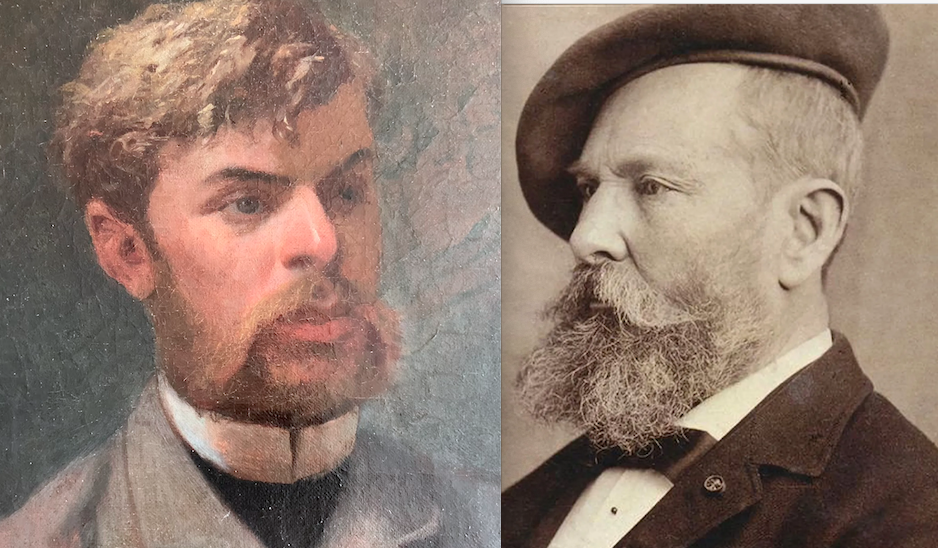
Photographic comparison
Many decades separate these two images, however thanks to this much later photograph we an ascertain that this is indeed a portrait of Alfred Sisley due to the characteristic shape of his nose. We will also note his distinctive bearing is similar with his head slightly tilted back for a dignified pose in both instances.
Often a model for Renoir
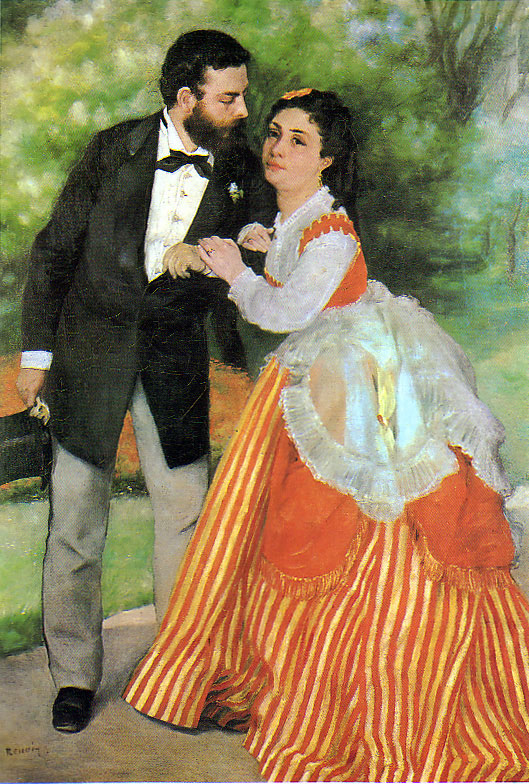
Renoir portrait of Sisley
Fortunately, we know Sisley's appearance thanks to his impressionist friends who painted him quite a few times. In this 1868painting 'Les Fiancés' by Renoir Sisley he appears a good five years older than in our self-portrait. Renoir took the artistic liberty of darkening his hair for dramatic aesthetic effect, it was in fact light brown. Despite the side view of the pose we can see that his hair is parted on the left.
Murder after the 'Bal masqué'
RECENT ADDITION TO OUR COLLECTION
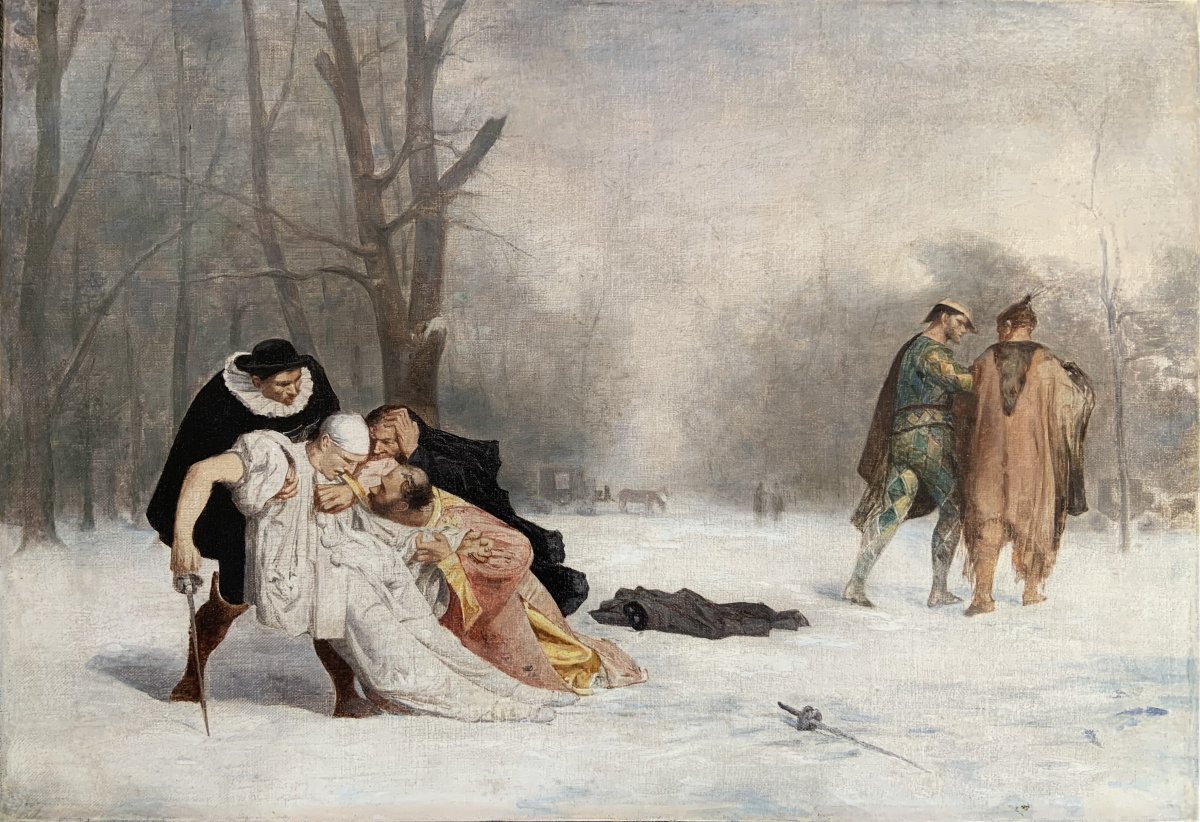
The original version of Duel at the Masquerade
Our discovery of this painting brought to light that it was the very first rendition of this scene by painter Jean-Léon Gérôme. It was painted with clearly recognizable models who were not idealized yet, as it was to be in the subsequent versions. Many details are different, such as their positions and colors of their costumes. Also the lighting of this first draft is less contrasted and brighter, the shades are more muted and the positions of subjects change slightly. This scene shows in the distance the two carriages who brought the duelers and their seconds to the Bois de Boulogne to settle a dispute after a masked ball. The victor dressed like a Native American walks away with one of his seconds as Harlequin. Fatally wounded, Pierrot is attended to by his second, Domino who dropped the mask, and a man clothed as a Venetian Doge, Doge being a latin term for Duke.
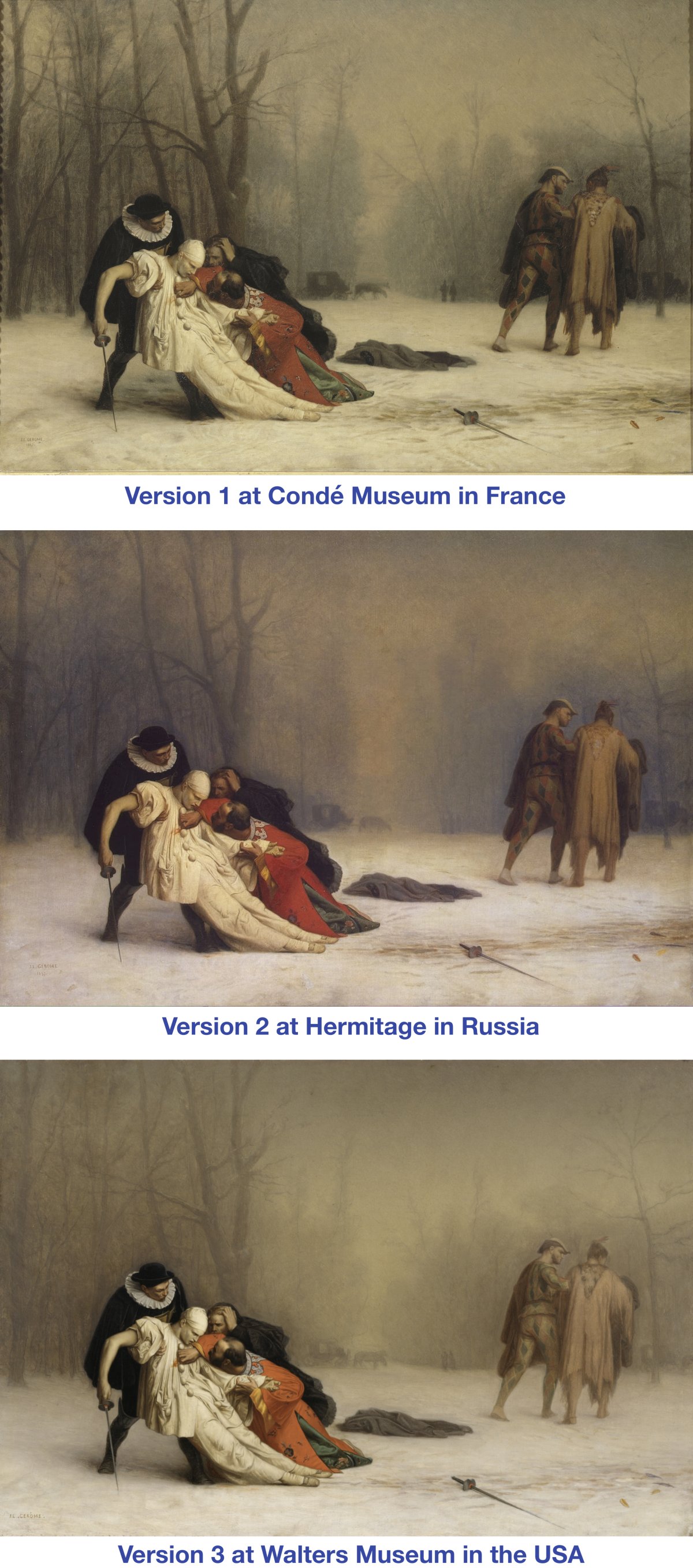
THree famous versions in museums
Gérôme went on to paint this scene 3 more times
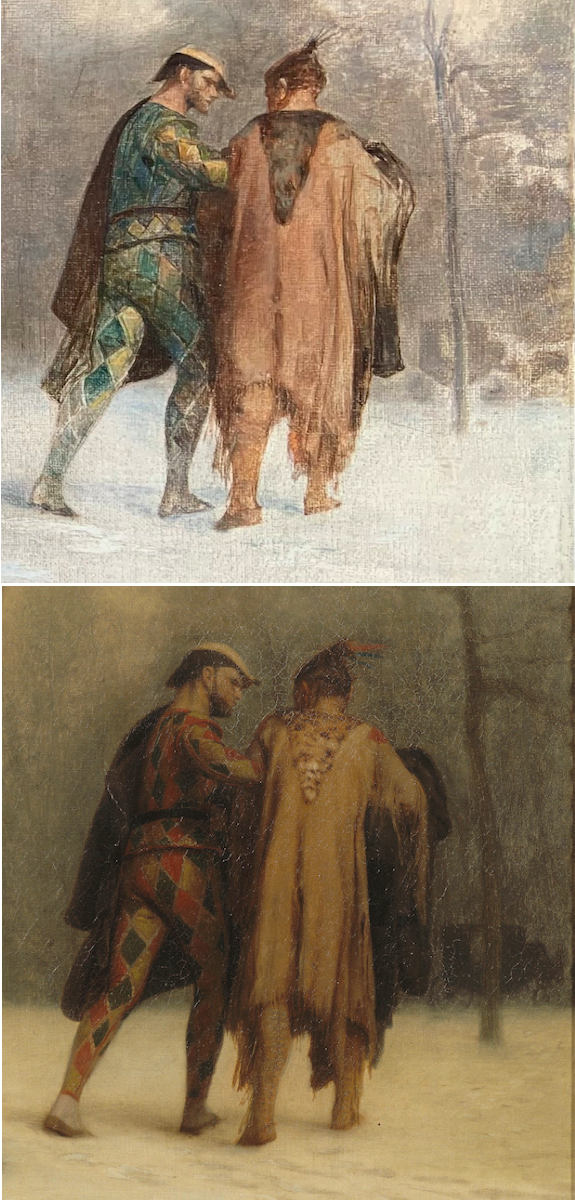
version comparison 1
Harlequin and Indian
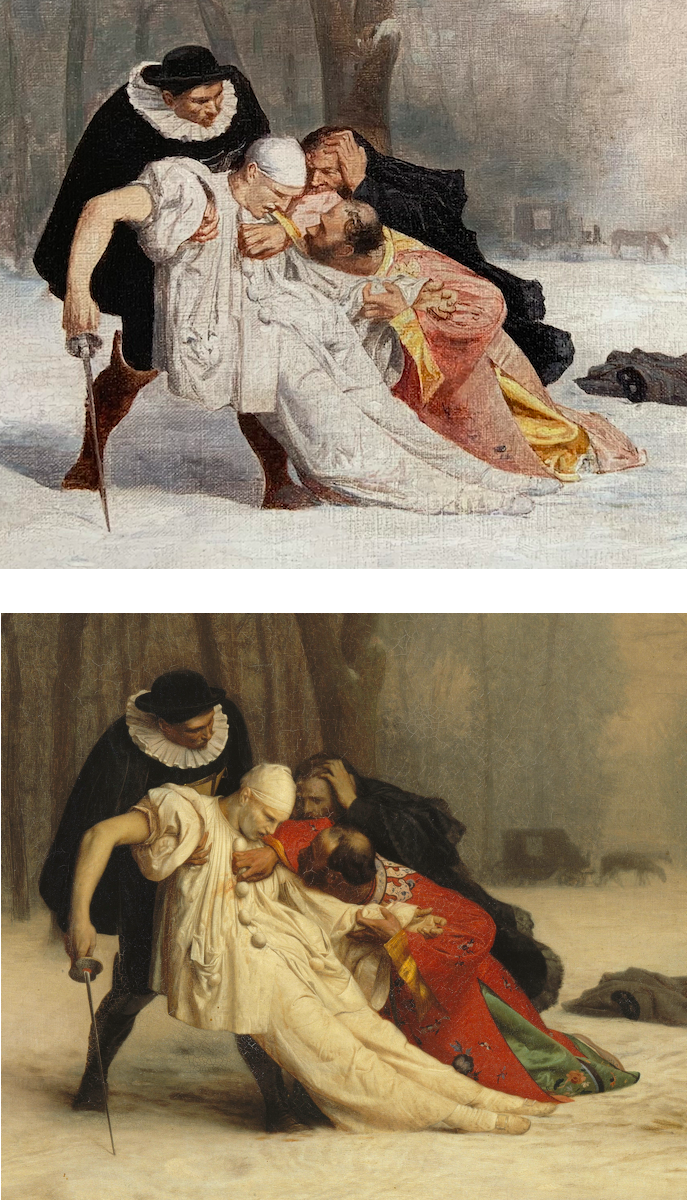
version comparison 2
Pierrot and Domino
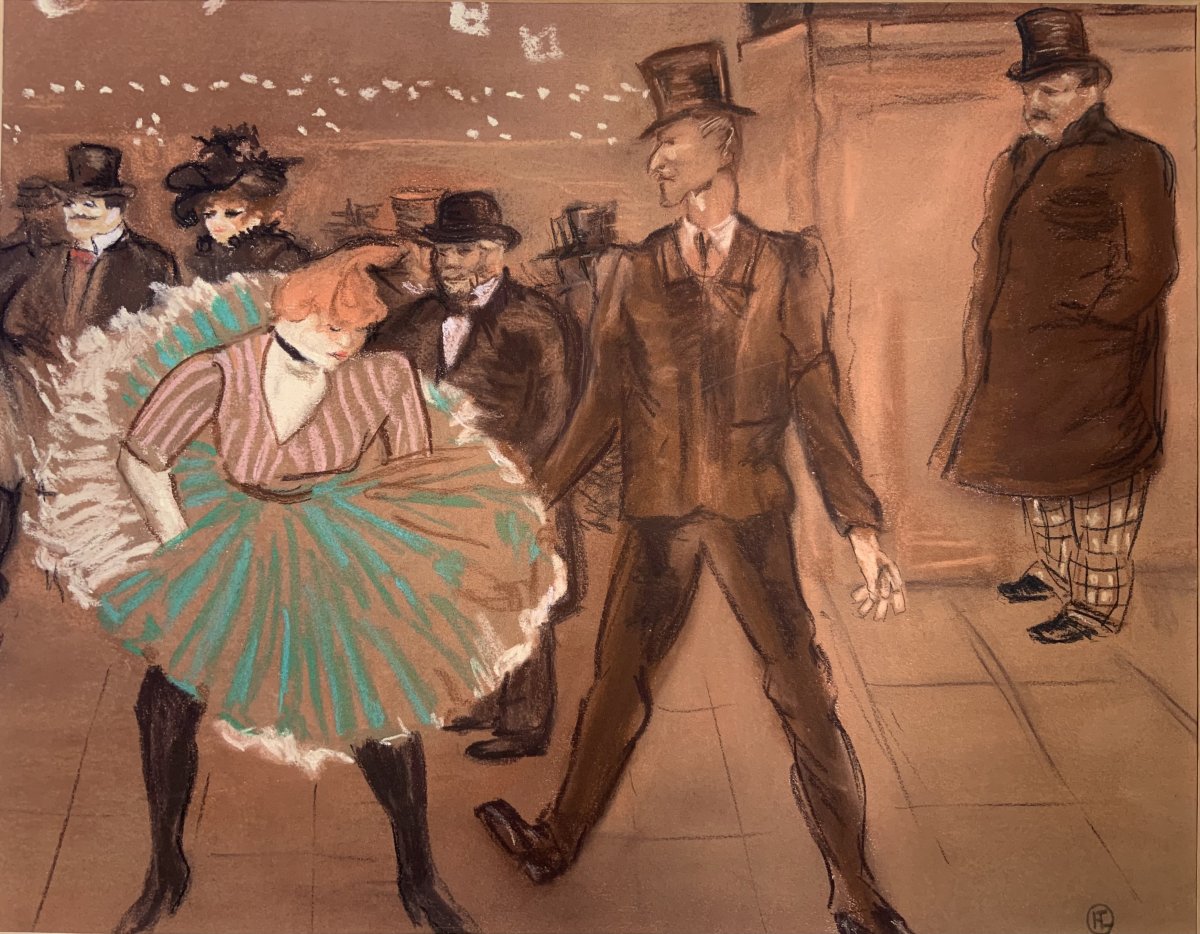
La goulue dancing with valentin
LATEST ADDITION TO OUR COLLECTION
Toulouse-Lautrec pastel
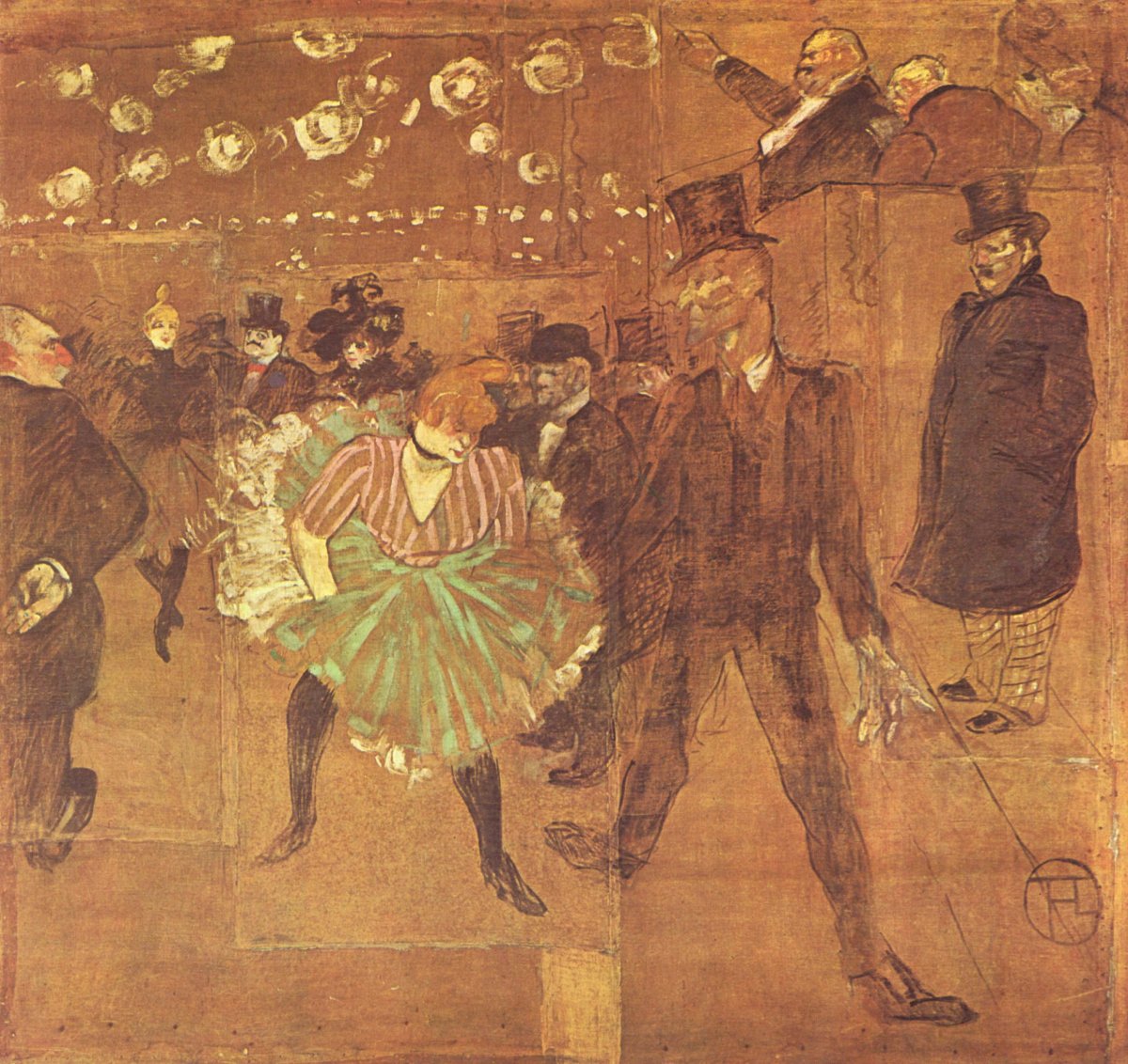
This pastel on paper is an early work used while designing a much larger oil painting commissioned by Louise Weber, known as La Goulue. She is seen here with dance partner Jules Renaudin nicknamed Valentin le Désossé, a former wine merchant rue Coquillère. Mistitled Le Bal du Moulin rouge it takes place at l'Élysée Montmartre where she was discovered by the co-founder of the Moulin Rouge, Charles-Joseph Zidler. To the left we see Lautrec's friend Maurice Guibert in a top hat walking by with Jane Avril. In an overcoat, watching from the right, we see Zidler scouting for talent at Elysées Montmartre to showcase at the opening in his cabaret Le Moulin Rouge in 1889. Lautrec used this pastel among other works as a basis for his large oil painting for La Goulue. The final painting is a detailed caricature, while this working study depicts them with more natural faces and hands that are less stylized.
Transition to oil on canvas
Scene copied later in his painting for La Goulue
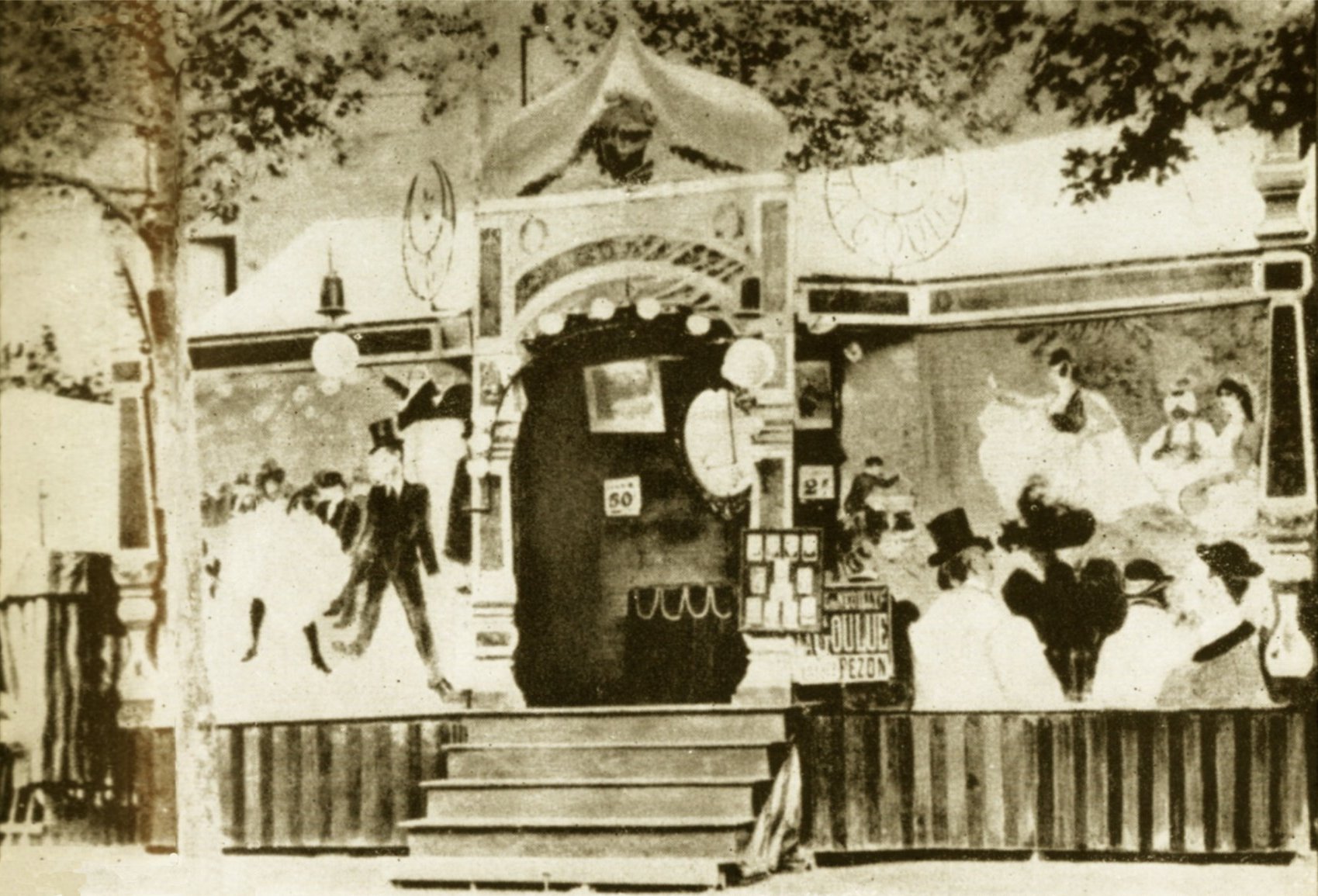
Toulouse-Lautrec completed this painting in March 1895. It was one of two large canvases painted to decorate the fairgrounds cabin of La Goulue when she left the Moulin Rouge. Each of these was approximately three meters by three meters in size. We will note that in the final work Lautrec added Louis Dufour in the elevated musician's box behind Zidler. Lautrec is known to have extensively reworked his artwork in the studio, his seemingly spontaneous brush stroke uncannily resulting from exacting study and diligent precision. We can note that he modified and further expressed the features of his painting's characters in this final rendition. Both Zidler and Valentin were painted taller and La Goulue was set back from the foreground, granting the composition a stronger dynamic perspective.
AN ephemerous work Rescued
Fairgrounds destination of the final painting
This photograph shows the barrack of La Goulue in an outdoors alley of the Foire du Trône fairgrounds at the edge of Paris. We can see it was set up as the left pendant of a pair of works by Toulouse-Lautrec on either side of the entrance. These works meant to be temporary and perhaps later discarded, were fortunately rescued by a collector at the dismantling of the cabin to be reconstituted. Today they can be seen at Paris Orsay Museum.
MORE COLLECTION ADDITIONSScene at the Cabaret du Chat Noir
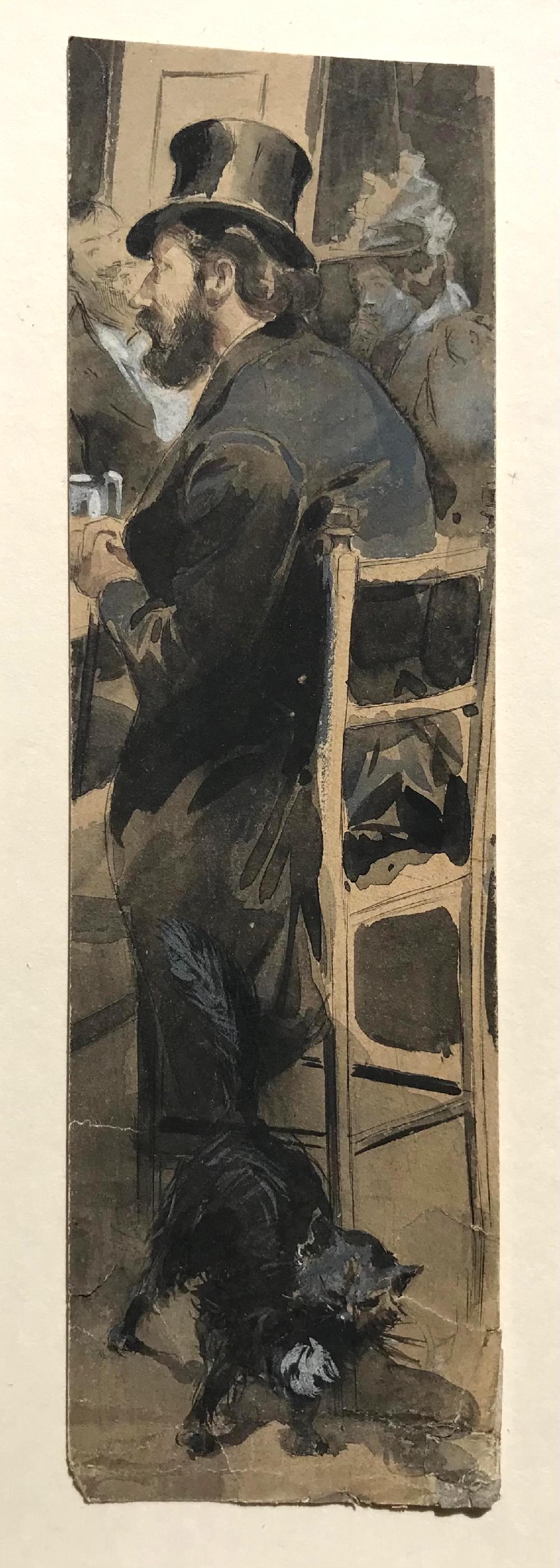
This unique drawing is a rare portrait of Rodolphe Salis, founder of the very first modern cabaret. It was located on Boulevard Rochechouart in Montmartre and opened in 1882. He can be seen here seated at a table in his venue, in the company of artist and model Victorine Meurent and most probably painter Alfred Stevens. His friend Alfred would later transform his own personal townhouse a few blocks south into the second location of the Chat Noir. The Chat Noir was named after a black cat discovered by Rodolphe Salis during the construction of the club. He adorned him with a blue ribbon and made him his Mascot. Here we can see this cat portrayed at his feet. It is presumably the very cat to become world famous by a poster by Steinlen. This work was quickly drawn on a small scrap of paper, possibly from a journal or a theater program, and then highlighted in watercolor. It is especially noteworthy as it is a very rare memento from this period with the sitters being present together before the artist in that location. It is drawn with a degree of talent equal to that of a master and a stylistic study may reveal to whom this work is tributary.
Physiognomic Comparison
First sitter identification
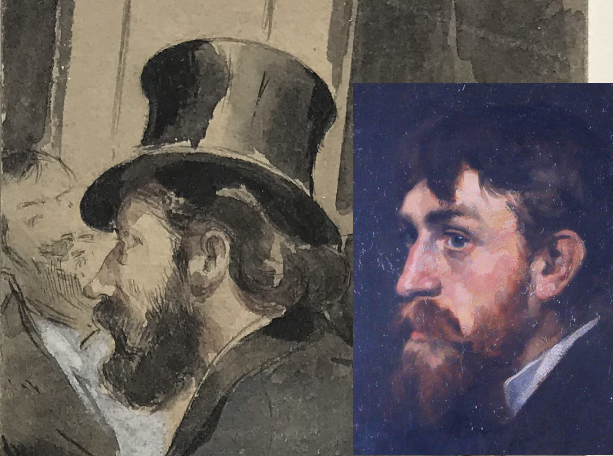
Next to our drawing we can see a portrait of Rodolphe Salis painted by his friend, fellow artist René Joseph Gilbert, conserved at the Musée de Châtellerault, home town of the Salis family. René Gilbert knew Rodolphe Salis quite well, as they both collaborated on religious paintings before Salis transformed their workshop into a cabaret for artists and poets. Across from him, a reclining man is seated at the same table. His features and mustache are quite similar to those of Alfred Stevens. Stevens is known to be the artist who first discovered the model Victorine Meurent. They were also said to have had a romantic liaison. Stevens later introduced her to Edouard Manet, whose notorious paintings made her quite famous. Manet's earliest works with Victorine as his model were painted in Alfred Steven's studio.
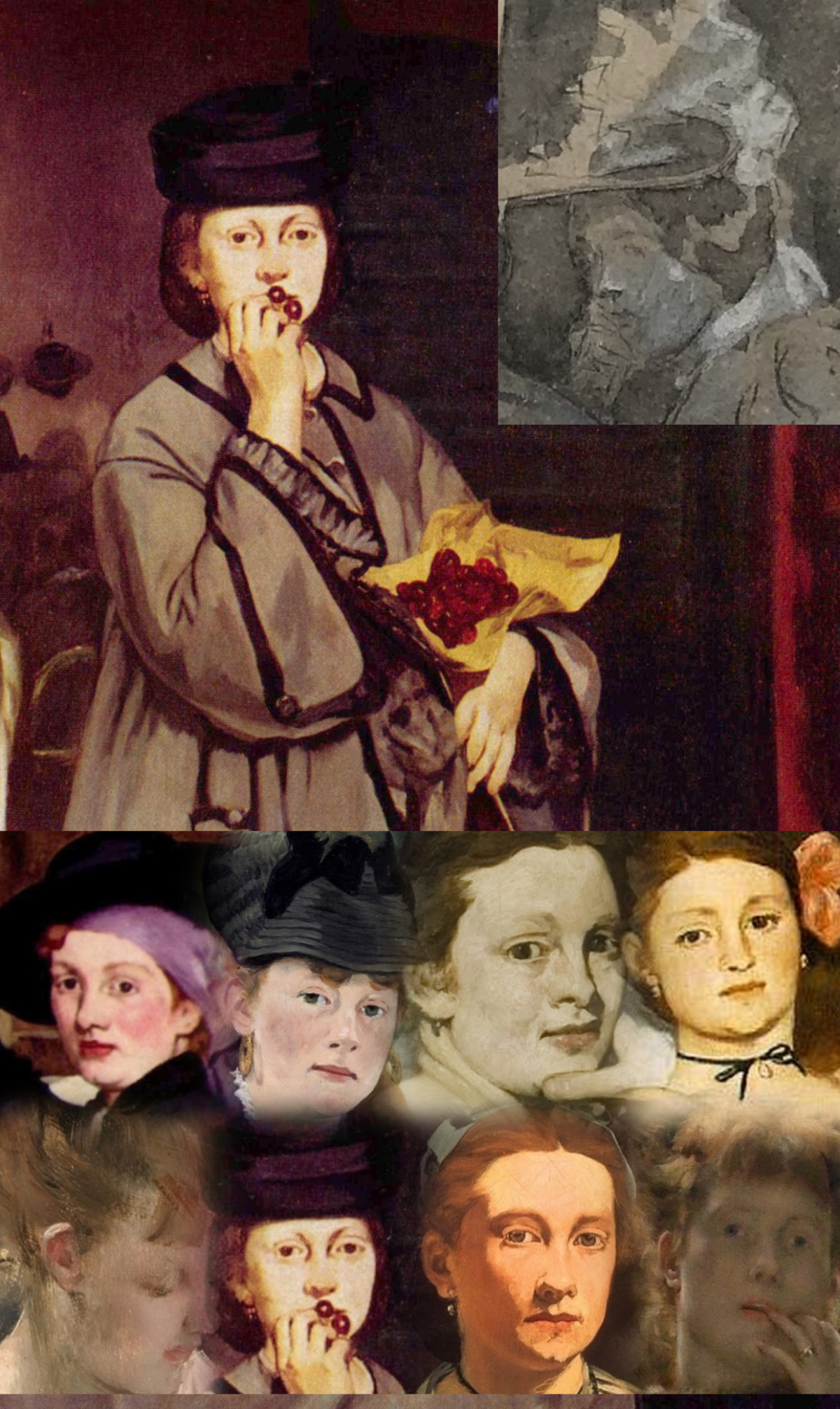
Physiognomic Comparison
Second sitter identification
Not less important than Rodolphe Salis, this second sitter is shown next to him at the same table. She happens to hold her hand similarly to her pose in Manet's very first painting of her as a street singer. In addition to modeling for artists she also performed in nightclubs. She posed for Manet more than expected. When rejected by other stage artists solicited to be his models, he was quoted to have said "It doesn't matter, I've got my Victorine."
Manet first painted her as a street singer eating cherries, seen here. Then as an Espada and afterwards more notoriously in the Déjeuner sur l'herbe before having her incarnate his highly scandalous Olympia. While at this time we cannot confirm that this drawing is by his hand, it has enough panache to be his work and it is uncanny that her gesture would be painted so similarly to his very first portrayal of her twenty years earlier. Manet died in 1883 a year after the opening of the Chat Noir.
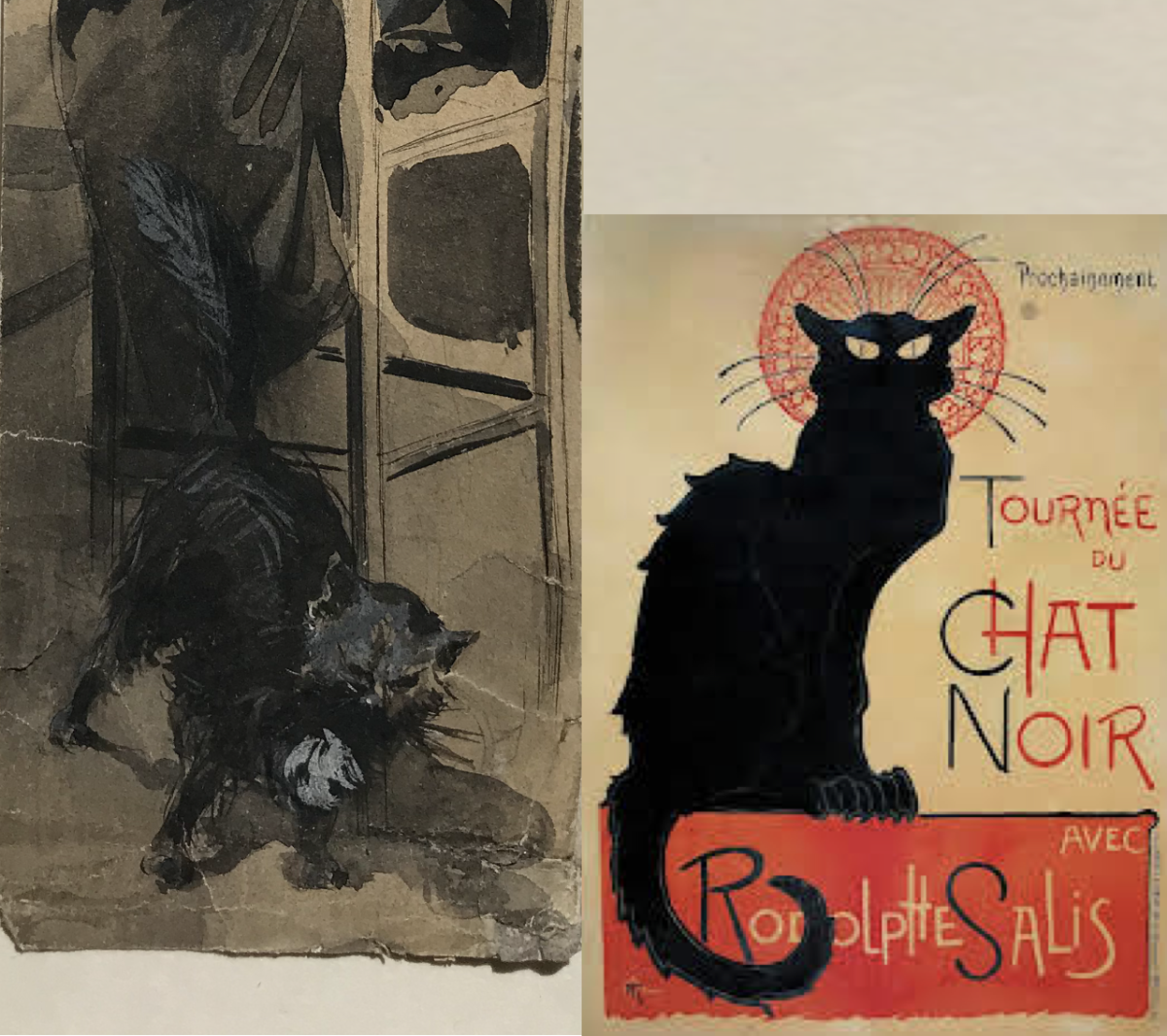
NOT JUST aNY BLACK CAT
Key sitter identification
The last sitter is arguably the most famous of all. The cabaret was named after its Mascot, a black alley cat living in the club during its construction later to be adopted by Salis. The club took on not only his name but also his likeness, with Steinlen drawing the most famous image of the Chat Noir which tourists visiting Montmartre cannot ignore.Defunct since 1897, various attempts were made to resurrect the Chat Noir, either in spirit or merely in name. While Steinlen's Art Nouveau graphic rendition of this famous character is well-known, it is interesting to see the original sitter posing here for this work and more realistically depicted in our drawing. He wears the blue silk ribbon that Salis adorned him with upon adoption, making him more eminently presentable to high society.
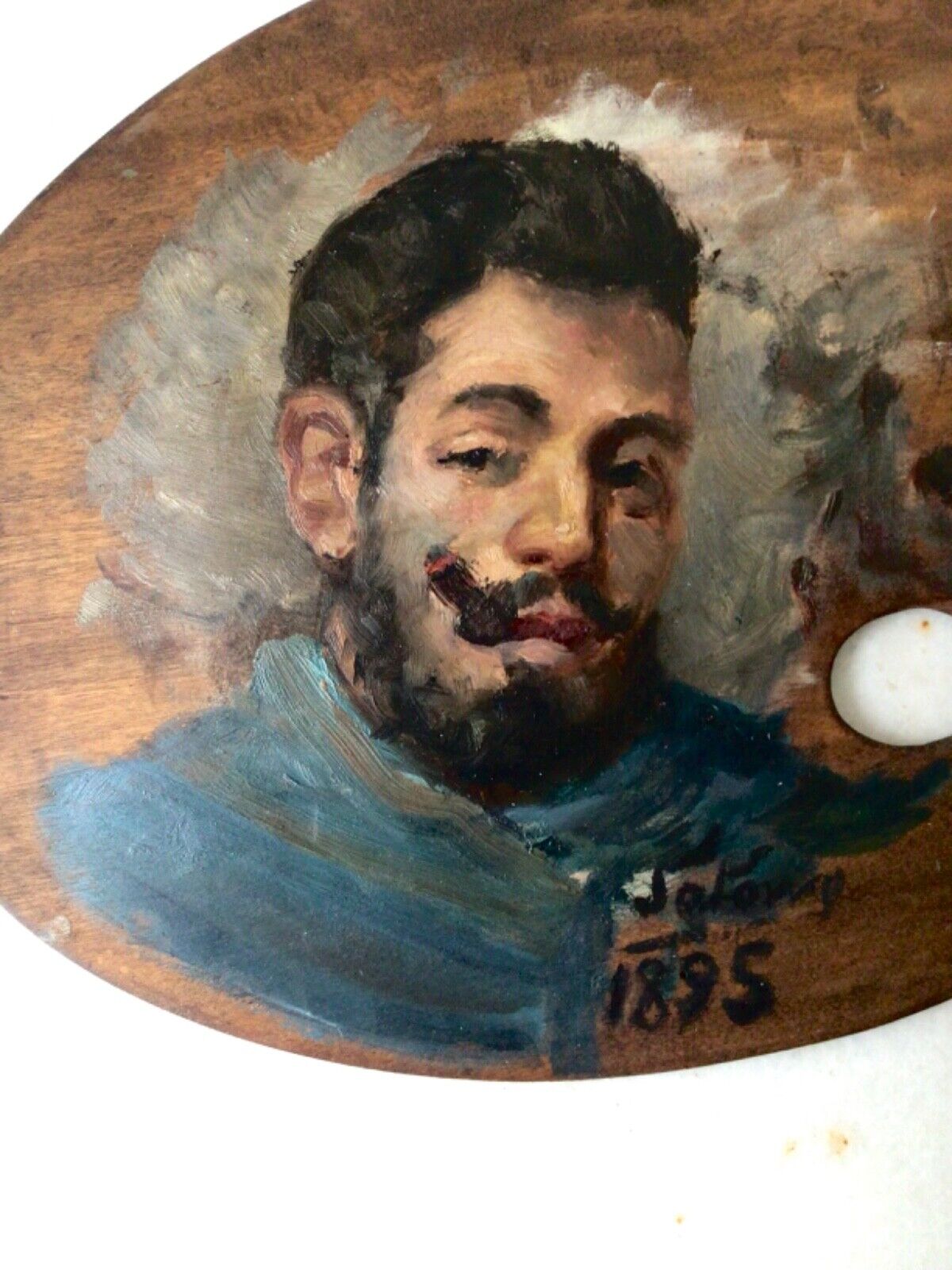
Inspired by Le Chat Noir
Portrait of Ramon Casas
Inspired by the Cabaret du Chat Noir during his many visits to Paris, Spanish painter Ramon Casas may have tried himself at Impressionism in these early days of his artistic training. On his return to Barcelona he brought together a small group of friends to create a similar poetic and artistic bar called 4 Gatos, the 4 cats.
A slightly older Ramon Casas
Not only does his strong personality and sturdy physiognomy make it easy to recognize him, he also often portrayed himself smoking with his characteristic cigare set in a pipe. This is also the case in our painted portrait, similarly to this self-portrait drawn 13 years later in 1908.
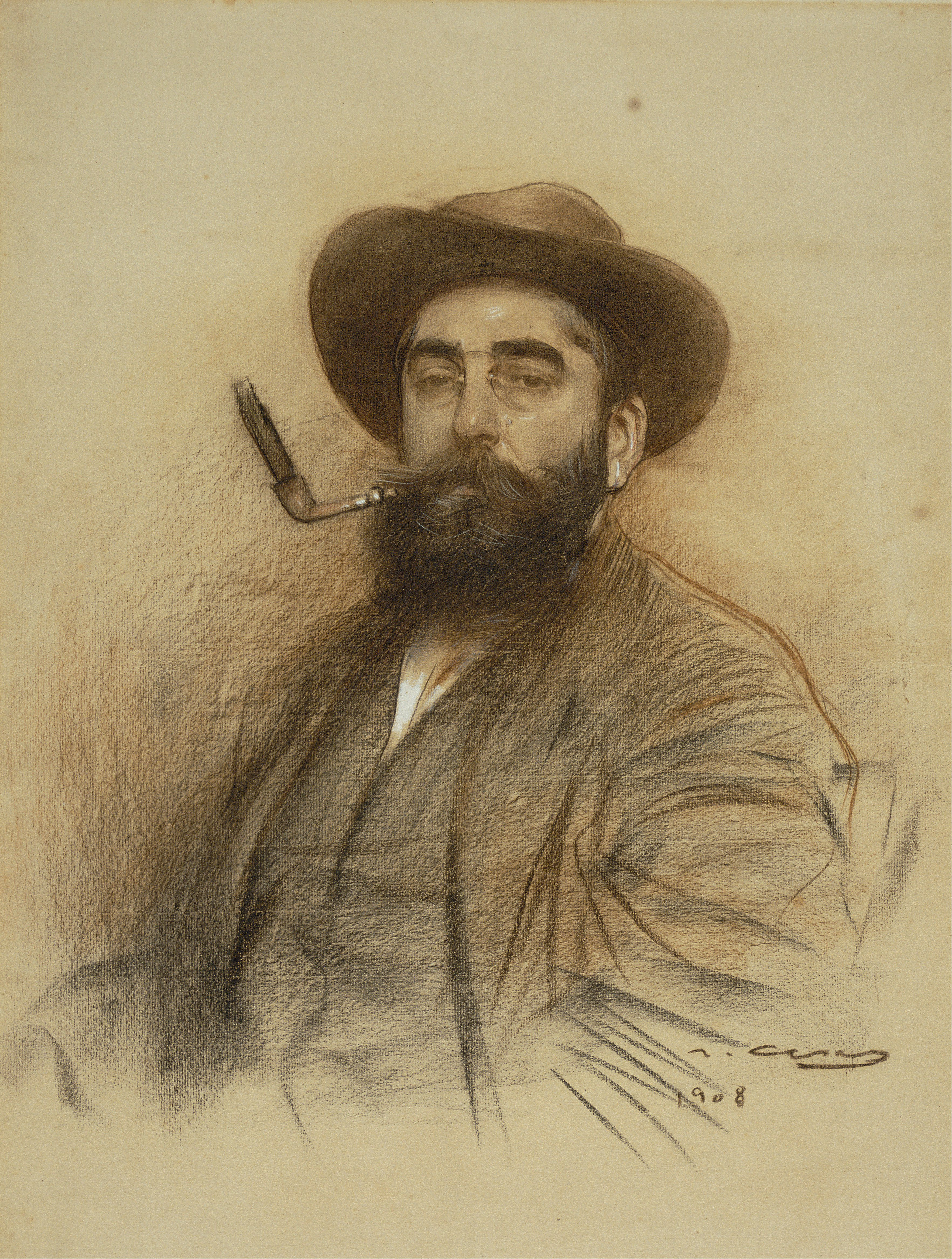
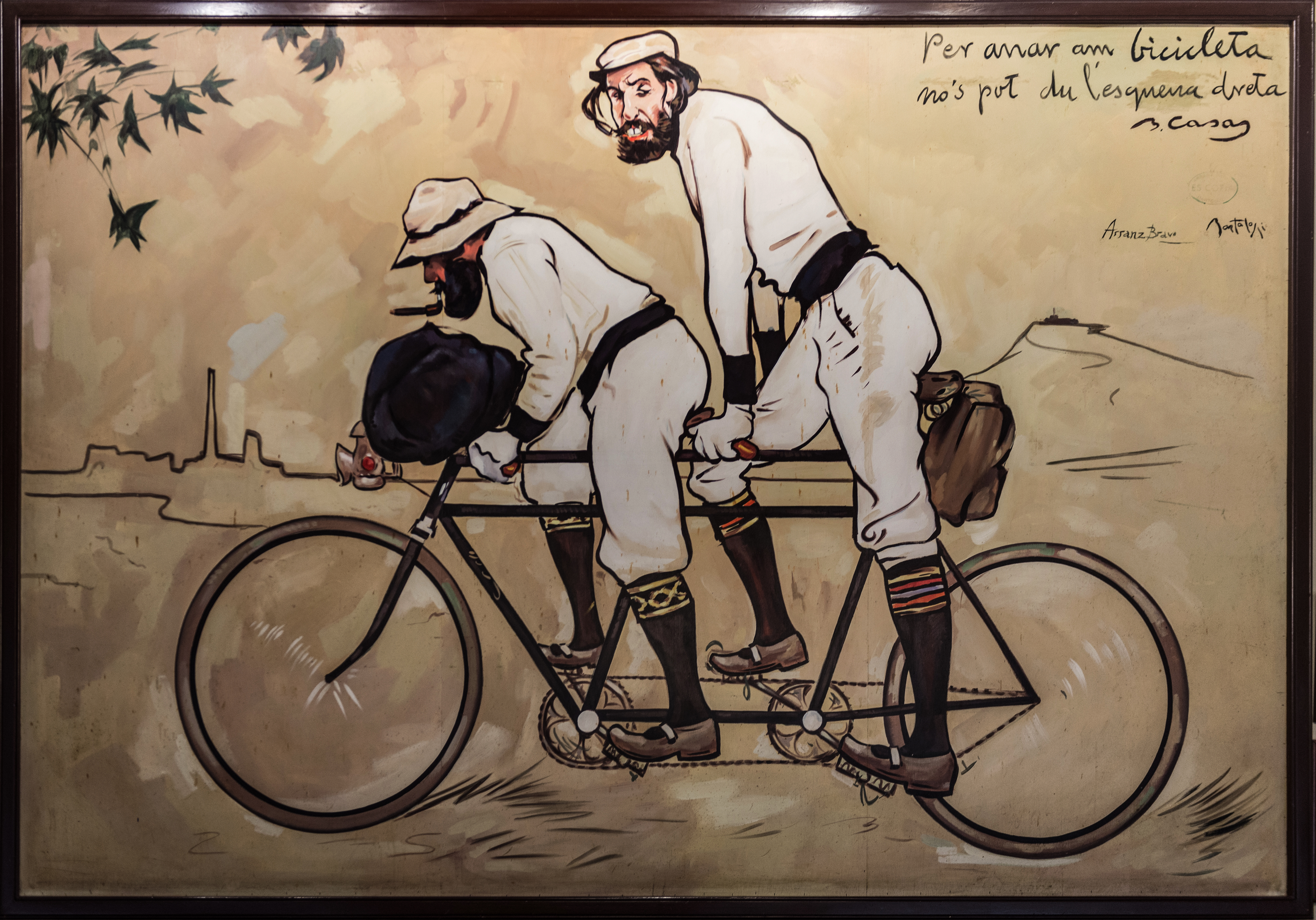
Symbolic of their partnership
Co-founders of 4 Gatos
This work was painted in 1897 by Ramon Casas showing him on a tandem with his friend Pere Romeu, proprietor and co-founder of the 4 Gatos bar. A smaller copy adorns the wall of the 4 Gatos today. We can note again his characteristic pipe.
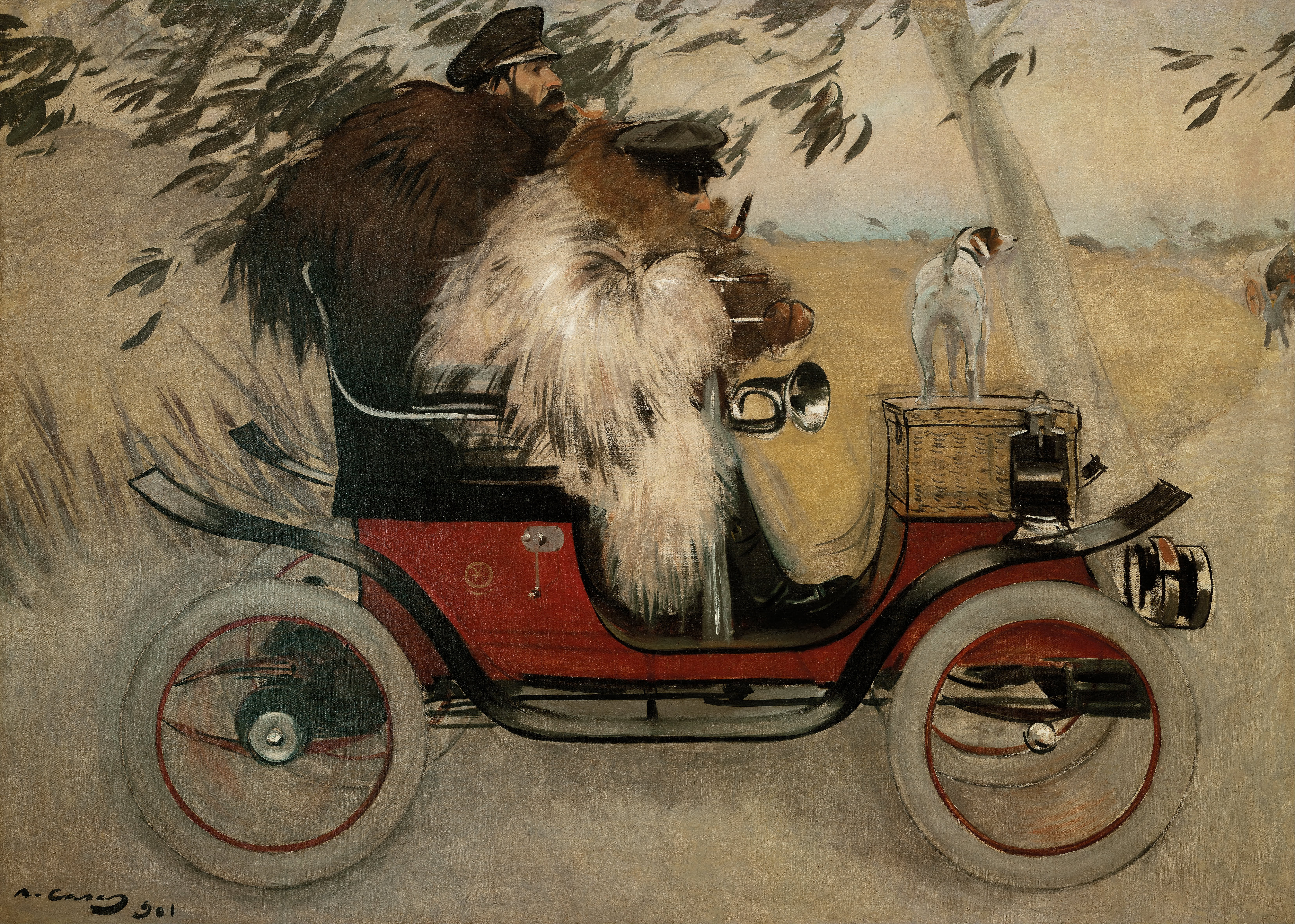
Entry into a new artistic era
The shift to modernism
Ramon Casas painted himself again with his friend Pere Romeu in 1901. here we can recognize him from his pipe peering out of his heavy white fur motoring coat. A reduced copy of this work can also be seen at the resurrected 4 Gatos bar. The originals of both of these works are exhibited in Barcelona at the National Museum of Art of Catalonia.
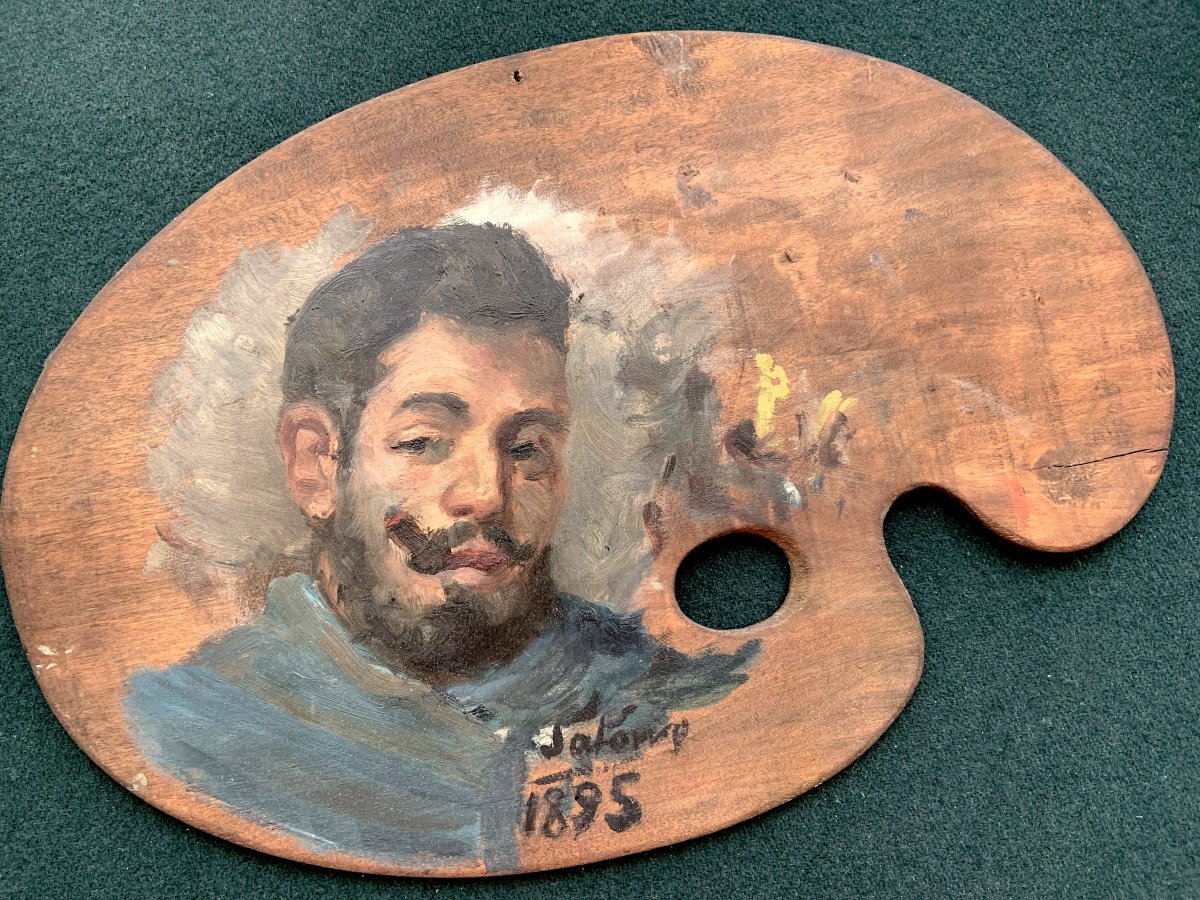
A personal memento
Portrait on a palette
Our portrait of Ramon Casas was painted on a palette, a fairly unused one without signs of wear. It carries the unexpected inscription 'Satory' above the date 1895.
The only known reference to this word is a location near Versailles used during the Franco-Prussian war as a hospital and military prison. It was later deserted and may have figured among places artists would find nature in abandonment. It is likely that this portrait was painted at that location, with the intention of gifting it. The artist, not having an extra canvas on hand would have painted on a small field palette to offer a gift as a memento.
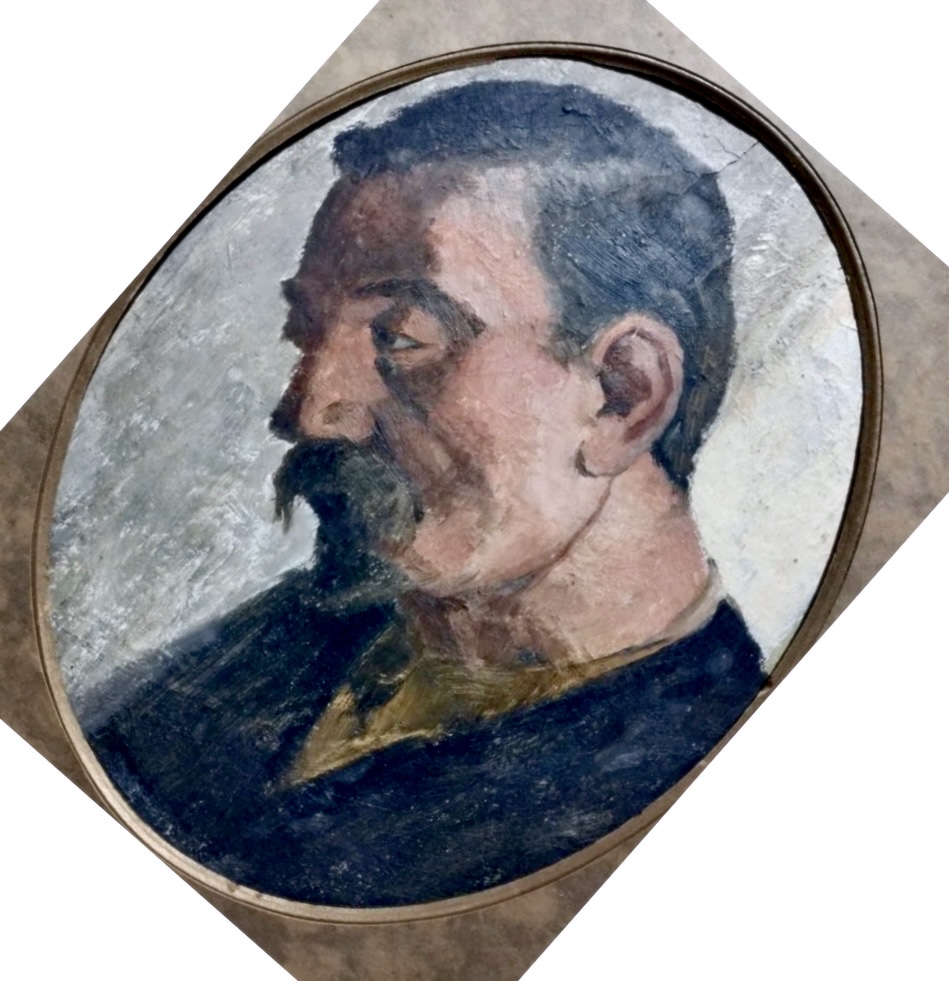
Impromptu portrait
Portrait of Paul Gauguin
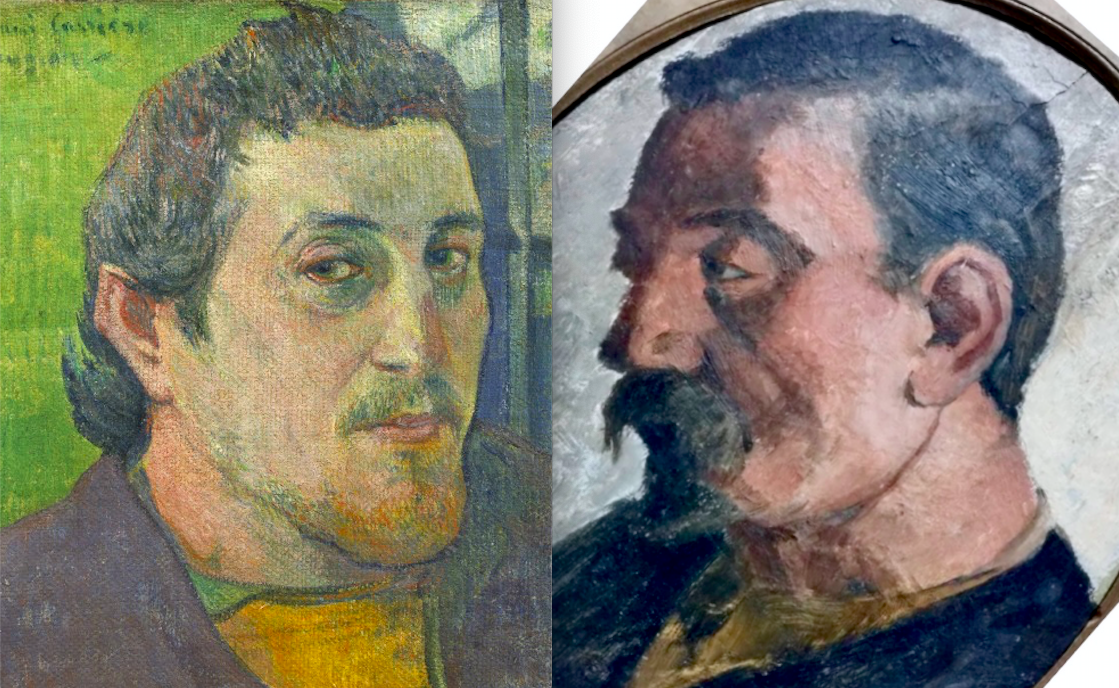
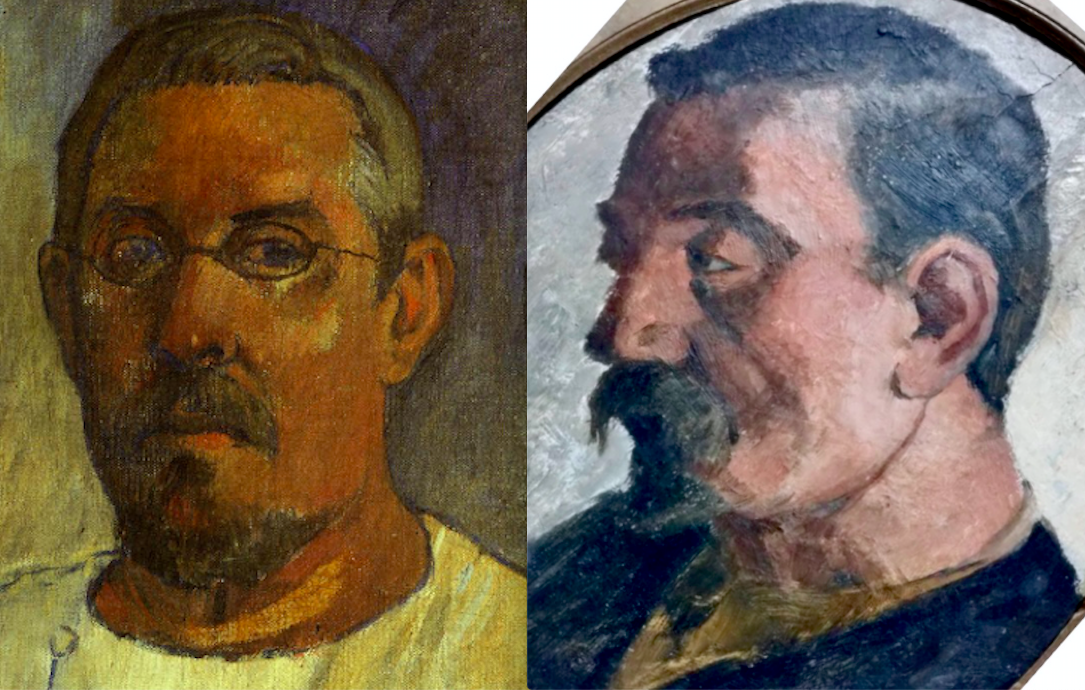
This small portrait of Paul Gauguin was painted on an irregularly shaped oval of cardboard, bringing us to consider that it was most likely a rapidly improvised rendering taking advantage of a short moment in the company of Gauguin. It does not look to be in any of the known styles of this artist. It is therefore unlikely that it is a self-portrait for t is stylistically more rugged with coarser strokes than his, with a very different color palette.
Dating the portrait
Comparison of features
We can date our portrait to approximately a dozen years after this 1882 self-portrait dedicated to Eugene Carrière. This would bring it to the period immediately before or after his last trip to Tahiti in 1896. His weathered face and tan complexion also attest to this. His hair short, had a thick mustache and an upwards curling beard. His earthy ruddiness conveys that he has indeed done what he set out to do: become the quintessential Primitive Man.
Locating the portrait
Sitter identification
When we compare our portrait with his very last self-portrait in 1903, aside from his wearing spectacles and his greying hair and beard we notice very similar features. Though he is more gaunt when approaching death we can denote identical bone structure, hair style, mustache and beard. Worth noting as a mark of identification, his ear cartilage is identical in both portraits. We can then place this portrait as having been painted in the mid to late 1890's.
Early work by Emile bernard
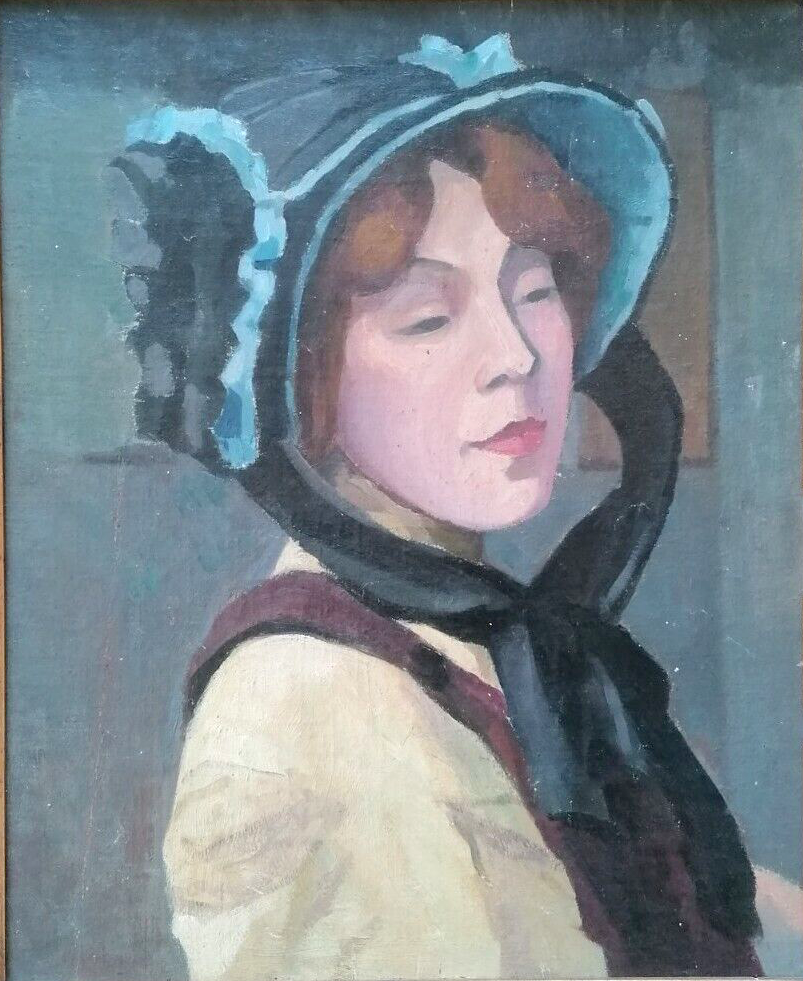
Portrait of Jane Avril
At first glance this work seems to quite modern, maybe from the first decades of the 20th century. However, the identity of the sitter dates this painting to circa 1885 when Jane Avril is still very young. Her solemn expression and demure clothing shows her freshly arriving in Montmartre at age 16 after spending two years in a sanitarium recovering from maternal mistreatment. The illegitimate daughter of an Italian aristocrat, she became known for her elegance and eccentricity. She was attached to the water-drinking Secretary of the Folies Bergeres, jokingly nicknamed Intrépide vide bouteilles, the theatrical critic Charles Desteuque. This work predates the opening of the Moulin Rouge cabaret in 1889 by several years.
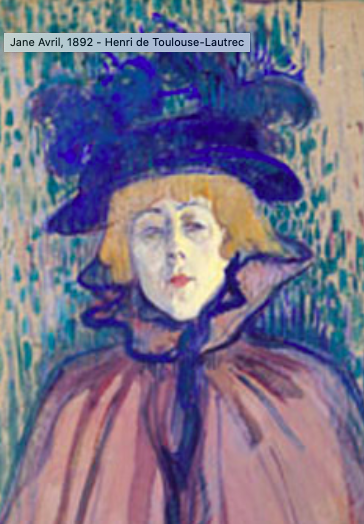
Sitter identification
Here we see a portrait of Jane Avril by Henri de Toulouse Lautrec painted in 1892, about seven years later than our portrait. Her rather unusual features, hairstyle and jawline make her eminently recognizable. We can see that Lautrec candidly shows her with a slightly hardened stance, whereas Emile Bernard focused on her elegant grace, This gritty representation by Lautrec shows that she had grown up and become a star of the Parisian nightlife.
Stylistic comparison
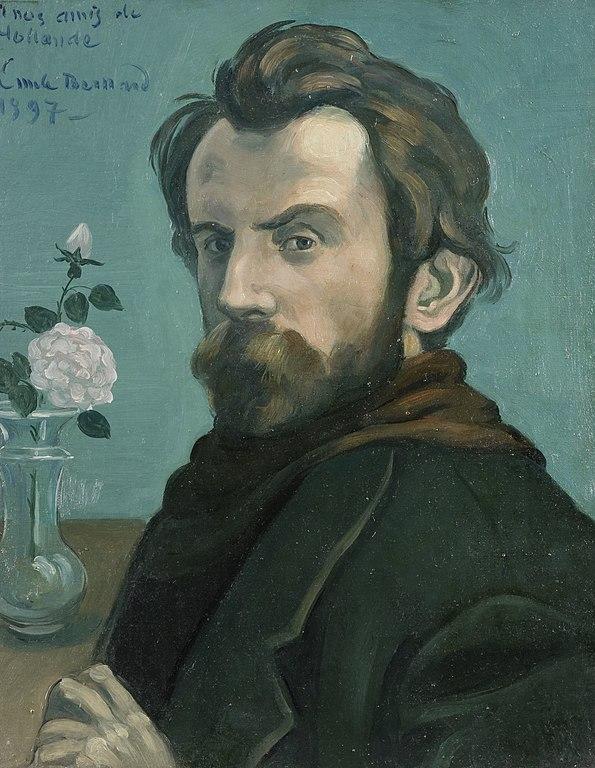
The French painter Emile Bernard attended lessons with Fernand Piestre with classmates Toulouse Lautrec, Louis Anquetin and Vincent van Gogh at Atelier Cormon, 104 Boulevard de Clichy a few doors away from the Moulin Rouge where Jane Avril danced. We can notice that the composition and framing of his 1897 self-portrait seen here is identical to those of our portrait of Jane Avril, The main difference being its reversal due to his mirrored image. Our Jane Avril portrait is an early example of the Cloisonnisme art movement of which Emile Bernard was a pioneer, inspired by stained glass andJapanese Ukiyo-e paintings,. Thus in our portrait shapes are uniformly expressed as flat regions of color within crisp outlines and an absence of details. These considerations lead to the attribution of this work to a very young Emile Bernard.
Artistic context
Birth of a movement
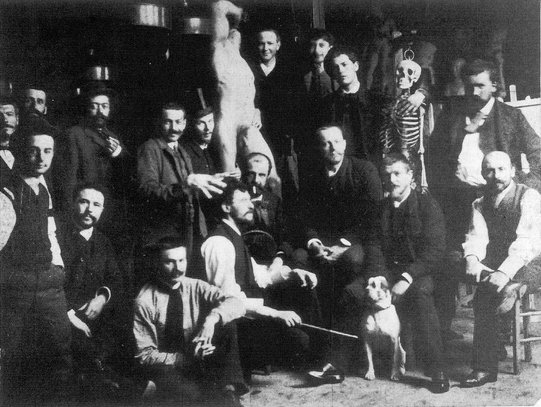
In this photograph of the students of Atelier Cormon we can see to the far left a very young Toulouse Lautrec and just above him the tall bearded Louis Anquetin. Near the center Vincent van Gogh jests wearing a top hat next to a male nude model. We can see Emile Bernard standing to the far right.
Painting by Albert marquet
Sunset in Algiers
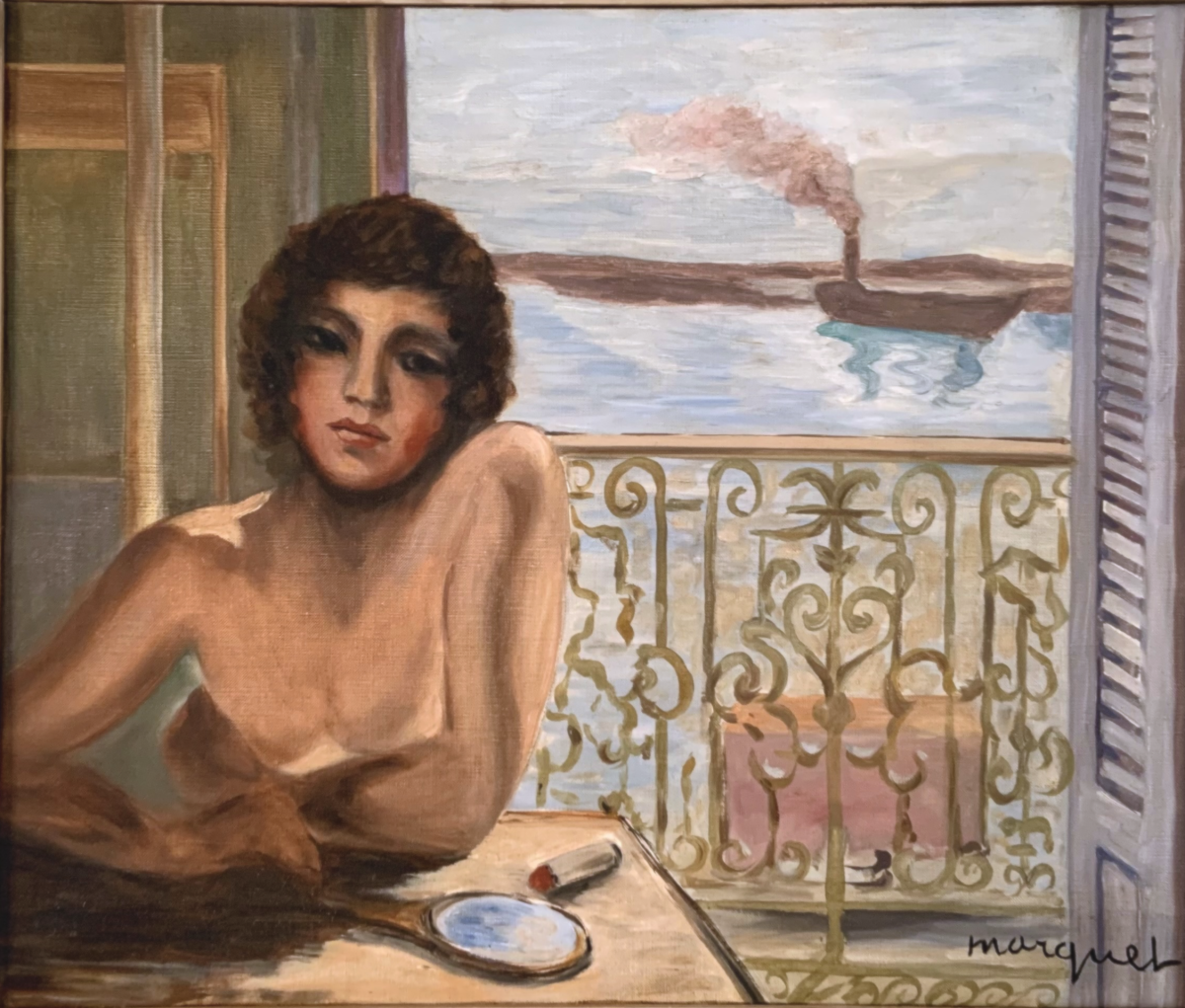
Albert Marquet was the art school classmate and best friend of Henri Matisse. However, despite his talent and great potential, he shunned the path to fame for a more dissolute life of adventure. This work was painted in 1924 at the port of Algiers. It can be dated thanks to another work kept in the artist's private collection. Ours was presumably painted about one hour before the other as can be determined from the angle of the shadows. This work was probably sold or gifted as it was signed, not the other one he kept. If it was indeed his wife Marcelle who posed for these paintings, it is logical that he would have slightly changed her features for our work to be sold.
Other painting of the same session
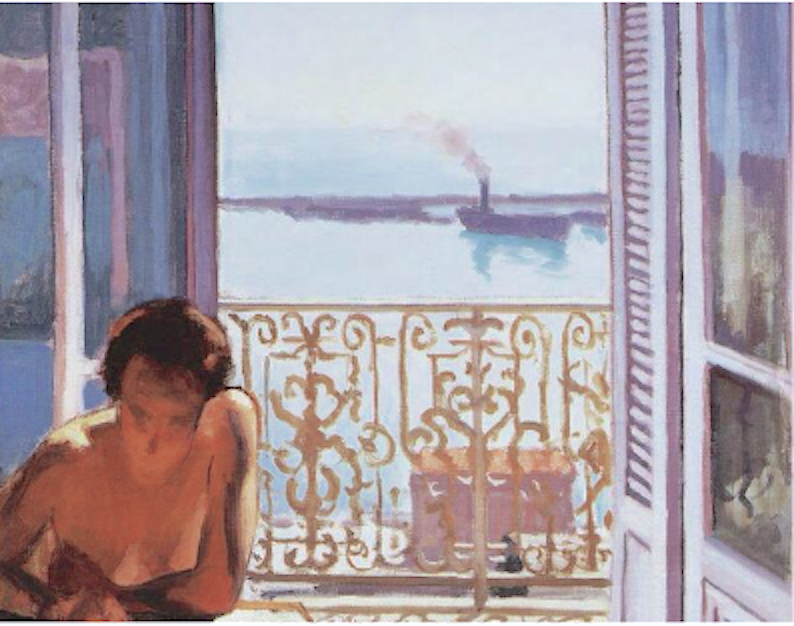
Painted on a canvas of identical dimensions, this other work can be dated to the same day in 1924 when Marquet painted another of hi works. This other one was kept in his private collection and much later sold by his wife Marcelle. We will note that our painting was brushed from the vantage point of a chair, with the model seated on the floor at a low table. The second work shown here was painted standing up, as can be seen from the perspective most easily noticed by the height of the models head relative to the bannister. The differences in color could be attributed to the slightly later time and different lighting from a higher position in the room.
RECENT ADDITIONPortrait of Paul Verlaine
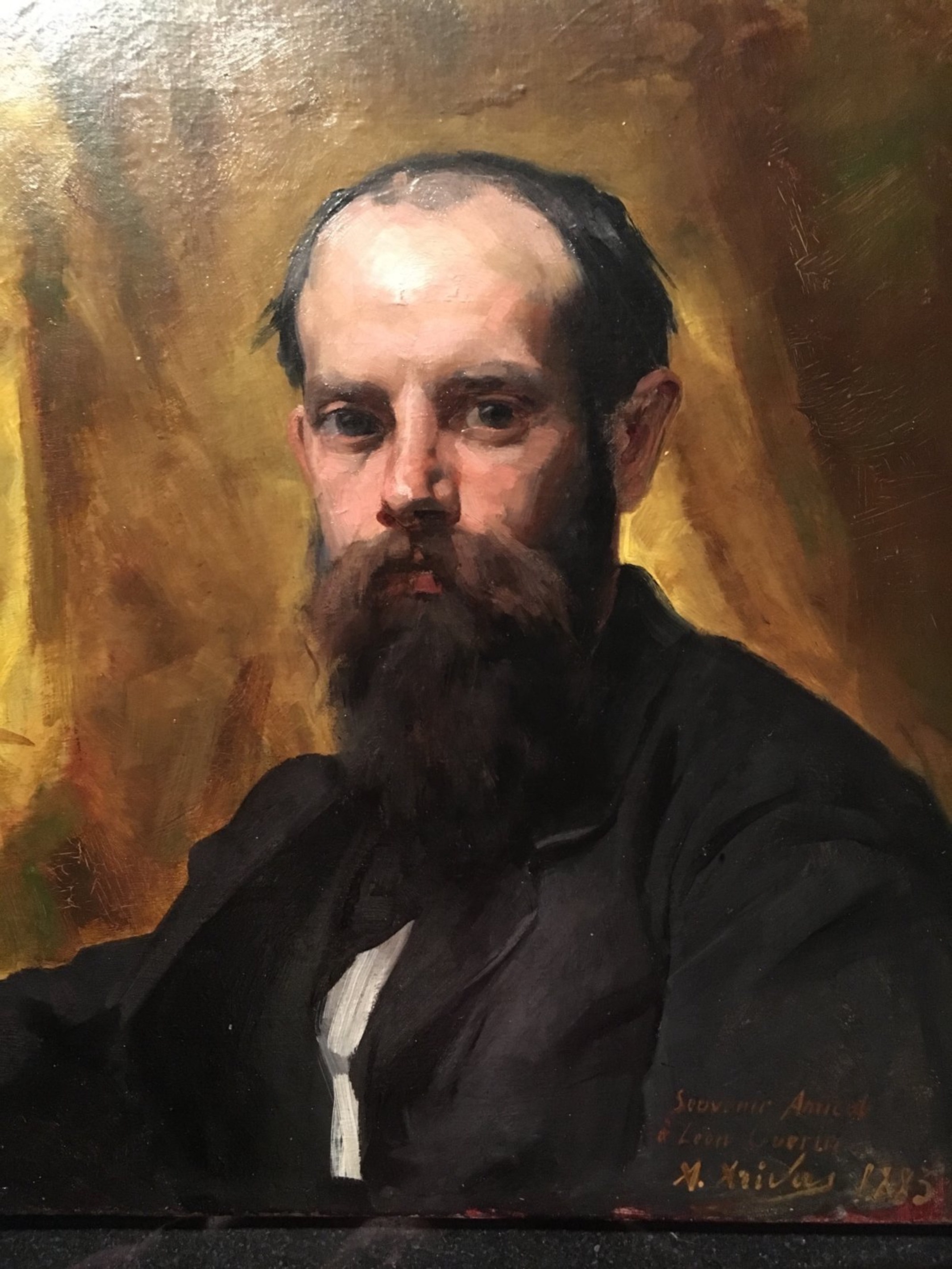
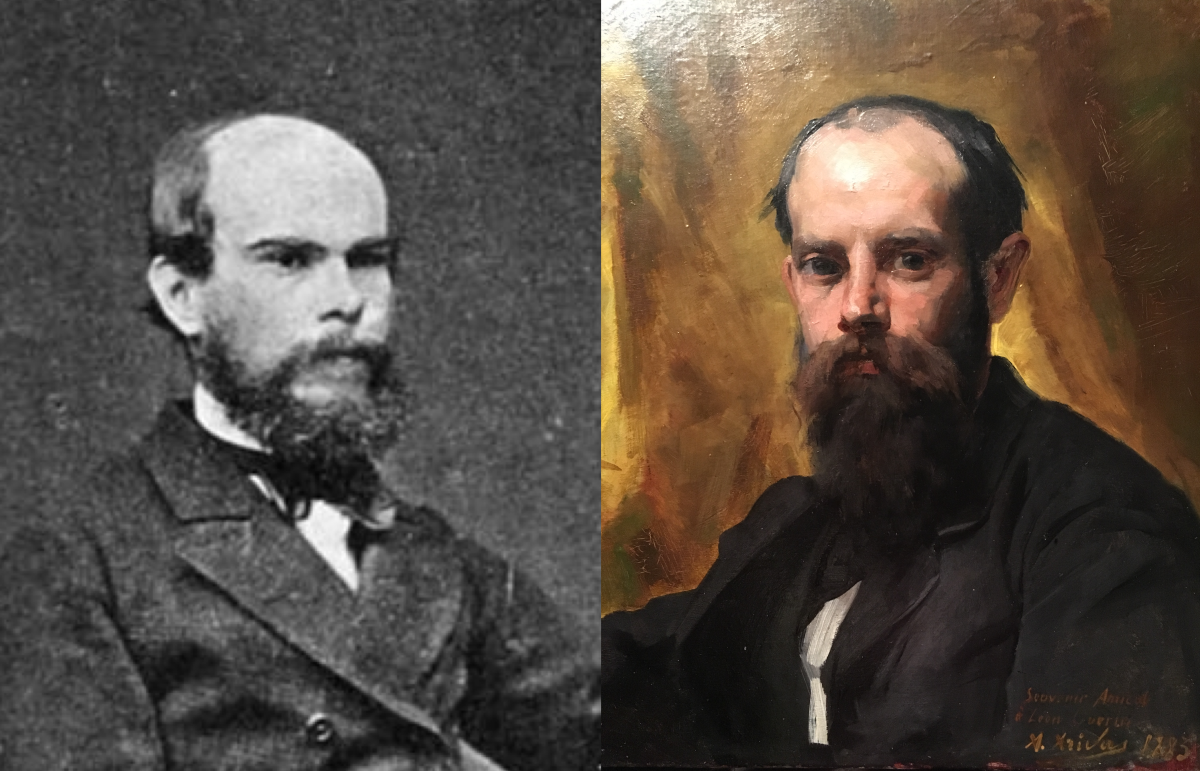
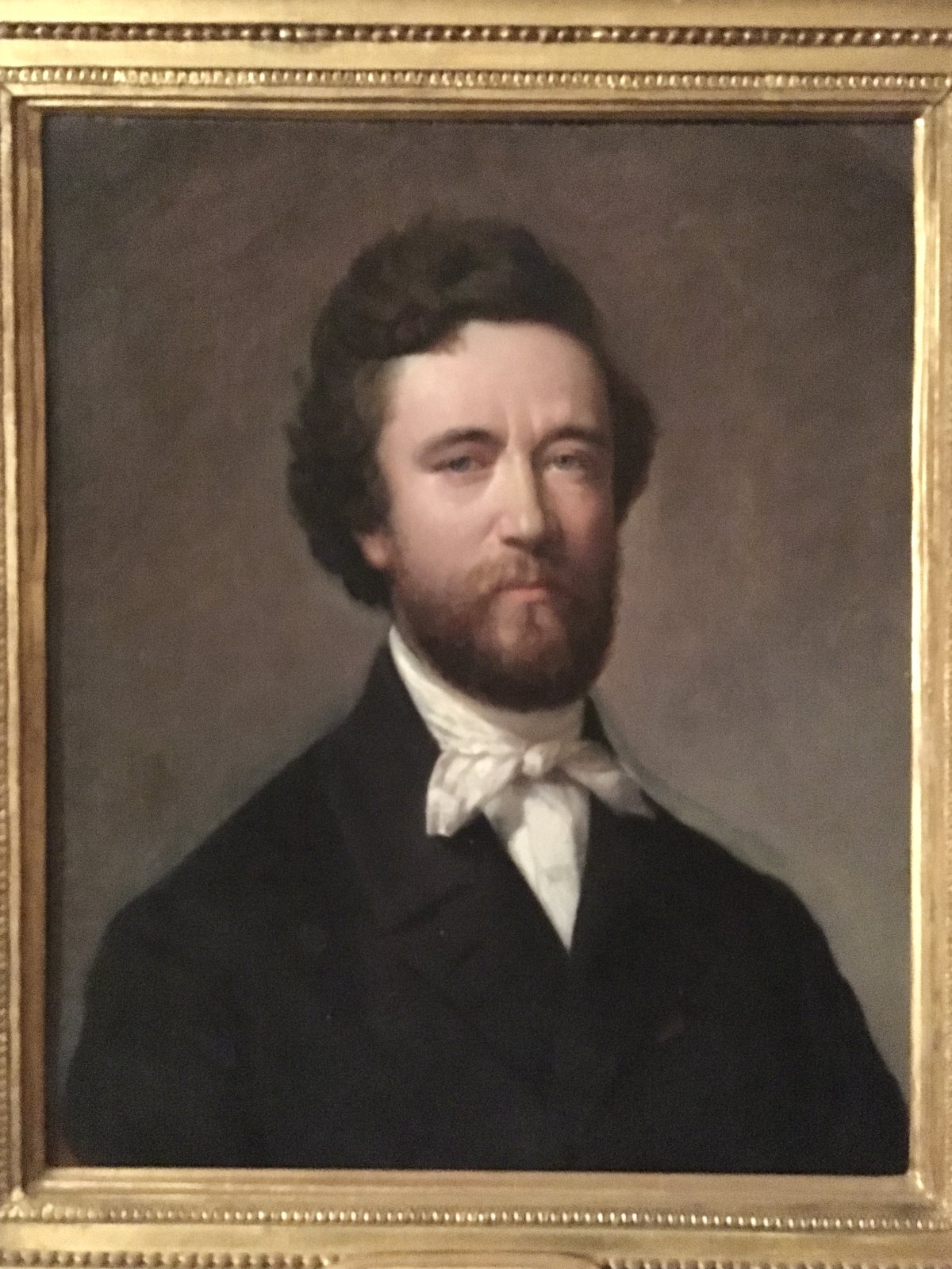
The French poet Paul Verlaine is usually known for his appearance later in life, when he had lost all of his hair and his romantic misfortunes with Rimbaud and time spent in prison had marked his features tragically. There is a painting by Frédéric Bazille of a young Verlaine with a full head of hair that would never be recognized today had we not had documentation of its existence. This portrait is another nod at his changing appearance. He was still married and had not yet suffered the hardships to come. His pose is from above at a slight an angle, making his nose appear a bit longer than in other portraits. His clothing is masterfully rendered in its folds and shading and the light in the background is beautifully painted.
Physiognomic Comparison
Sitter identification
We shall compare our portrait to a photograph of Paul Verlaine from approximately the same time period. In our portrait we note his mustache is almost identical while his beard is a bit fuller. His head is slightly tilted which makes his nose seem longer. That can be verified by his ears that look slightly higher due to the difference in visual angle. His pose is more relaxed in the painting, due either to the rapport between the portraitist and the sitter, or because the pose lasted much longer than a photograph, allowing one to relax.
Provenance
Painted inscription
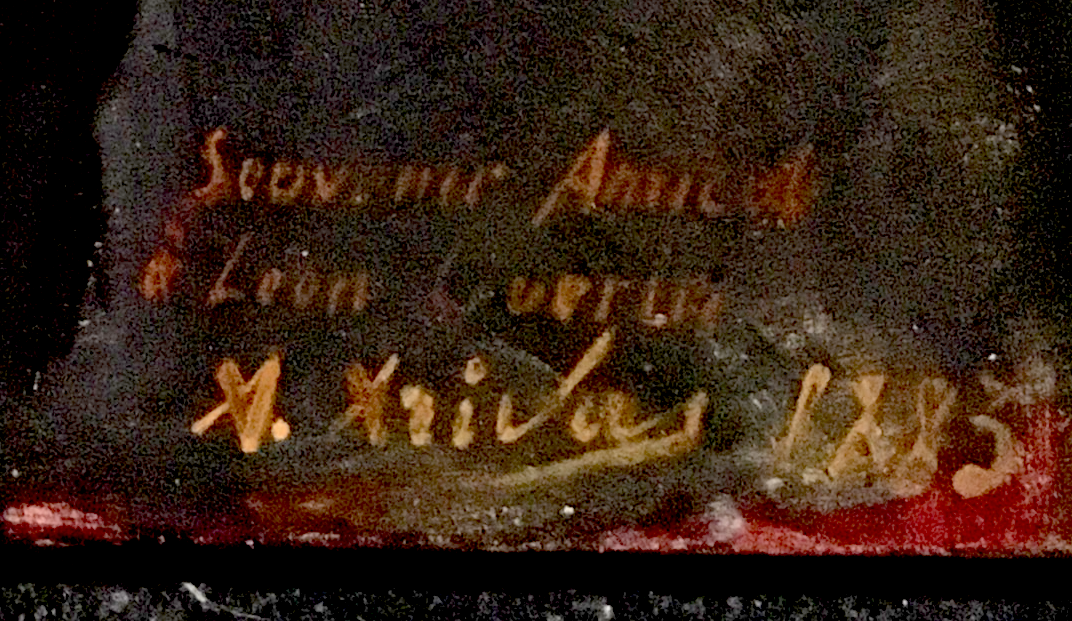
Thanks to an inscription in the lower right corner of the canvas we can trace the second owner of this painting back to the private collection of French author and historian Leon Guérin. This work was gifted to him in 1883 as attests the note painted on its surface:: "Souvenir Amical à Léon Guérin X. Xrivas 1883". It would be unlikely that an artist named Xrivas would leave no trace, with such talent. It thus becomes likely this might have been a signature in jest by Verlaine. Xrivas is a phonetic derivative of Scrivas, in latin a Scribe. This would be a fitting namesake for a poet to use with an author. Léon Guérin passed on two years later, and the painting eventually made its way into our collection. In the 19th century it was also usual to gift a friend with a portrait of oneself, or of them, and not a portrait representing a third party.
Physiognomic Comparison
RECENT ADDITIONPortrait of Alfred de Musset
The well-known French author Alfred de Musset was seldom painted in his lifetime. However, the Palace of Versailles has a portrait in profile painted from the side by one of his closest friends, the artist Charles Landelle. He may well have painted a second portrait of Musset, this time from the front. It is a portrait that we can legitimately consider probably was kept in the personal collection of the artist, as it bears glued to the back of the wooden panel a note from Musset to Charles Landelle.
Note to Charles Landelle
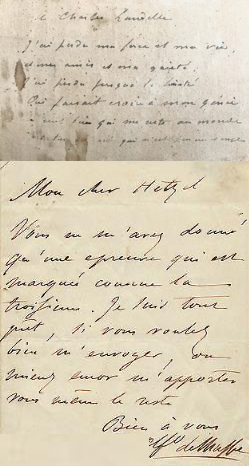
At the back of the wooden panel on which this portrait was painted, a handwritten note was found. It was left facing the wall and is partially erased. It is a note addressed to Charles Landelle and written by Alfred de Musset. We can see here his handwriting compared an earlier example of his writing to Hetzel below. That was at a time he was more youthful and brimming with hope, not the somber notes of our own example. However, it can be established that it was indeed penned by Musset.
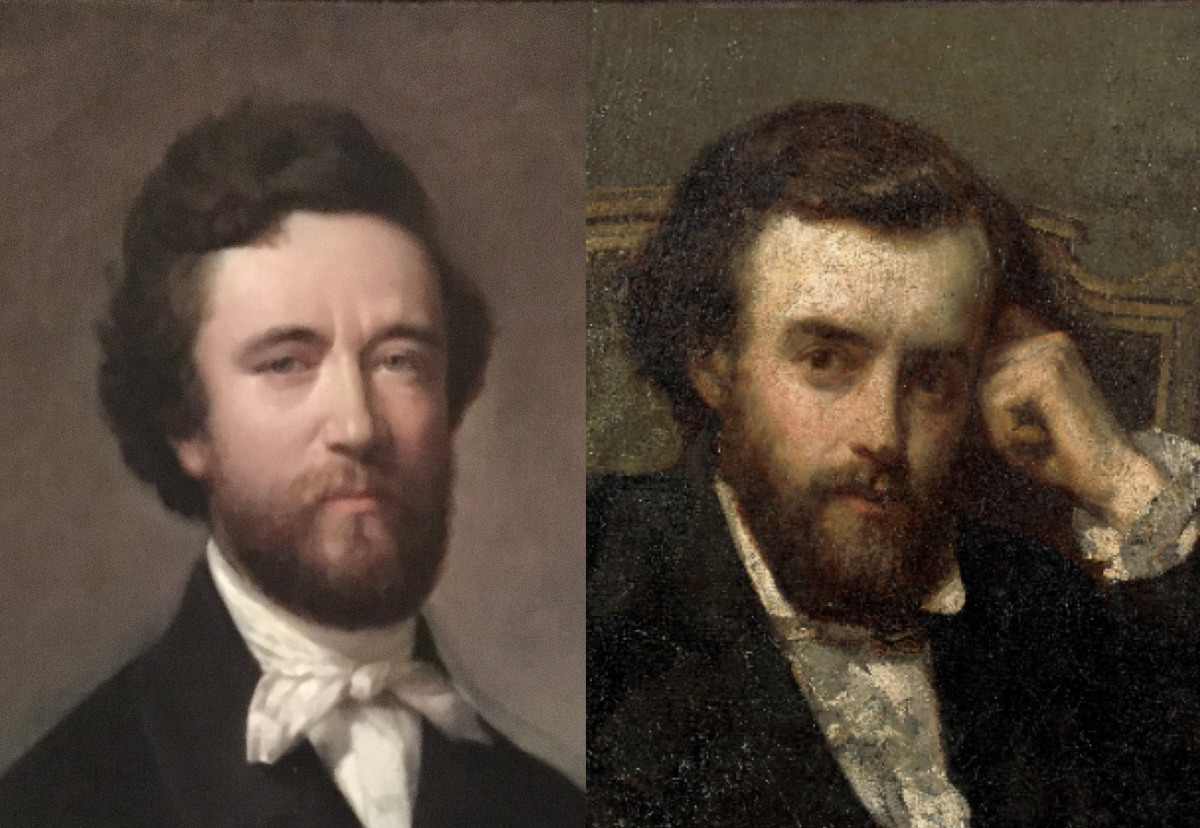
Physiognomic Comparison
Sitter identification
The French author Alfred de Musset can be seen here next to a portrait of him by Louis Gustave Ricard. We can see that in our portrait he is middle aged versus the other where he is a good bit thinner and much younger. However we can readily recognize the same facial proportions and features.
Physiognomic Comparison
RECENT ADDITIONPortrait of George Sand
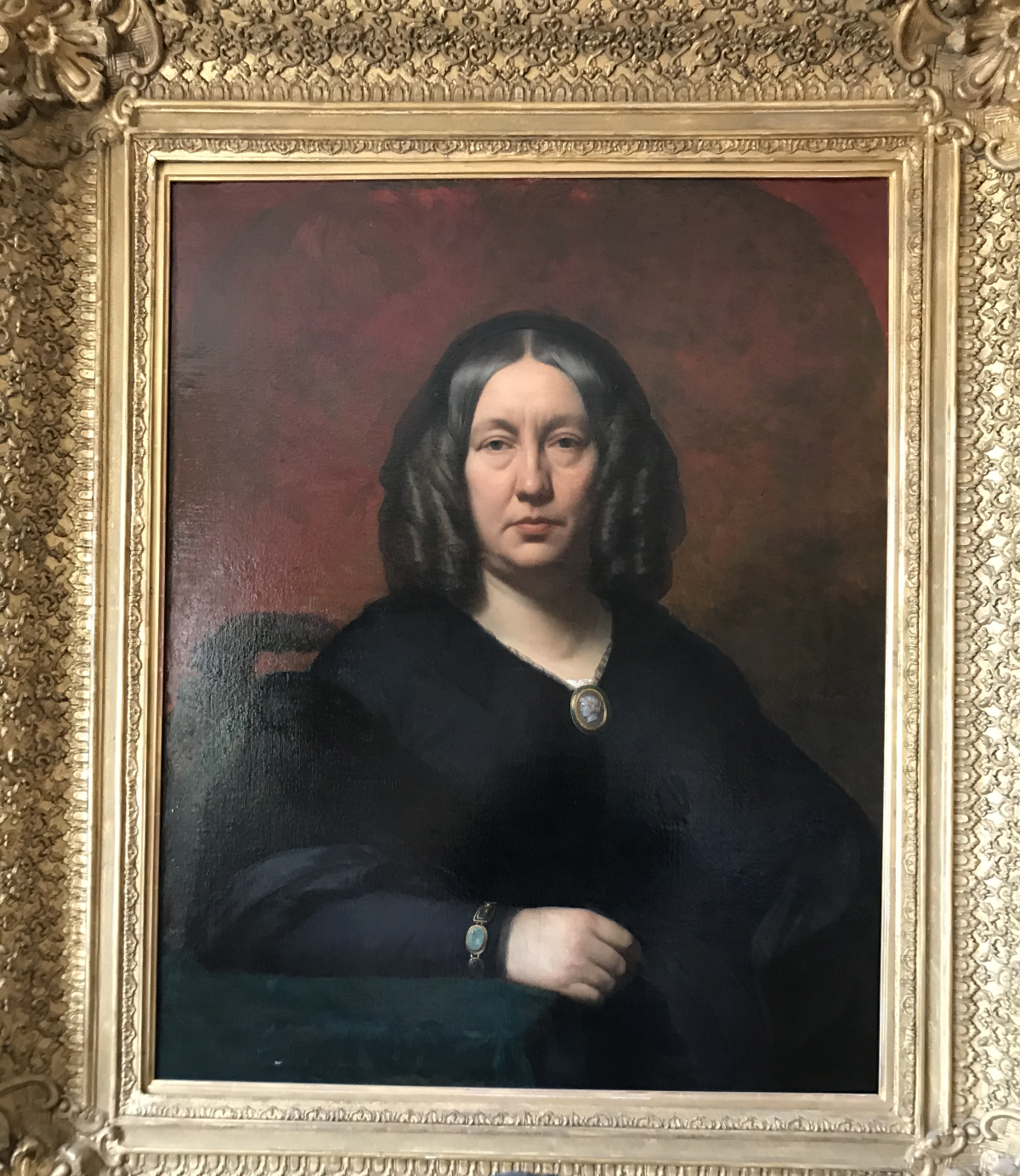
This large painting signed by society portraitist Charles François Jalabert is a portrait of the feminist author George Sand, by birth name Aurore Dupin. She launched her literary career learning from her paramour, the famed Romantic author Alfred de Musset. Their love affair ended tragically in Venice and she later took up with composer Frederic Chopin. He was to be the love of her life. This portrait show her circa .1850 shortly after his death. She is soberly dressed in mourning and clearly suffers at his loss.
Sitter identification
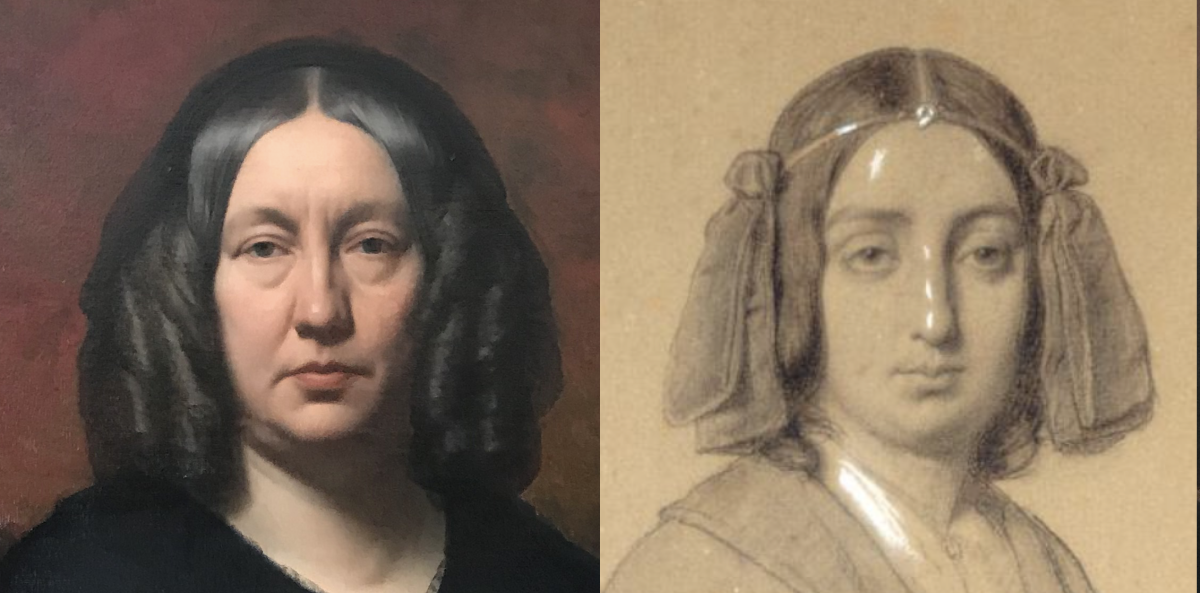
We can see a number of similarities between our portrait and one dating back to 1837 by Luigi Calamatta almost 15 years earlier. In the earlier drawing ribbons are masking her hair curls. We can see that she had gained some weight as well as had carried the burden of caring for an ailing Chopin for quite a few years.
RECENT ADDITIONPortrait of Frederic Chopin
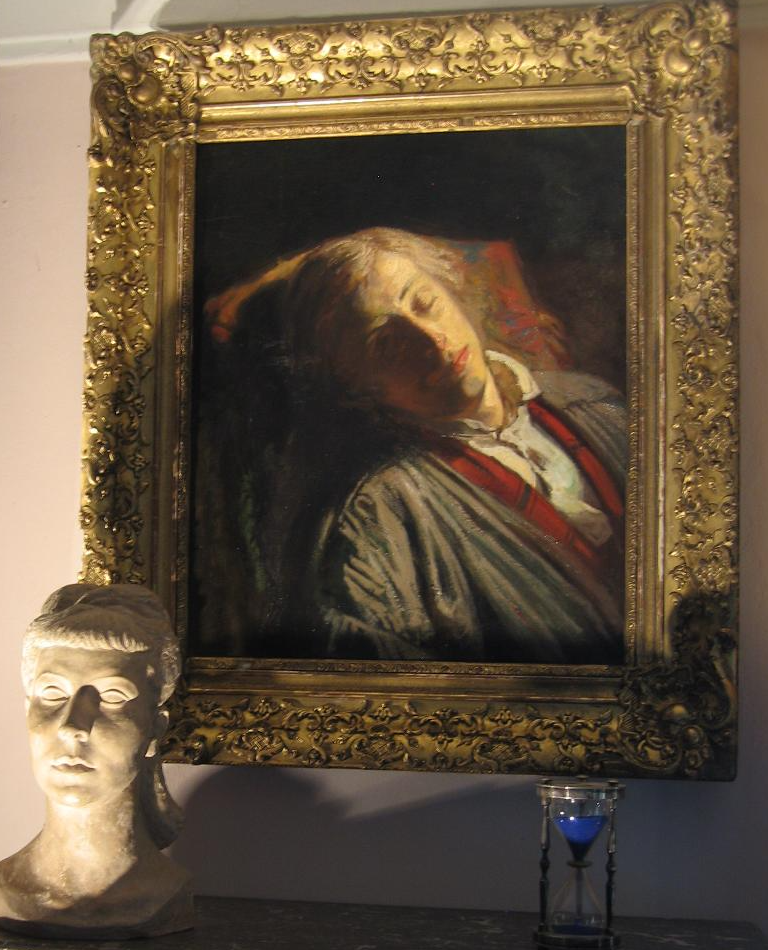
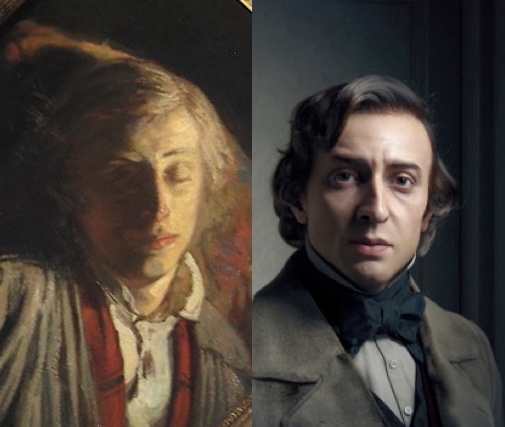
This painting is quite a rarity as it shows the sitter sleeping in the artist's studio still wearing an artist's smock that he had presumable put on over his clothes to stay clean during a lengthy visit. Given his fame and presence alongside George Sand in Paris society we can expect that he knew may painters well. Eugene Delacroix was possibly his best friend, although it is unlikely that this work could be of his hand. We have been able to identify the sitter as being the great composer Frederic Chopin, we still must establish the author.
Physiognomic Comparison
Sitter identification
For the purposes of the comparison of facial features and proportions we have straightened the image in our portrait and placed his face alongside the 3D reconstruction of Frederic Chopin by Hadi Karimi. We can note a very close likeness other than the flat dimple on his chin present in numerous other portraits of the composer. It is almost as if, to the right, he has just awakened from his slumber and hurriedly gotten dressed.
Physiognomic Comparison
Photographic confirmation
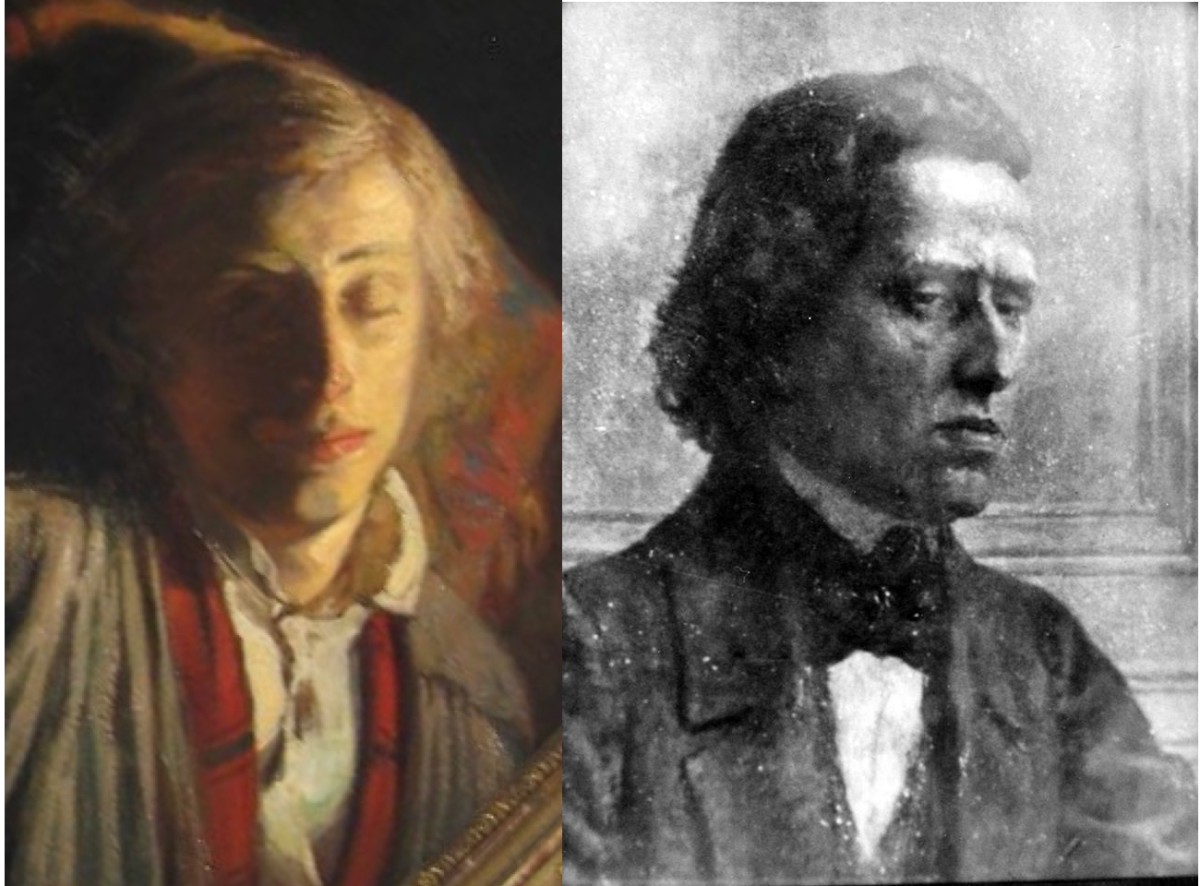
Recently discovered, this Daguerrotype by Louis-Auguste Bisson was taken in 1847. It is the only known photo of Frédéric Chopin, previously we only had painted portraits, drawings or engravings. Here we compare our painting to this early photograph and can note only three small differences. Firstly his hairline looks a bit lower in the painting. This could be due to it later receding or to it being combed across the forehead, it may have fallen lower during his sleep. Secondly his brow is more curved, possibly because while resting it is not furrowed from tension caused by the creative concentration of the composer. Finally, due to the side lighting of the painted portrait his chin dimple is more contrasted.
RECENT ADDITIONPortrait of Franz Liszt
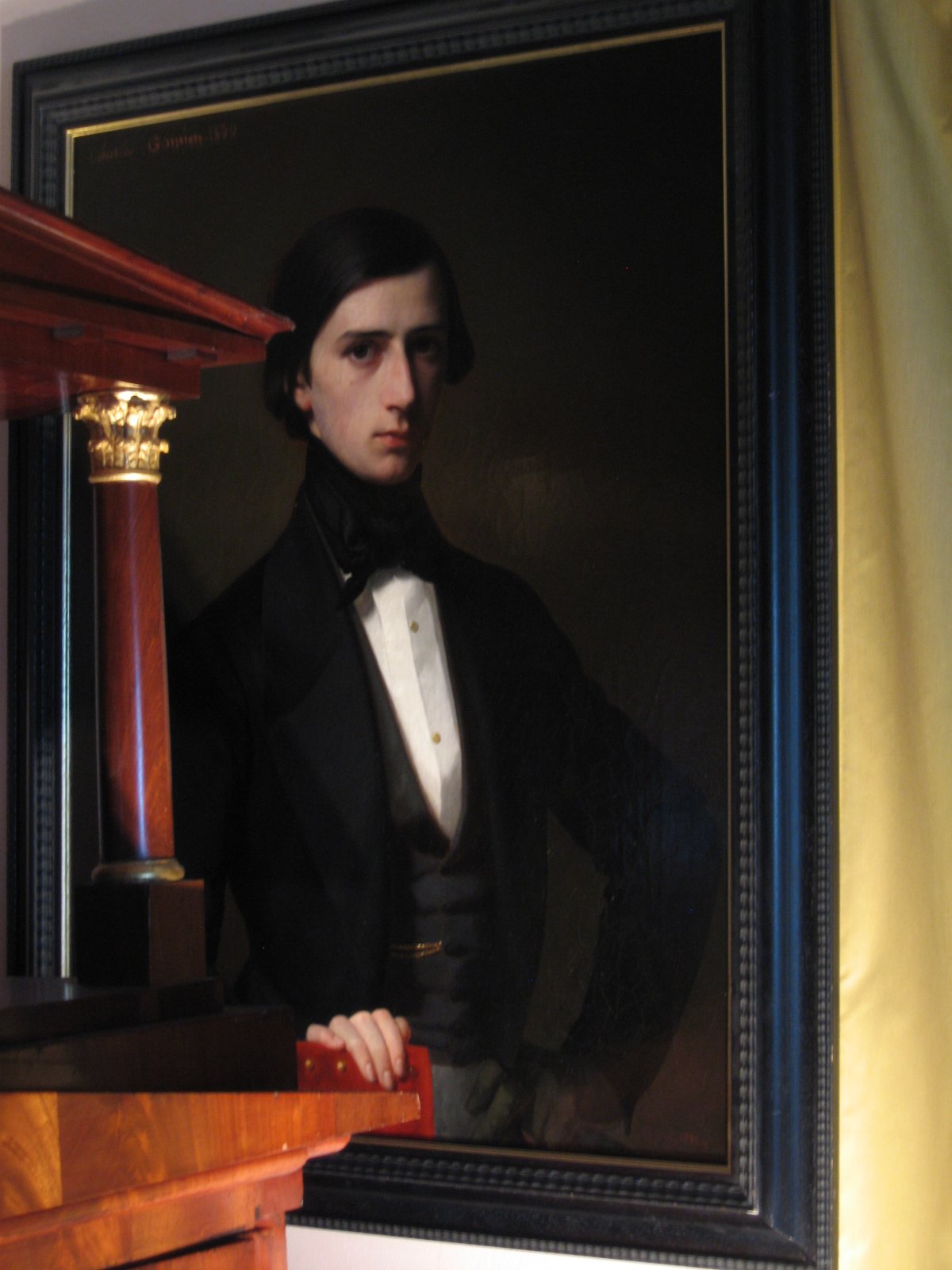
This painting signed Charles Gomien and dated 1830 is a portrait of pianist and composer Franz Liszt at age 28. He is portrayed with his hand resting on the back of a chair, looking at the artist. At this age he was one of the very first superstars, stirring the hysteria of droves of fans with his virtuoso piano playing and romantic compositions.
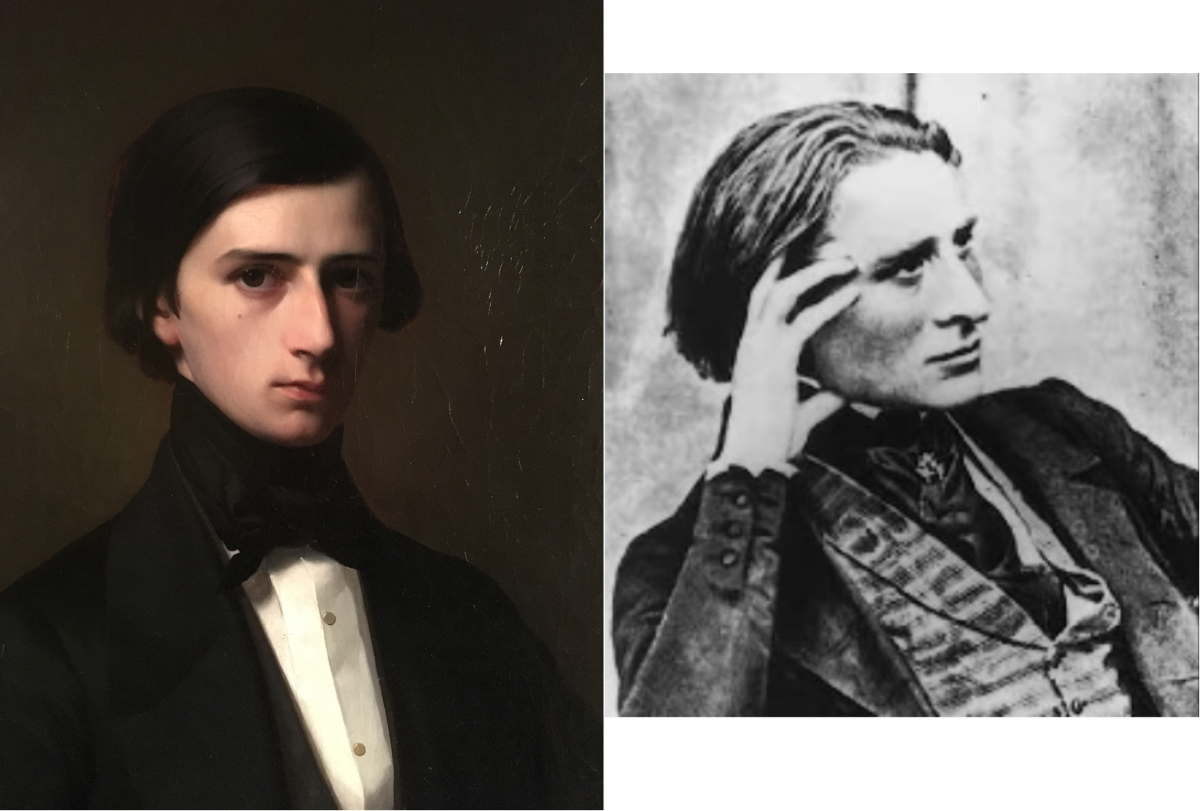
Physiognomic Comparison
Sitter identification
Here we can see a detail of our portrait next to a Daguerrotype of a young Franz Liszt. We will note that he has almost identical features and proportions making this easily identified as a portrait of Liszt, even if his youthful appearance was quite different from his more stern and striking looks later in life, We can also note the similarity of his delicate pianist hands, both in the photograph and the portrait..
RECENT ADDITIONPortrait of Ludwig von Beethoven
Ludwig von Beethoven is portrayed here at age 26 by French painter Jean-Charles Traversier circa 1797 one year before he became deaf. This portrait shows him gazing into the distance, possibly seeking inspiration. In later renderings his facial expression changed dramatically and these more severe poses are those best remembered. This painting was stylistically influenced by the period of the French Revolution which Beethoven held in great esteem. He is represented as an idealistic 'sans culotte' dreaming of a better world. This translated into an outspoken admiration for Bonaparte when still a Revolutionary General, giving the Napoleon Symphony. However when Napoleon crowned himself Emperor, Beethoven was enraged and immediately undedicated his 3rd Symphony.
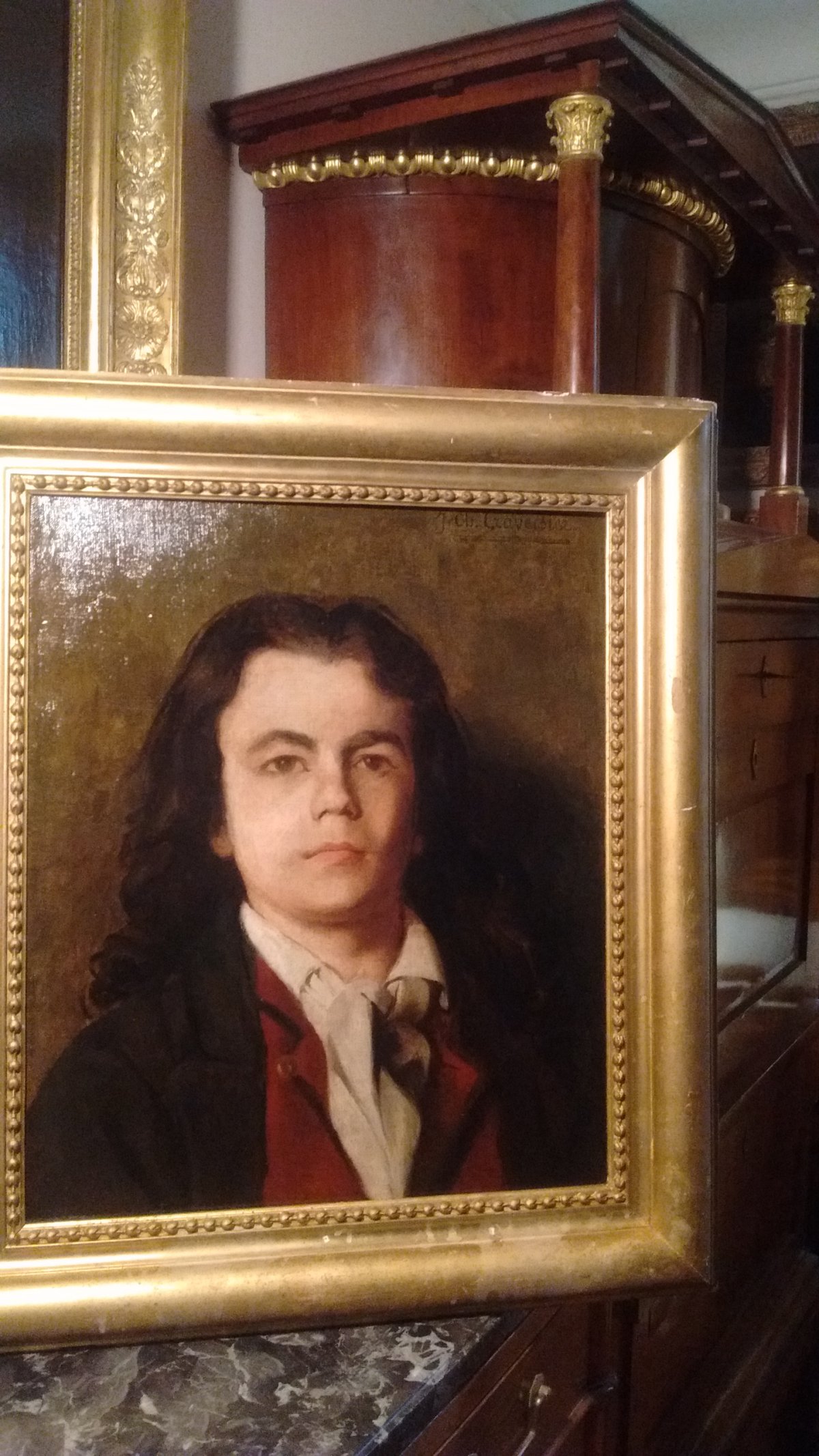
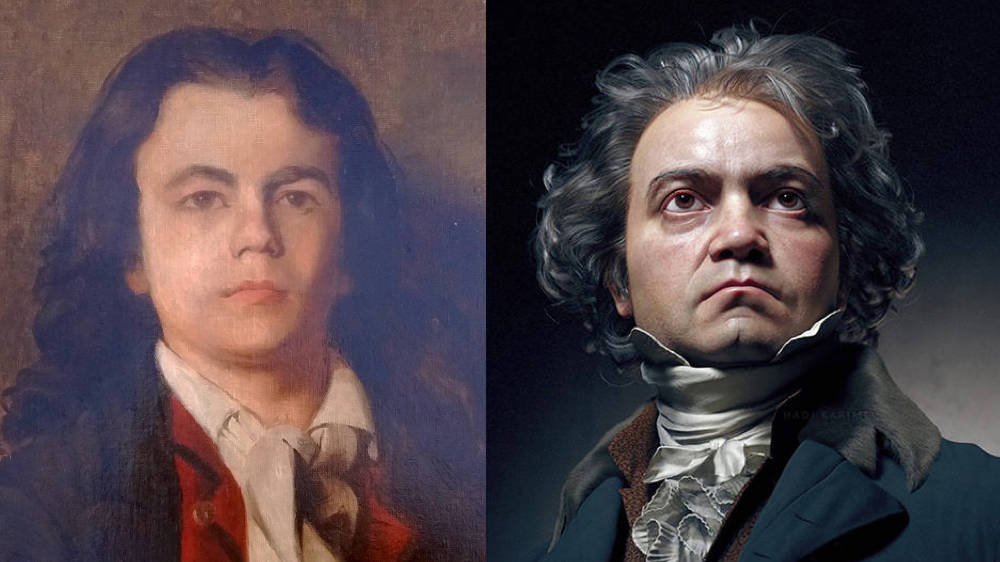
Physiognomic Comparison
Sitter identification
To compare his features and proportions we have used a composite 3D reconstruction of his appearance. We must take note that Beethoven is seen here from below and bears a much more gentle facial expression than in his later portraits. This one of the rare portrayals of him with very long hair which changes his general demeanor. His eyes are looking straight ahead while those of the 3D rendering are wider as he is looking upwards. His nose is quite similar, even when inspecting the respective shapes of his asymmetrical nostrils. This level of detail is not found in posthumous portrayals in which he was not the sitter. Exceptionally, 3D reconstruction was able to add such precision from elements such as his death mask If his mouth looks different, it is because he is shown frowning and pursing his lips in the computer generated reconstruction. Our portrait bears a very close resemblance to this highly detailed image, suggesting it would have been painted in the presence of the sitter.
ART COLLECTION
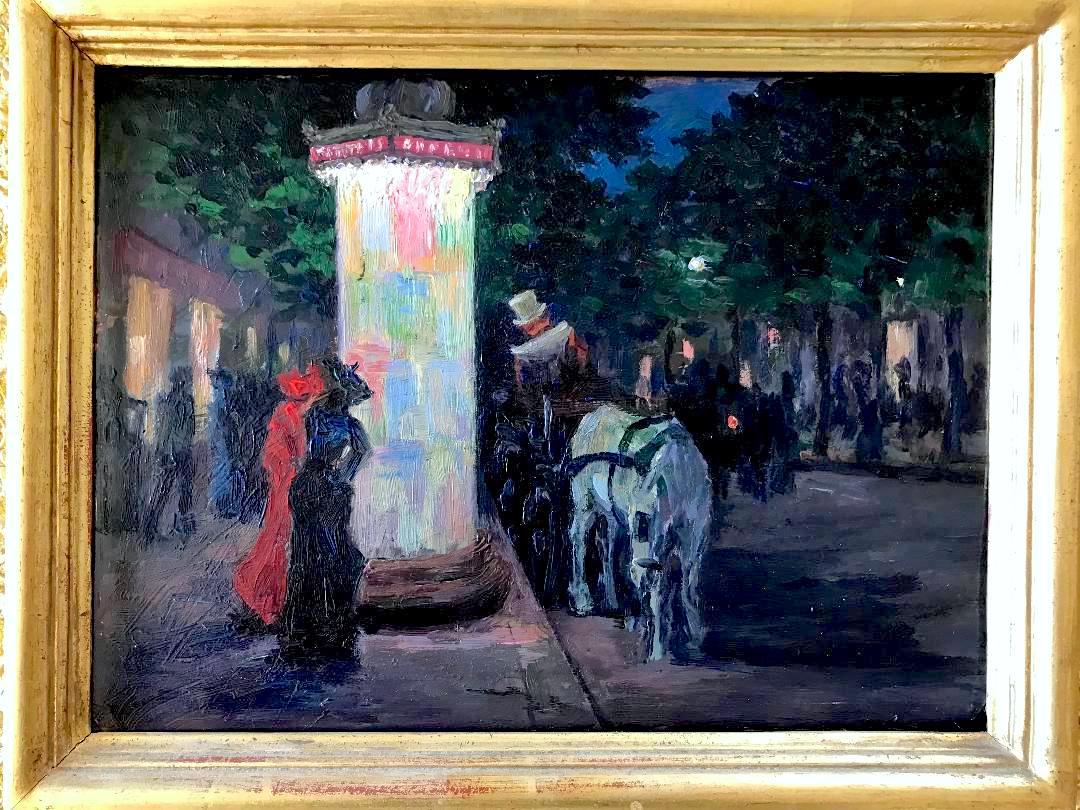
Welcome to THE VALORISM INSTITUTE
Cultural Contributions of Artists
Art is humanity's highest attainment for enlightenment, bewilderment and admiration. Supporting the arts as the main bastion of culture, the Valorism Institute seeks to participate in a Renaissance of Culture.To this end we work steadfastly to promote the arts and bring cultural components into more widespread expression n politics, economics, society, and technologies. Painted circa 1888 by Frederick Childe Hassam, this oil on wood panel work in our collections is a night scene of Grande rue des Batignolles, where Impressionist painters met at Café Guerbois.
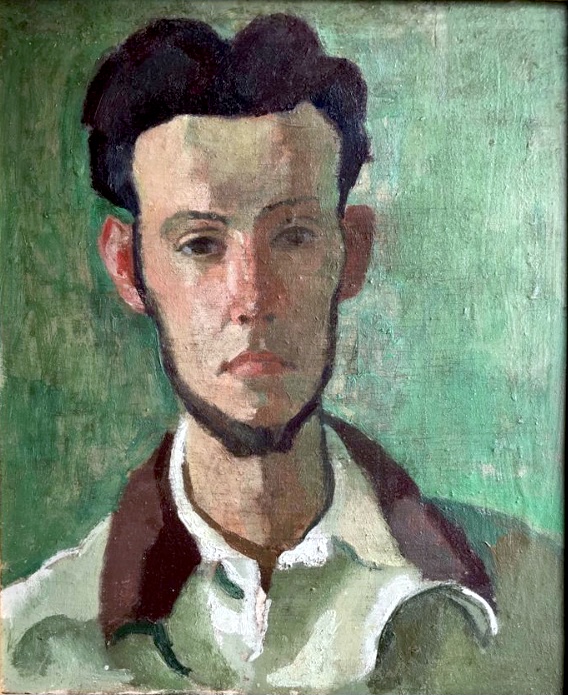
author IDENTIFICATION
Modigliani self-portrait
This work was originally found glued to the back of another painting, by French artist Felix Bellenot who attended the Colarossi Academy three doors away from Modigliani's apartment at 8 rue de la Grande Chaumière in Montparnasse.When discovered and added to our collection it had been preserved hidden and facing the wall when hanging. The 'front portrait' was signed F Bellenot and was painted in the 1950's as dated by the sitter's age. It's artistic style is closer to the Paris School of the 20th century. It portrays a young redheaded actress Nadine Tellier, to later become Nadine de Rothschild. It seems likely that Bellenot kept the Modigliani self-portrait hidden from strangers to prevent its theft, while still allowing his personal viewing of the painting. It is easily noted that it carries the artist Modigliani's powerful expression.
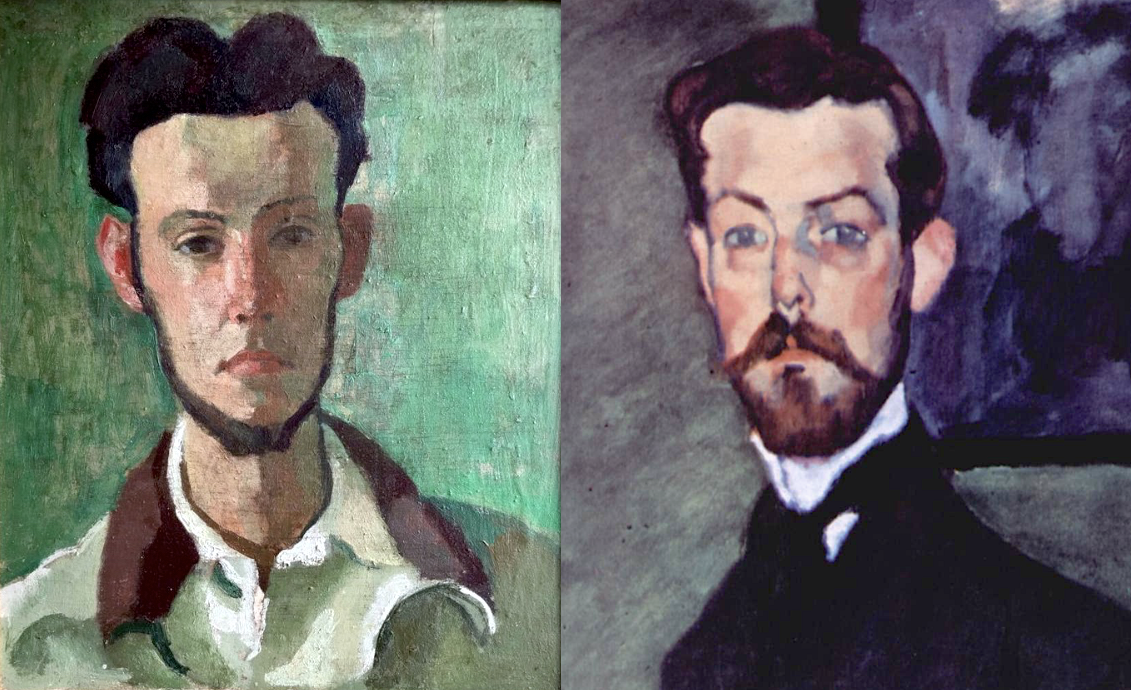
Stylistic comparison
One of his early portraits
There are many similarities with Modigliani's 1909 portrait of Paul Alexandre now at the Modern Art Museum of Tokyo. The main ones are the vertically elongated silhouette, highly contrasted contours, sculpturally exaggerated cranial shapes, a head-on pose, patchy facial coloring, thinly stylized eyebrows and ruggedly sketched ears. They both are looking towards the painter, gazing in an absent way with the sitter in our portrait opening his eyes less widely. We can note a very similar treatment of background shading. We await a photograph of the Montparnasse artist Felix Bellenot to ascertain whether or not this might be a portrait of this fellow artist, six years his junior or perhaps a self-portrait he gave to his friend.
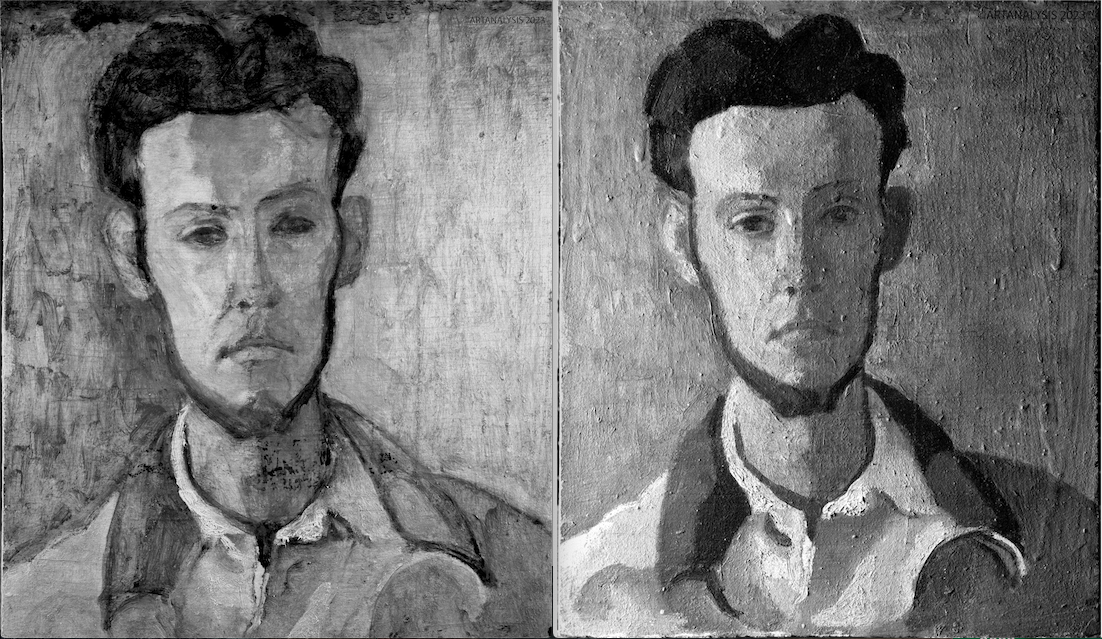
Drawing comparison
One portrait, two separate sittings
We can note when comparing an infrared photograph of the work with a side lit surface picture that he first painted himself in a deep depression, looking despondent and very sad. Later, when he finished the work he changed his overall expression to present a more placid face to the world. This provides evidence that it is indeed an original work with the sitter present for two separate poses. His feature reversal, Modigliani's right brow being higher than the left, shows it to be also a mirror image of the sitter, thus a self-portrait.
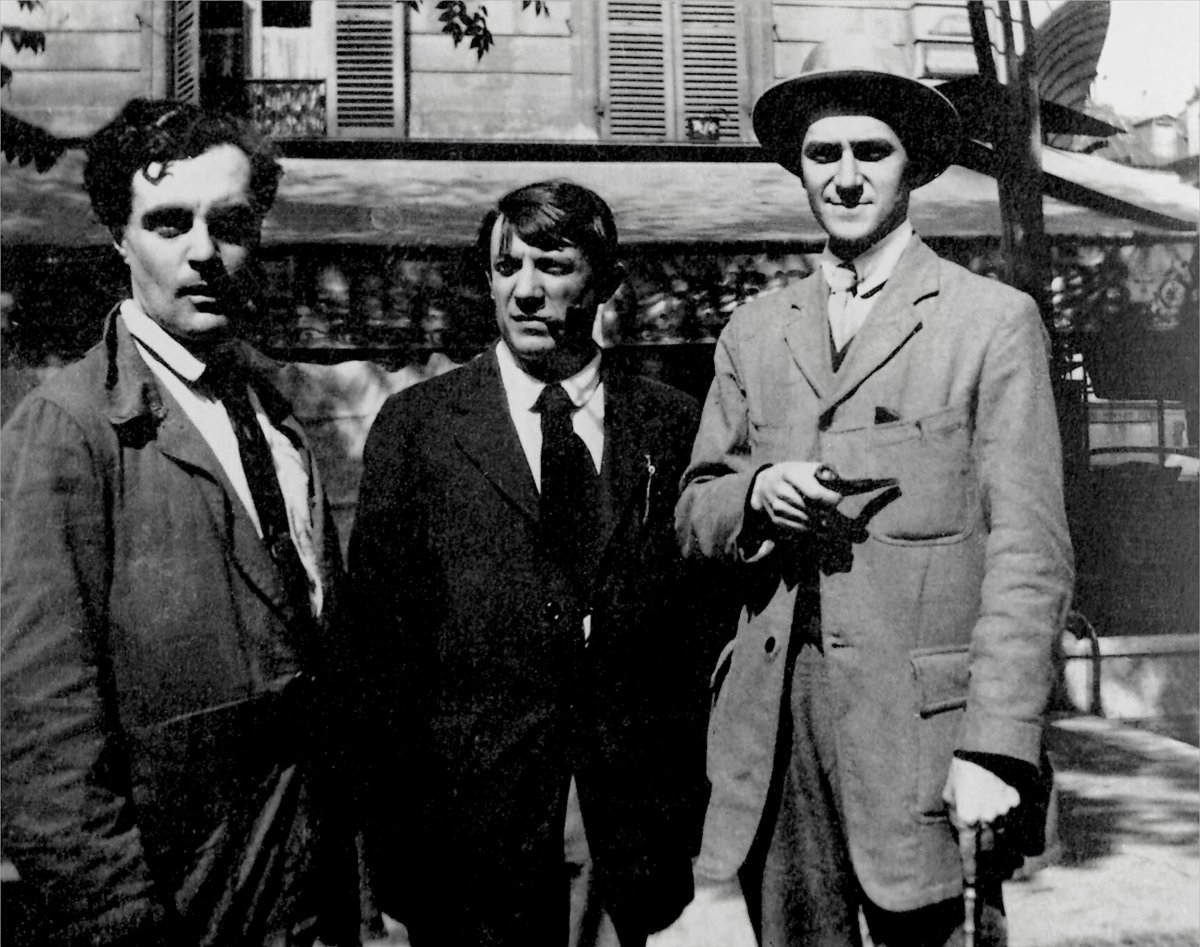
Modigliani with Picasso and Salmon
Modigliani was photographed here by Jean Cocteau in 1918 with his friends Pablo Picasso and André Salmon in front of a Montparnasse café. We can notice that at this age he had a quite rare particular feature, a salient vein on his forehead that can even be detected at a distance from a faded photograph.
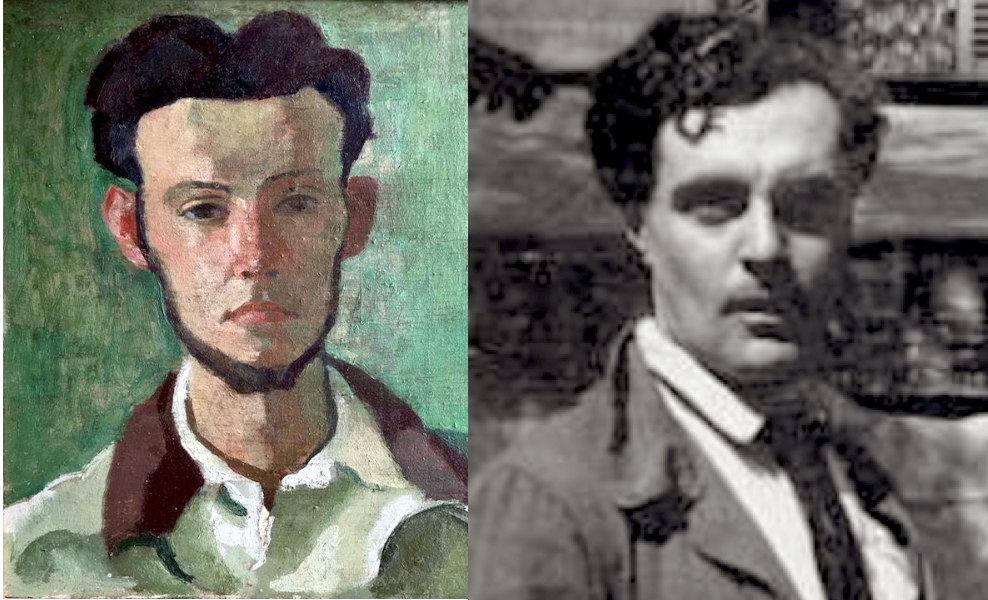
sitter identification
Photographic comparison
Modigliani was known to distort vertically his portraits similarly to his sculptures. To compare this portrait with a photograph we had to correct its artistically stretched vertical height. Side by side we can see that they have the same cranial shape, hair, facial features and proportions. Modigliani had a minor facial asymmetry with his right eye slightly higher. In our portrait it is the left eye that is a bit higher, pointing to a mirrored self-portrait. The only thing missing for a perfect match would be the presence of a small beard.
Confirmed sitter and artist identity
Comparing these images we analyzed the angular patterns on the foreheads made by irregular veins. The sitter for the painted portrait had two forehead veins, the photograph only shows one. To match the veins on each image we had to flip the photo horizontally to turn it into a mirror image. The veins match perfectly. This shows that this work was necessarily painted from a mirror reelection, and is therefore a self-portrait.
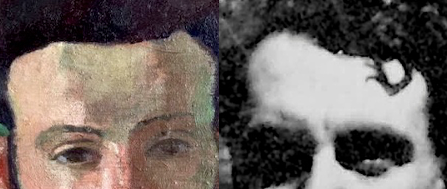
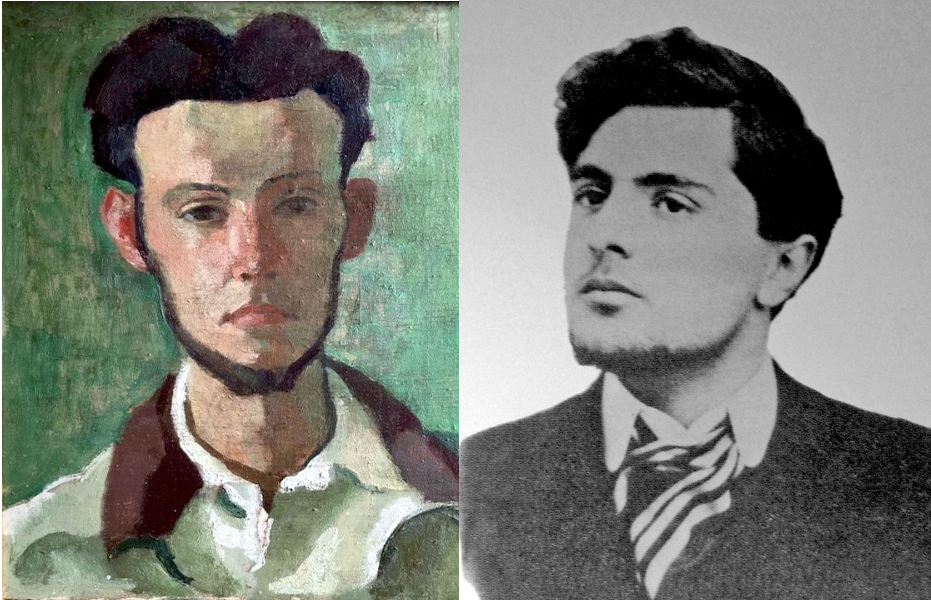
Further identification
Self-portrait confirmation
In this photograph of Amadeo Modigliani in 1905, we can see that he had a similarly thick head of hair and hairline, thin eyebrows, thick downturned pouting lips as well as the same beard as in the portrait. This grants a strong likelihood that this work is an early self-portrait by the artist. He has identical features and the very same beard, helping us to date this painting circa 1905-09.
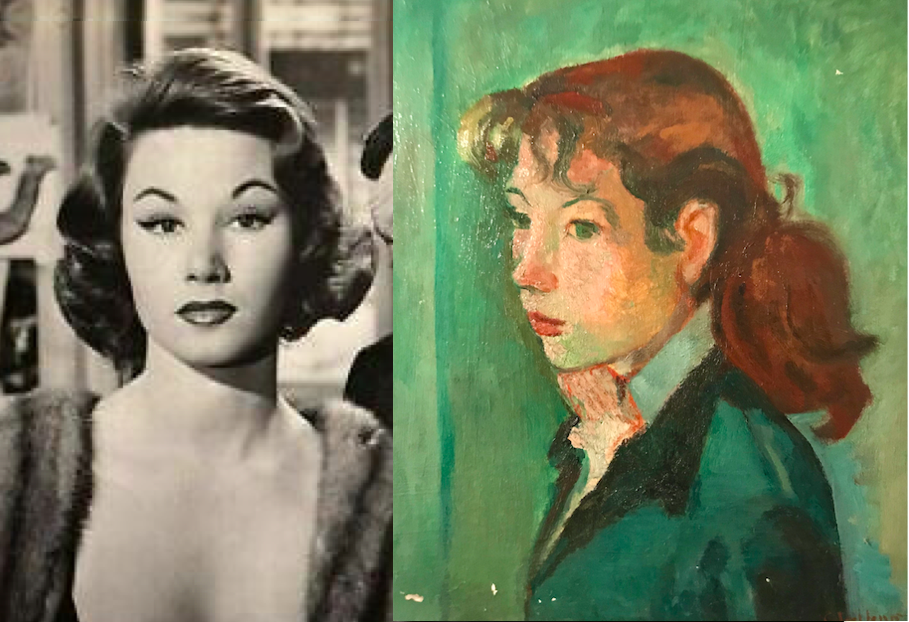
OTHER sitter identification
Portrait of Nadine Tellier de Rothschild
The portrait hiding Modigliani's self-portrait was a circa 1955 portrait by Felix Bellenot of a youthful actress Nadine Tellier. She started modeling for artists at a young age most notably for Pierre Domergue. Here we see her in a poster for the film Mam'selle Strip-Tease in which she co-stared with Brigitte Bardot.
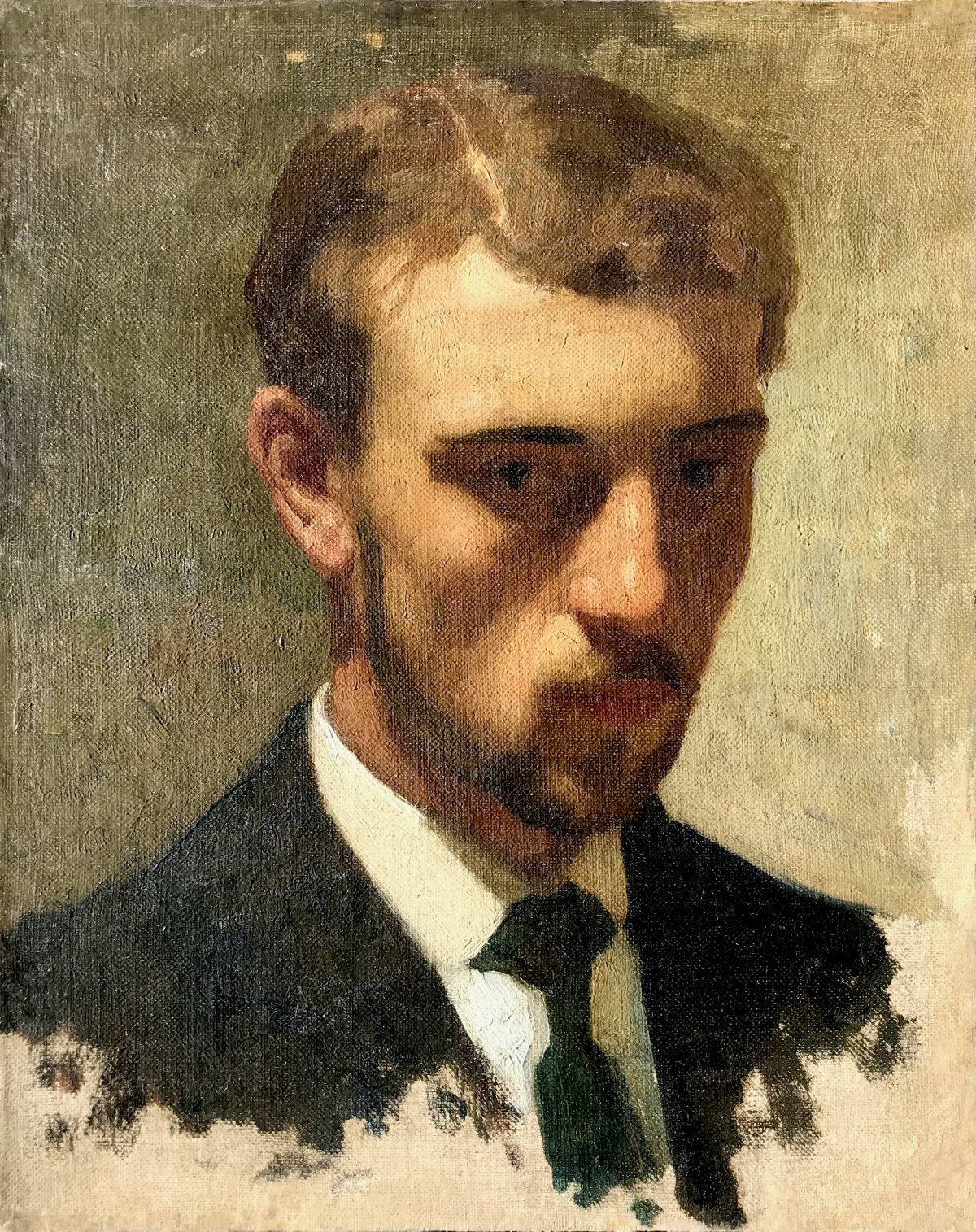
LIKELY EARLY SELF-PORTRAIT
Portrait of Paul Gauguin
This portrait was painted early on in the painting career of Paul Gauguin, circa 1870 in the days when he still worked at the Paris stock market. At that time he had befriended Camille Pissarro who from time to time dispensed advice to this beginning artist. We can see him dressed in his work clothes, and this might be indeed a self-portrait, this possibly remains until its author is fully identified.
The intensity of his eyes make it quite possible that this is an early self-portrait by the artist before he developed his unique highly colored and contrasted Fauvist style. He painted in muted colors before going to Pont-Aven and meeting painter Emile Bernard whose influence was key to his later vivid artistry.
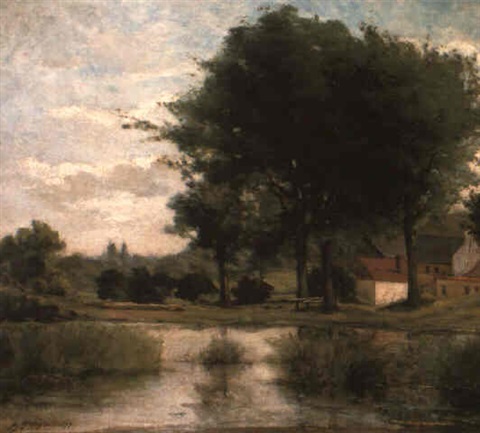
Gauguin's early palette
We can see in this landscape painted by Gauguin in 1877 that his palette and painting style was fairly academic and far different from the works his name is usually associated with. It is nonetheless a known work by the artist. This points to the likelihood that our painting is indeed most likely a self-portrait painted before the modernist influence of Emile Bernard.
SItter identifiCATION
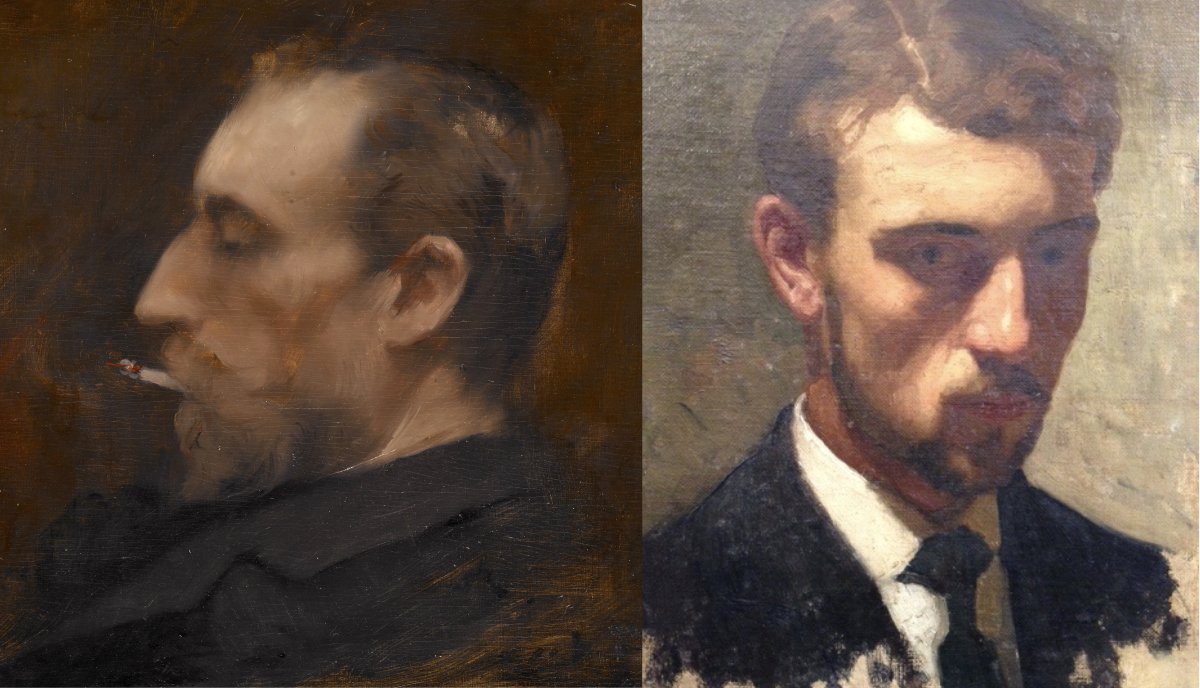
Portrait comparison
When we compare our painting to a portrait of Paul Gauguin painted by Carolus-Duran in 1872 we notice a number of things. First of all his features are very much the same, down to the shaping of his ear cartilage which is different in every individual much like finger prints. We see the same cheek bones and hollowed face, identical thin horizontal eyebrows, similar hair, mustache and beard. We will notice the puffed out mouth and prominent nose, even if in profile it seems thinner. In the 1872 portrait he seems a bit more gaunt and a touch older, confirming our tentative dating of our portrait to circa 1870.
SItter identification
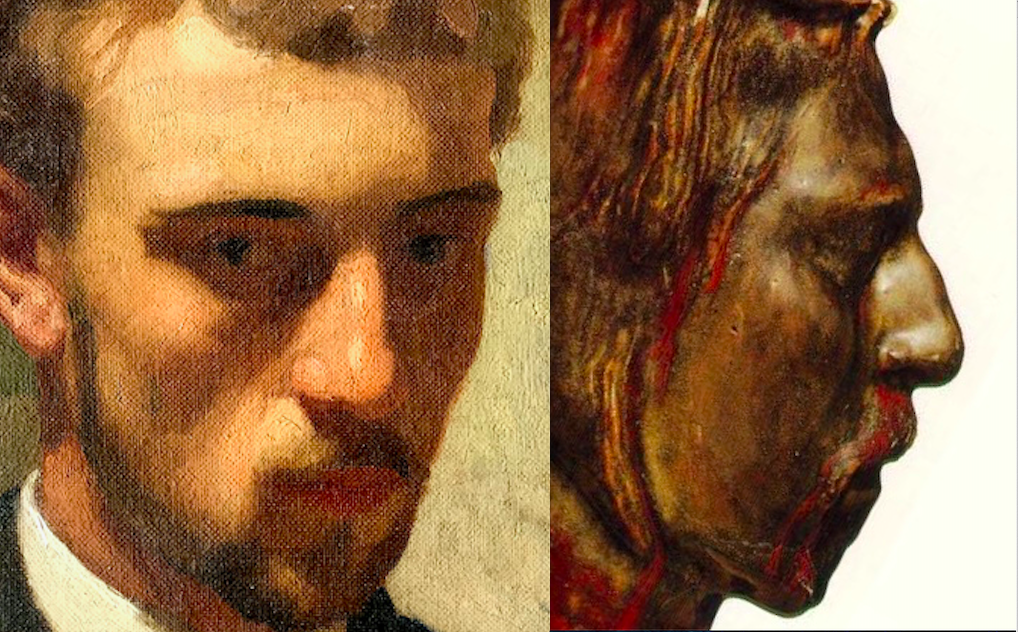
Sculpted portrait comparison
Paul Gauguin dabbled in ceramics and in 1889 he made a pitcher out of clay sculpted with his self-portrait. We can confirm the same nose and nostrils, sloping short forehead, deep set eyes, receding chin and even the way he holds his head. Such a similar portrayal of himself in sculpture lends a further argument to the likelihood that he earlier portrayed himself much the same way in our painting.
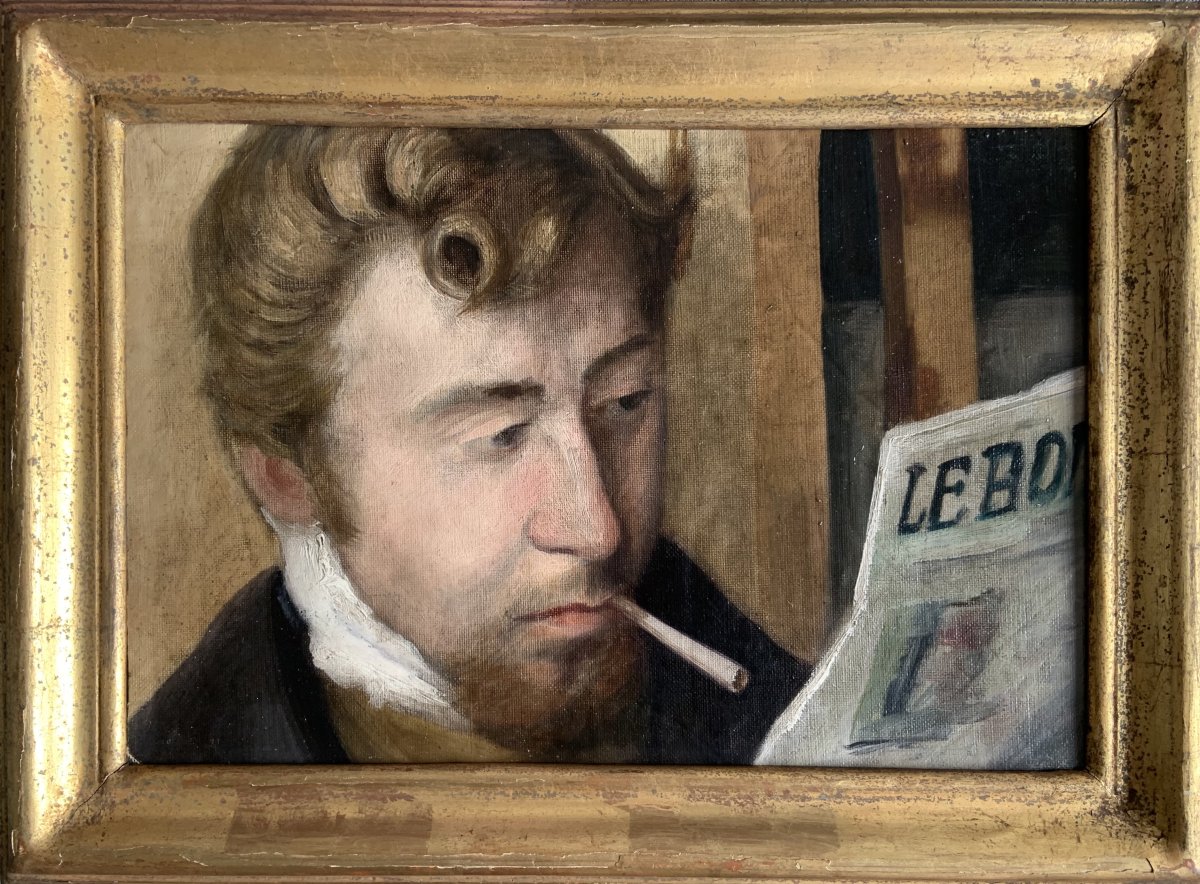
Second portrait of Gauguin
Paul Gauguin reading
This newly acquired painting shows a slightly less young Paul Gauguin after his return to France from Denmark, reading the weekly publication Le Bon Journal launched on April 26th 1885. A better dating of this portrait will be achieved from a search at the French Bibliothèque Nationale to recognize the cover page of the edition in the painting.
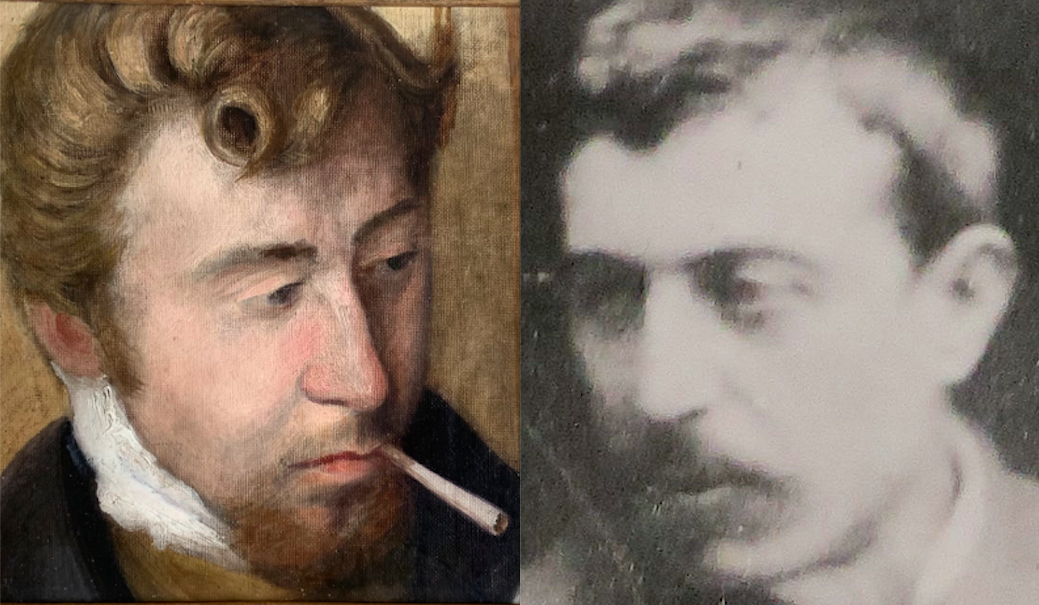
Gauguin circa 1885
We can see that he now sports a small beard and his hair is longer than in a photograph taken in Denmark in 1885, right before he left for France. This an important time of transition with Gauguin launched into a new career as a painter and leaving impressionism to become influenced by Emile Bernard.
portrait Comparison
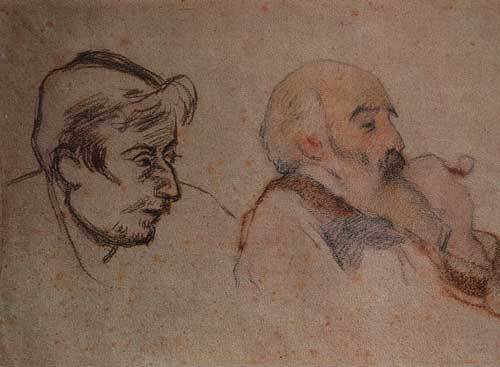
Gauguin with Pissaro
Ours is possibly a portrait painted by his friend and teacher Camille Pissarro. Previously an amateur, in 1885 Gauguin requested Pissaro's assistance in his quest to earn a living as a full-time painter. We will note that in this sketched portrait of Gauguin by Pissarro, his broken nose is more visible than in the photograph above or in our portrait, where it is viewed from a more forgiving angle. If Pissarro painted our portrait of Gauguin it would have been between mid 1885 and mid 1886, before Gauguin left for Pont Aven. Pissarro broke off relations with him in 1886, partly due to Gauguin promoting an untalented friend Emile Schuffenecker for the 8th Impressionist salon, and partly due to Gauguin's disdain for Seurat's pointillism.
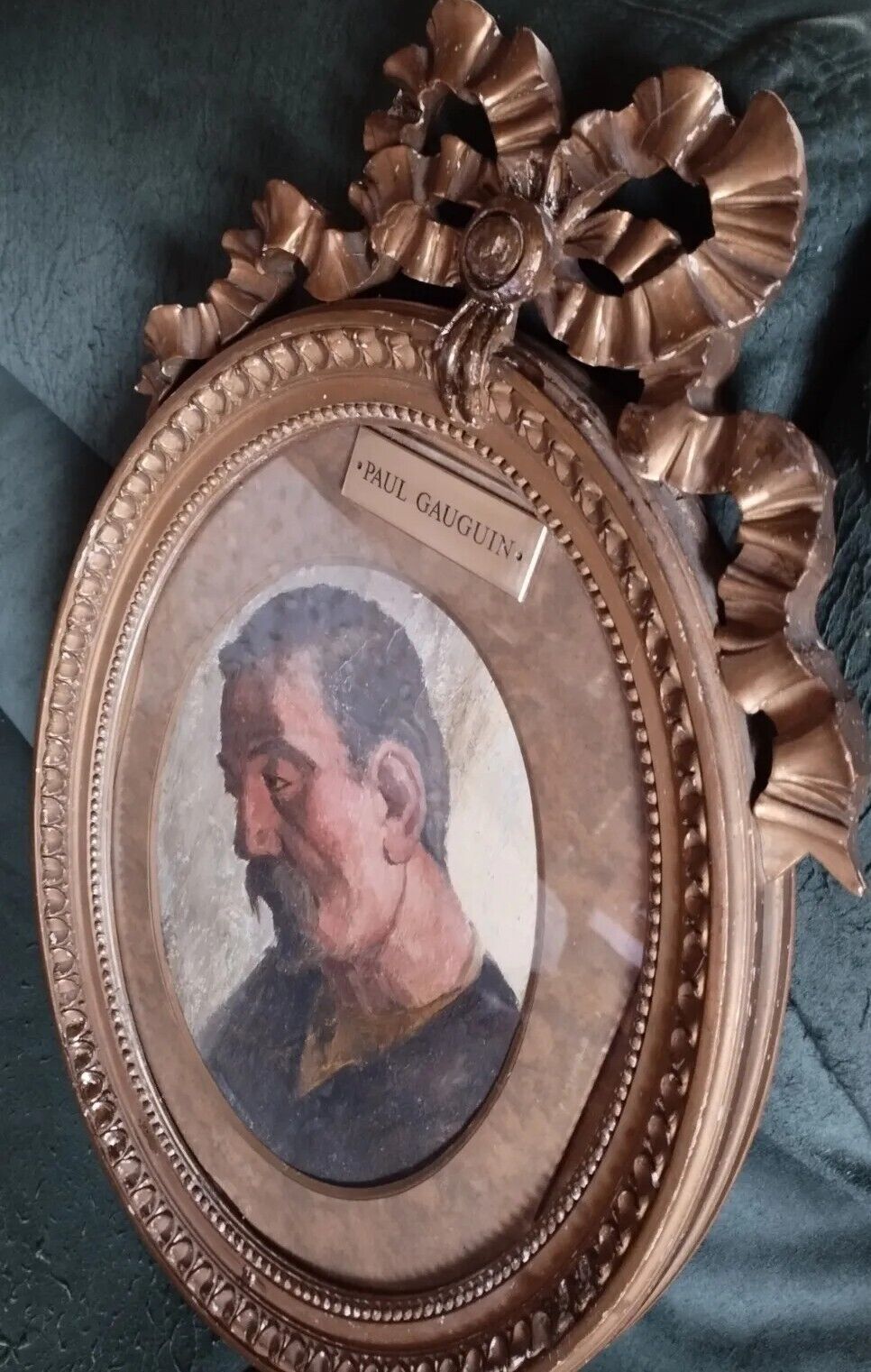
OVAL Oil on CardboaRd
Portrait of Paul Gauguin
This small oval oil painting is a circa 1895 portrait of Paul Gauguin most likely painted during one of his visits to Paris from Tahiti between 1893 and 1995. He was already an established fauvist selling his works through the art dealer xx.
Gauguin's artistic friendships
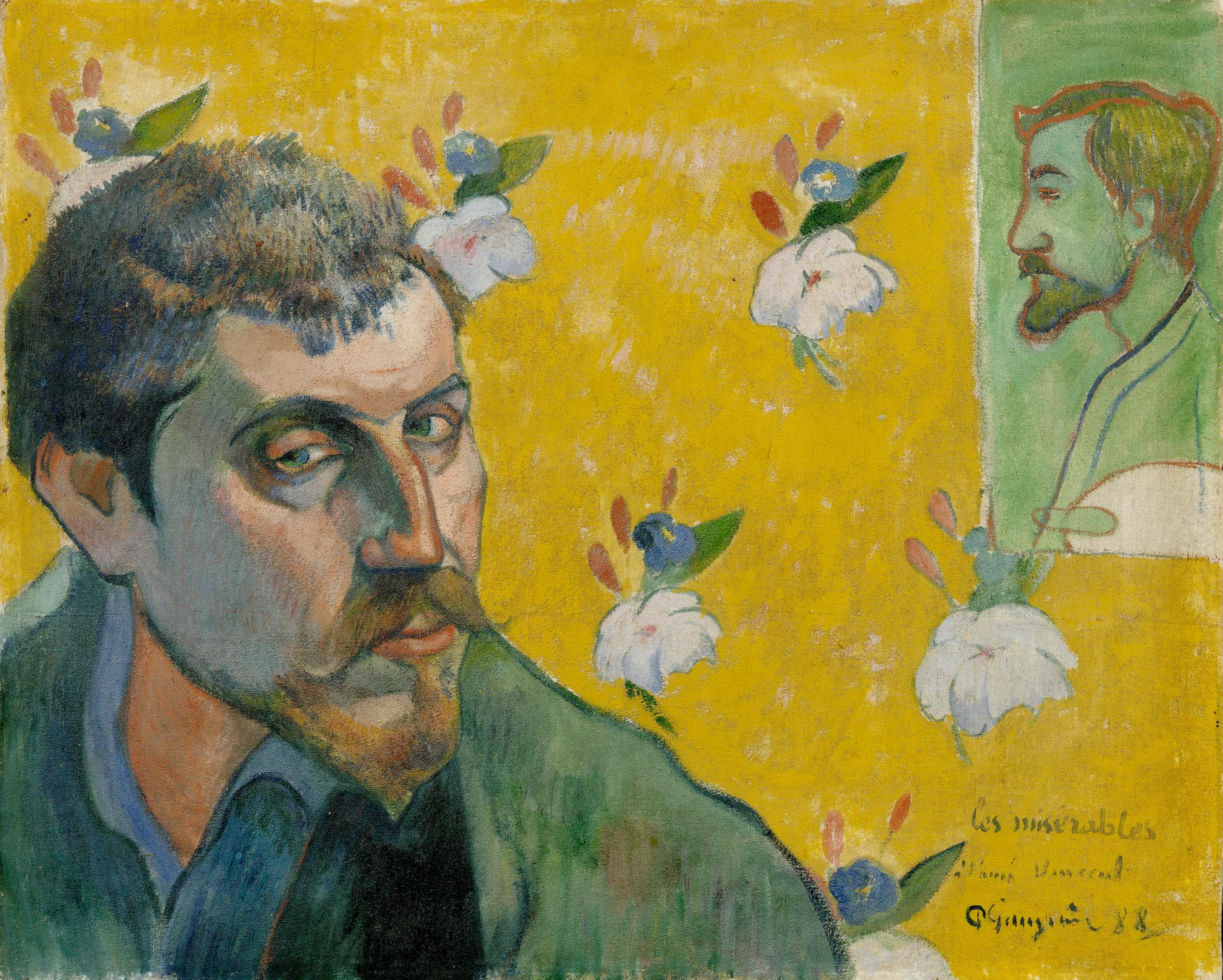
Three artists were very close friends. Paul Gauguin and Emile Bernard both sent their common friend Vincent Van Gogh their own self-portrait with a portrait of their third friend in the background. Here you can see the self-portrait Gauguin sent Van Gogh showing his portrait of Emile Bernard on the wall.
Emile Bernard's self-portrait
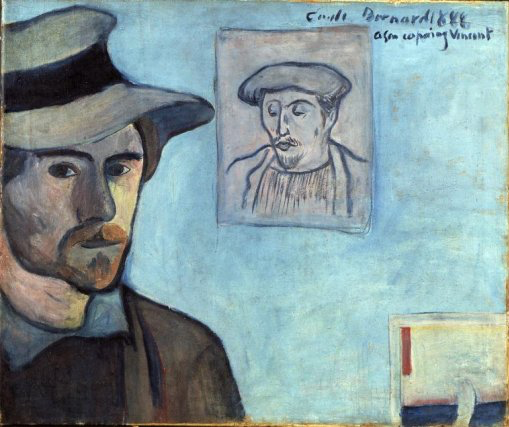
At the same time Emile Bernard wrote Vincent Van Gogh enclosing his own self-portrait with a portrait of Paul Gauguin on the wall behind him. This is what made it quite remarkable when we discovered by coincidence a portrait of Emile Bernard within an hour after acquiring the portrait of Paul Gauguin.
Likely SELF-PORTRAIT
Portrait of Emile Bernard
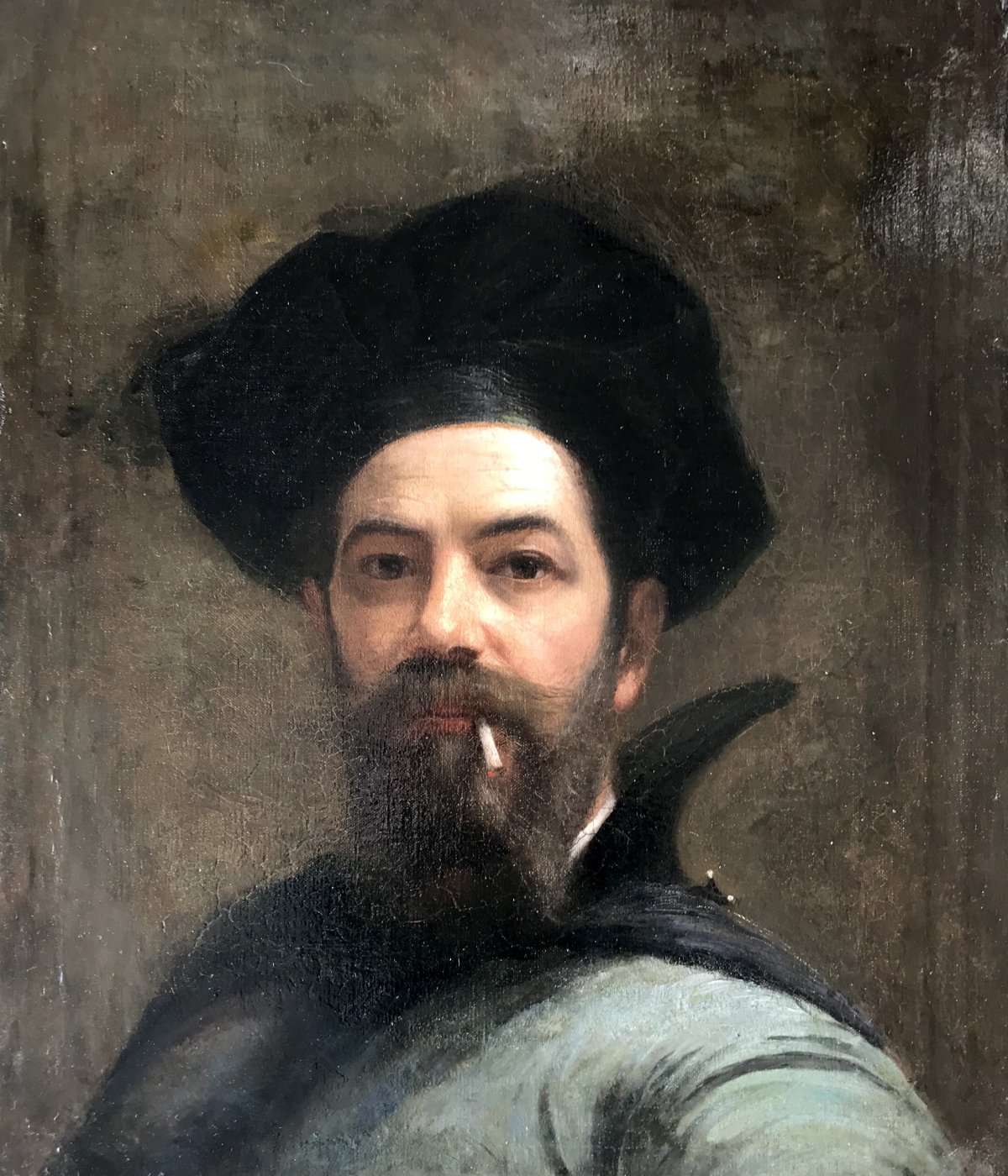
This portrait of Emile Bernard was painted later in the career of the artist, when he had given up his earlier precursor style and reverted to the academic painting of Realism.In this portrait he depicts himself dressed up like Rembrandt in the clothing of a 17th century flemish painter, but smoking a cigarette in a humorous note of anachronism showing he does not take himself seriously. His return to academic painting was prompted at least in part to the betrayal of his best friend Paul Gauguin who took credit for the innovations that were largely to be credited to the founder of the School of Pont Aven, Emile Bernard. They broke off relations, and later the same would happen between Van Gogh and Gauguin, recent research point even to the possibility to Gauguin cutting off his ear with one of the fencing swords he never left without
.
sitter identification
Photographic comparison
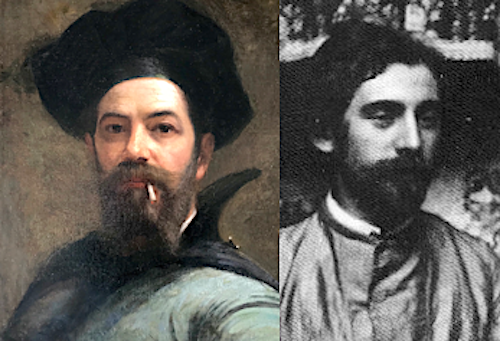
We can check the features and proportions of Emile Bernard in this portrait by comparing them to a photograph of Emile Bernard taken with his sister in his workshop. This shows him to have roughly the same age and a similar beard and facial features as in our painting. All one needs to do is add a hat and cigarette to visualize him in this pose. Also Emile Bernard was right handed and would have thus placed his cigarette on the right side of his mouth, making logical that this portrait was painted from his reflection in a mirror.
.
Emile Bernard's Realism
We can compare the work in our painting with Emile Bernard's portrait of Docteur Gachet painted circa 1930. In that much later work he achieved mastery in the style of Realism, making it easy to consider that our painting could indeed be a self-portrait.
Likely SELF-PORTRAIT
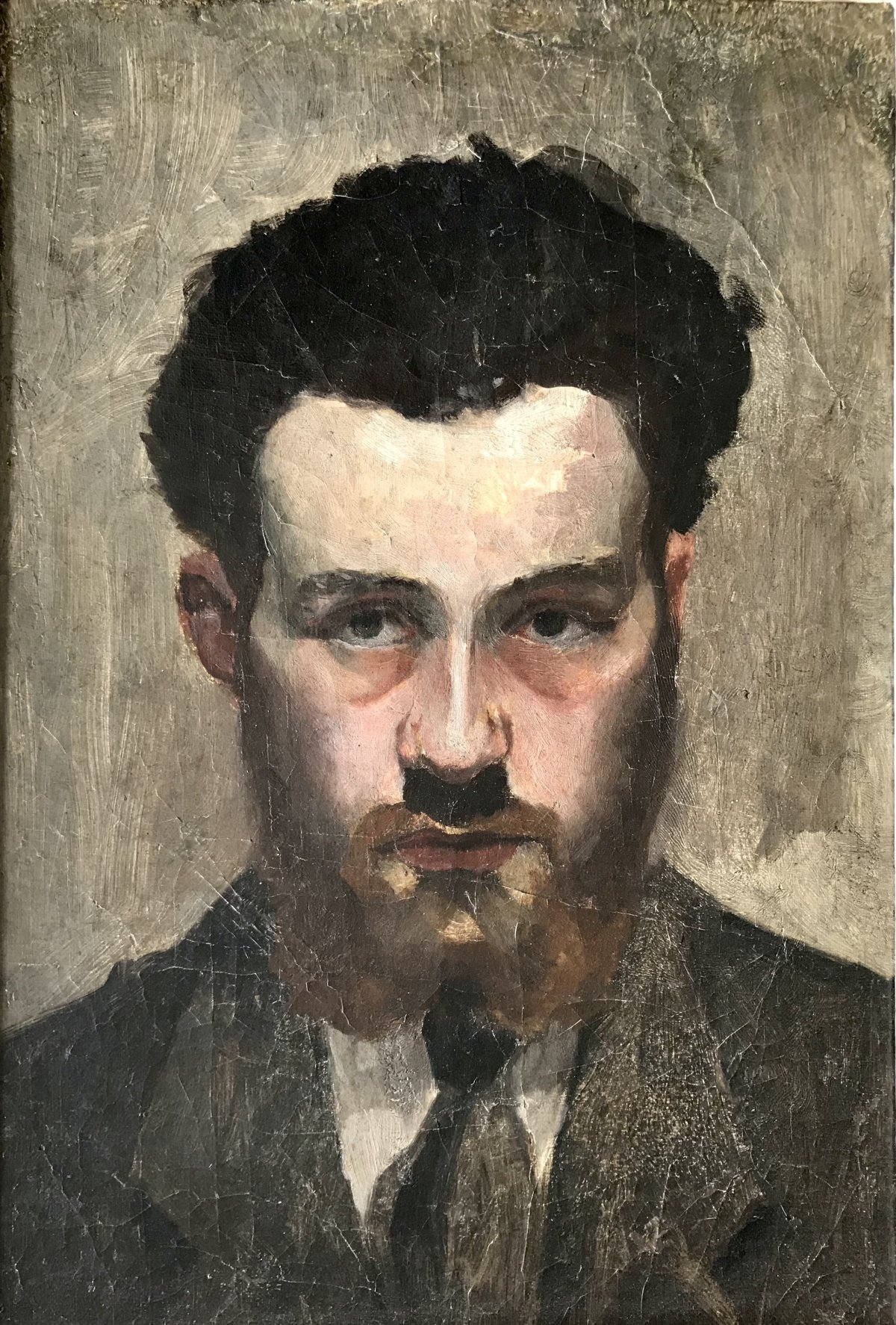
Portrait of Georges Seurat
We are happy to present a rare portrait of French painter Georges Seurat who founded the School of Pointillism. He is painted in strokes, and not in small dots. However it is nonetheless possible that this could be a self-portrait given his grave expression and lost gaze which would unlikely when looking in the eyes of a friend and fellow artist. He was known to experiment with contrasts and colors, and we will note the monochrome environment in which only the face is painted with color. This could be an experimental work with Seurat applying new concepts in the use of color. That would lend it historical and museographic importance as an extremely early combinations of black and white and color that have since become more commonplace.
sitter identification
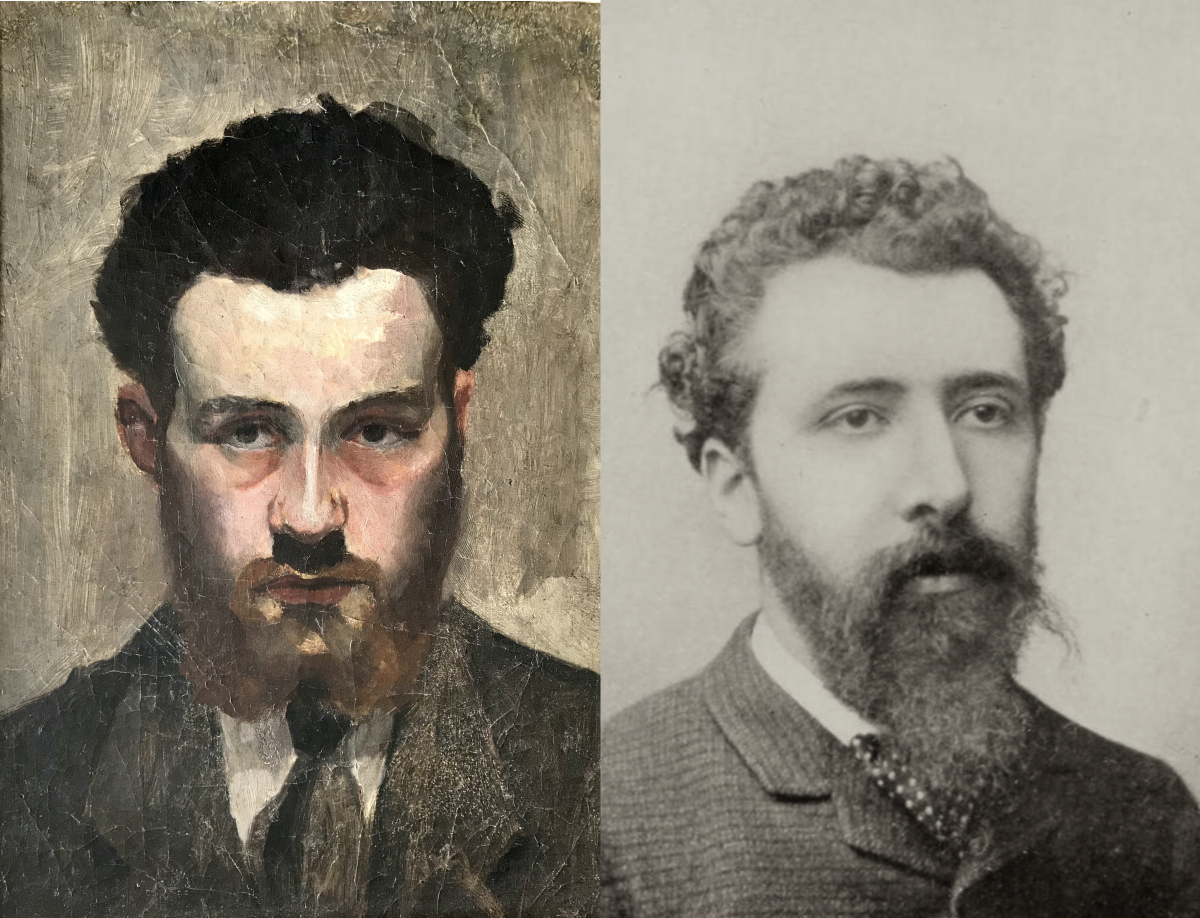
Photographic comparison
When comparing the portrait to a photograph of Georges Seurat from approximately the same period we can find a number of similarities and differences. His hairline, ears, nose, eyebrows and cranial proportions are fairly identical. However in the painting his beard is squared off and covering his cheeks, his jacket is less formal. He is also posing looking downwards, making his nose look bulbous and his hair seem fuller. In the photographic pose he looks ahead proudly whereas in the painted pose he tilts his head down, expressing a sadness reinforced by darkly circled eyes. This makes the painting a more intimate portrayal than the photograph where he is presenting a public facade..What discrepancies we see are due to his facial asymmetry and the optical reversal of his self-portrait painted in a mirror. We can notice Seurat's right ear in the photo is very close to his head, and corresponds to the left ear in the self-portrait, painted from his reflection in a mirror.
Self-portrait of an artist
Portrait of Francis Picabia
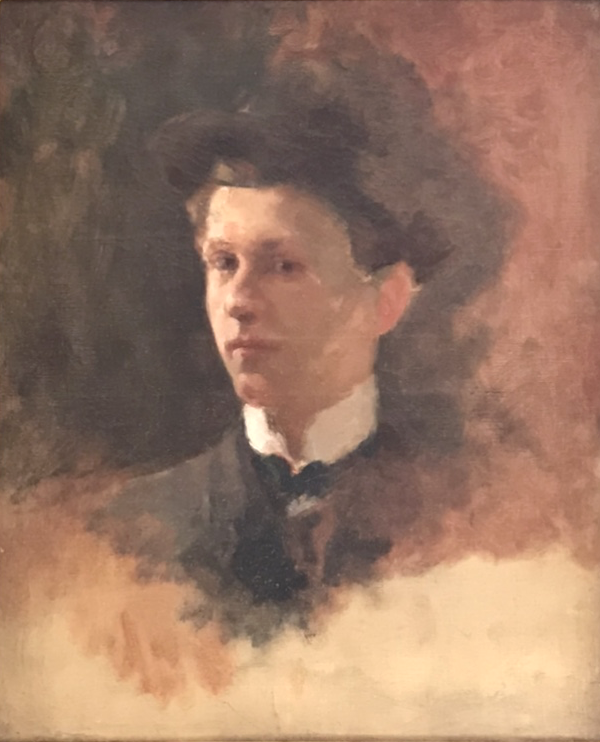
Given the artistic movement of this painting, the School of Realism, it appears that it was painted in the early years of the 20th century. This portrait has an unusual characteristic, it shows the sitter holding a flat object. This would be a square artist's pallet, as was widely used at that time. Were this a normal portrait, the sitter would be shown here holding the pallet in his right hand. Were it a mirror view, it would be held by his left hand and would thus be a self-portrait, as Picabia is known to have been right-handed. The dadaist painter generally credited with introducing modern art to the United States. This is a circa 1905 self-portrait by Francis Picabia when he was approximately 25 years old. Significantly, he chose to portray himself in an artistic style mastered in his earlier years, realism, to best represent his features and personality at the time.
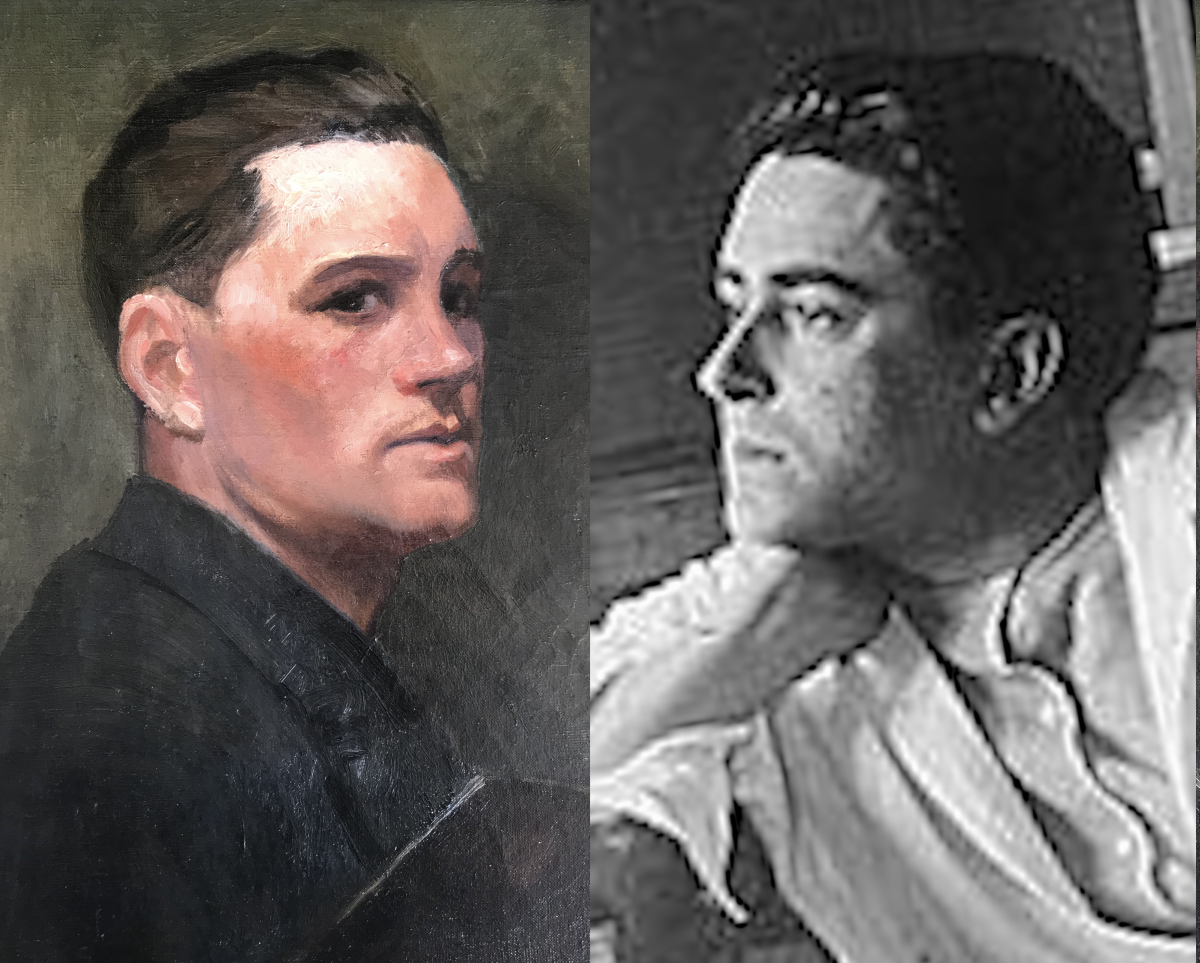
Sitter identification
Photographic comparison
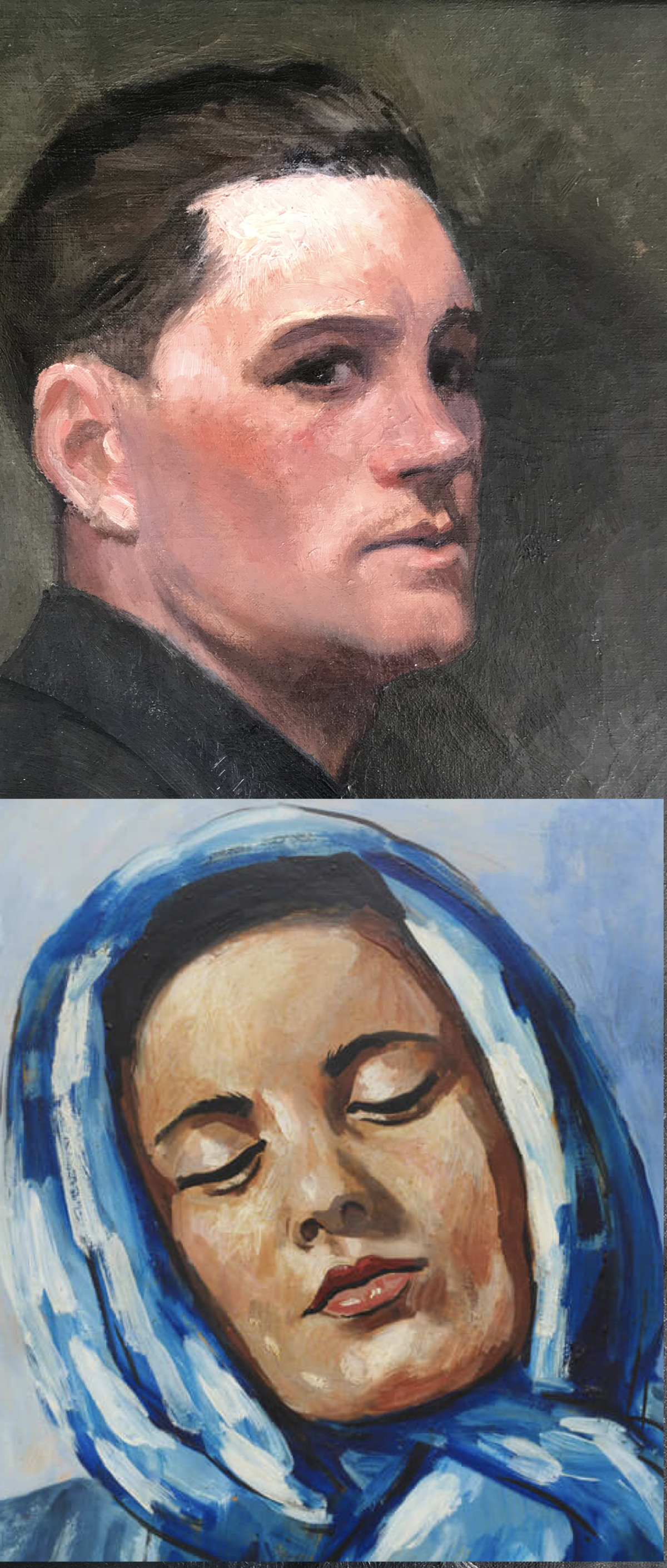
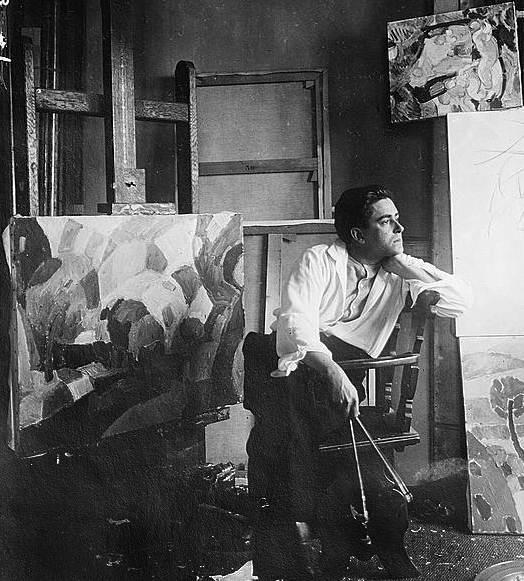
We will note that while approximately 15 years separate these two portraits, this is the same person. The forehead,eyebrows, chin, ears, hairline and nose are identical. If the painted portrait shows his nose slightly more concave this is an optical difference of a three quarter angle pose versus a full profile pose, We can therefore confirm that the sitter is also the artist of this portrait. The photograph from the published image of Picabia in his atelier, shown below, was reversed for comparison purposes.
Stylistic analysis
Our self-portrait circa 1905 shows the artist approximately at age 25. We can see that many characteristics of his Realism style were confirmed early on, and were retained with stylistic enhancement in later works such as can be seen in the circa 1940 Paysanne of which we show a detail. The same use of patches of color immediately calls for attention in comparing the two. Other details are quite similar such as the way he paints the eyebrows and eyelashes, distinctive noses with bright highlights, sharply outlined upper lips and sculptural jaws.
Francis Picabia: an enigmatic artist
Best known for his pivotal role in the revolutionary Dada movement, early on he already enjoyed considerable success in the sale of his works. He explored many movements and styles such as impressionism and pointillism, fauvism, surrealism and cubism. Known for introducing mechanism, realism was a recurring style in his work at various times. This photograph taken in his workshop was published in the New York Tribune in 1913. It shows him slightly older, as seen by hollows under his eyes. Instinctively he holds his paint brushes in his right hand as he gazes out the window.
a Norwegian in Paris
Portrait of Edvard Munch
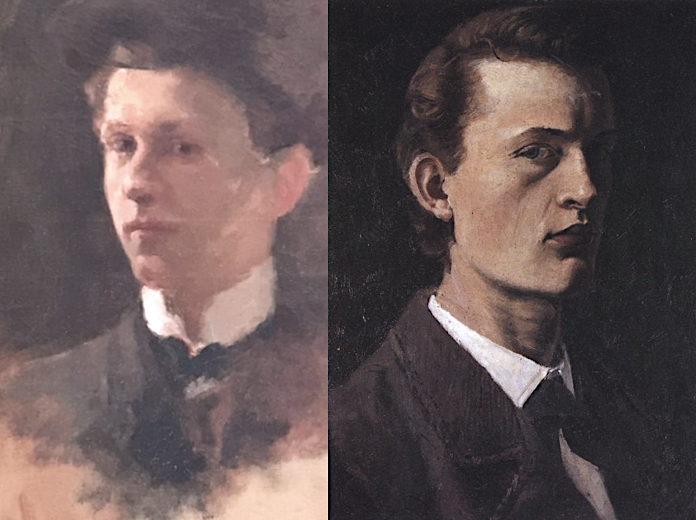
This is a very early portrait of Edvard Munch circa 1885. Given the relative symmetry of his face it isn't easy to rapidly determine if this painting is a portrait of him by another artist, or a self-portrait stylized by Munch under the early influence of Impressionism. This self-portrait discovered in Paris may have been gifted to a friend as a memento during his first visit to the city.
sitter identification
Two early portraits
The second portrait to the right is dated 1882. We denote a similar choice of color palette and an identical pose to the well known portrait of a slightly younger Munch. Although turned to the opposite side they are both lit from the left side of the canvas, which was the sitter's right side. Their quasi identical gaze leads us to consider tthat our portrait is also most likely a self-portrait.
Portrait or Self-Portrait
Photographic comparison
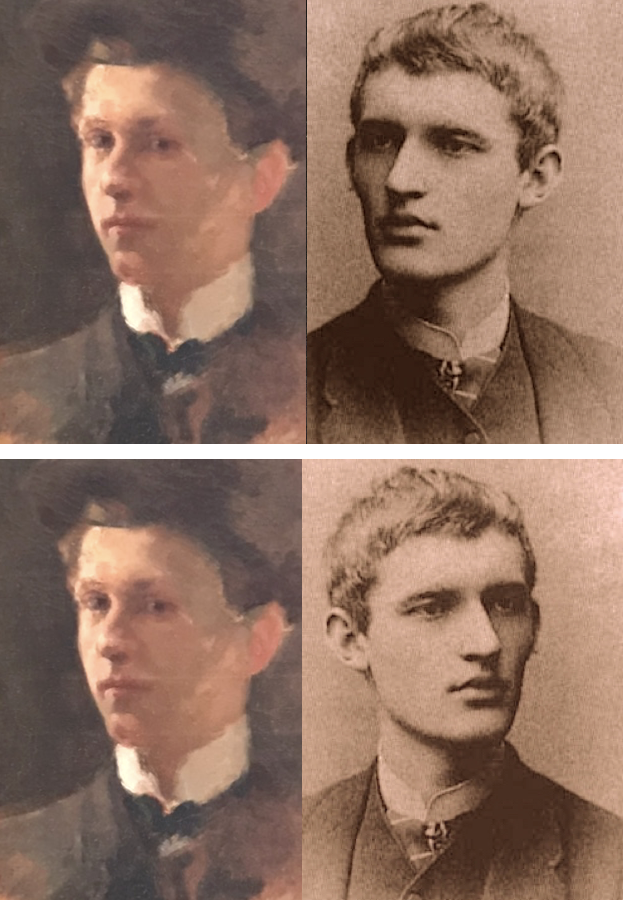
Comparing our portrait to a picture of Edvard Munch at age 17, he sports a similar clothing and straight collarless shirt and thin necktie. He could very well be wearing some of the same clothes given the approximately five years separating these images. Also, we can denote the greater likeness of the lower pair of images, where his photograph has been reversed to look like a mirrored reflection. This lends us to think that it is indeed a self-portrait as our subconscious perceptions are more fine tuned to small details than our conscious analysis. The upper pair merely looks similar without nearly as much of a dramatic likeness. In the lower pair it seems as if he has just turned his head, it is more lively.
Impressionist Self-Portrait
1885 comparison
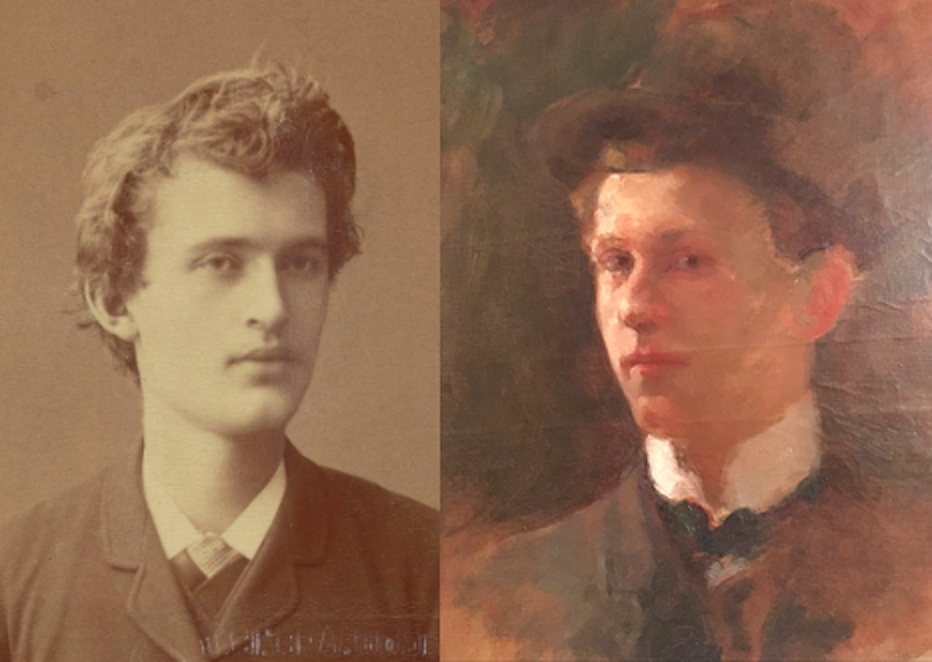
We now compare our portrait to an Identity photograph taken in 1885 for his entry at the Antwerpen International Exposition. He wears a similar jacket, his hair style is unkempt and his mood is closer to the relaxed demeanor of our portrait. It is noticeable that the painting style in soft touches was influenced by the Impressionists. Munch's artistry was stongly influenced by them during his stay in Paris in 1885. His photograph has been shown here reversed, to ensure we better note the strong resemblance.
Ecole de paris
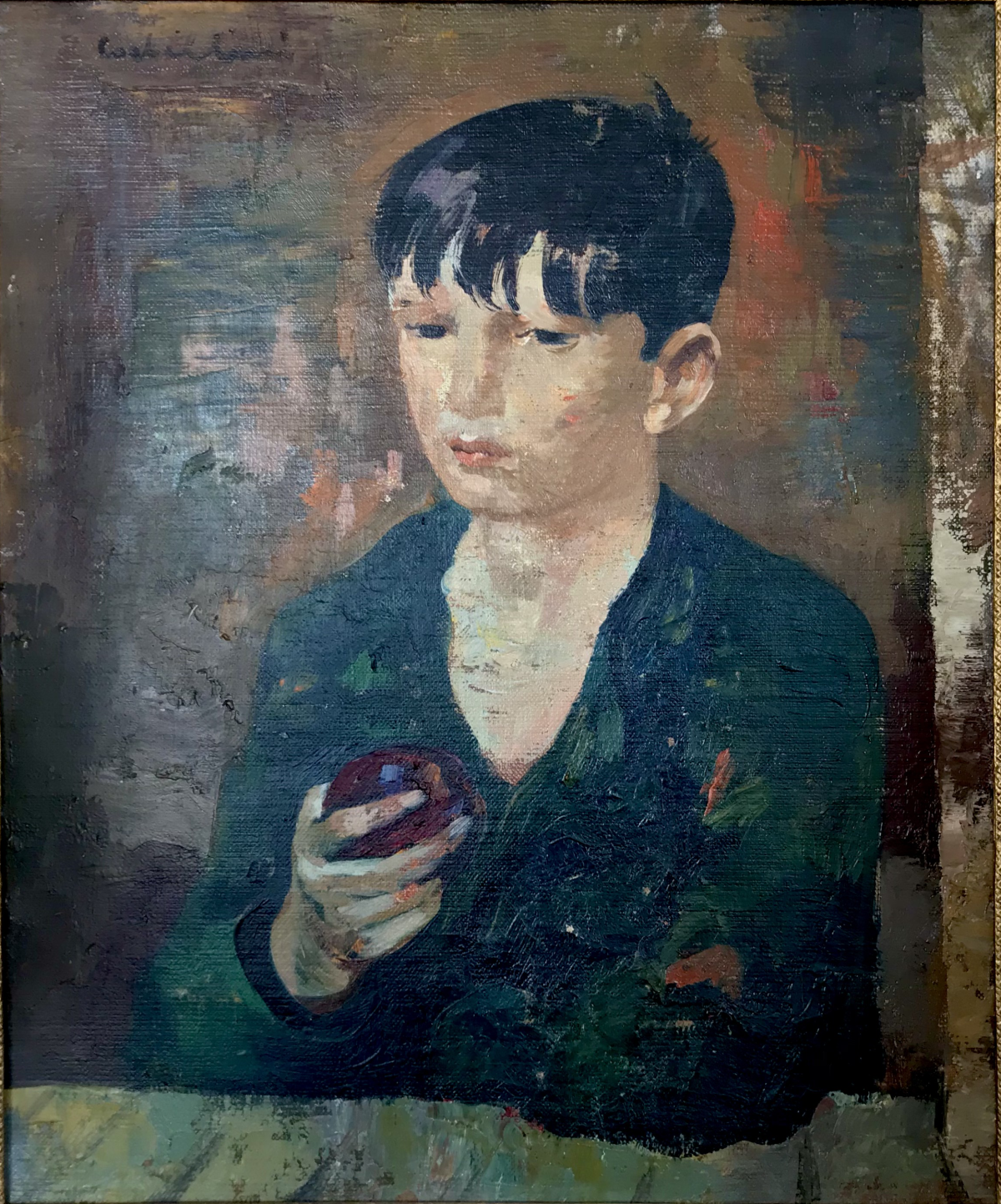
Luigi Corbellini Boy with Apple
This painting by Luigi Corbellini was signed but not dated. However, by identifying the sitter we were able to date it fairly precisely. Luigi Corbellini moved from Bruges to Paris in 1923 and in 1924 he took over Picasso's former workshop at the Bateau-Lavoir in Montmartre. When his portraiture became in vogue in 1925 he moved to Montparnasse where much of the artistic movement had migrated. We can note the stylistic expression used in painting the boy's hands echoes some of Picasso's earlier works from his Blue Period.
Pablo Picasso with son Paul
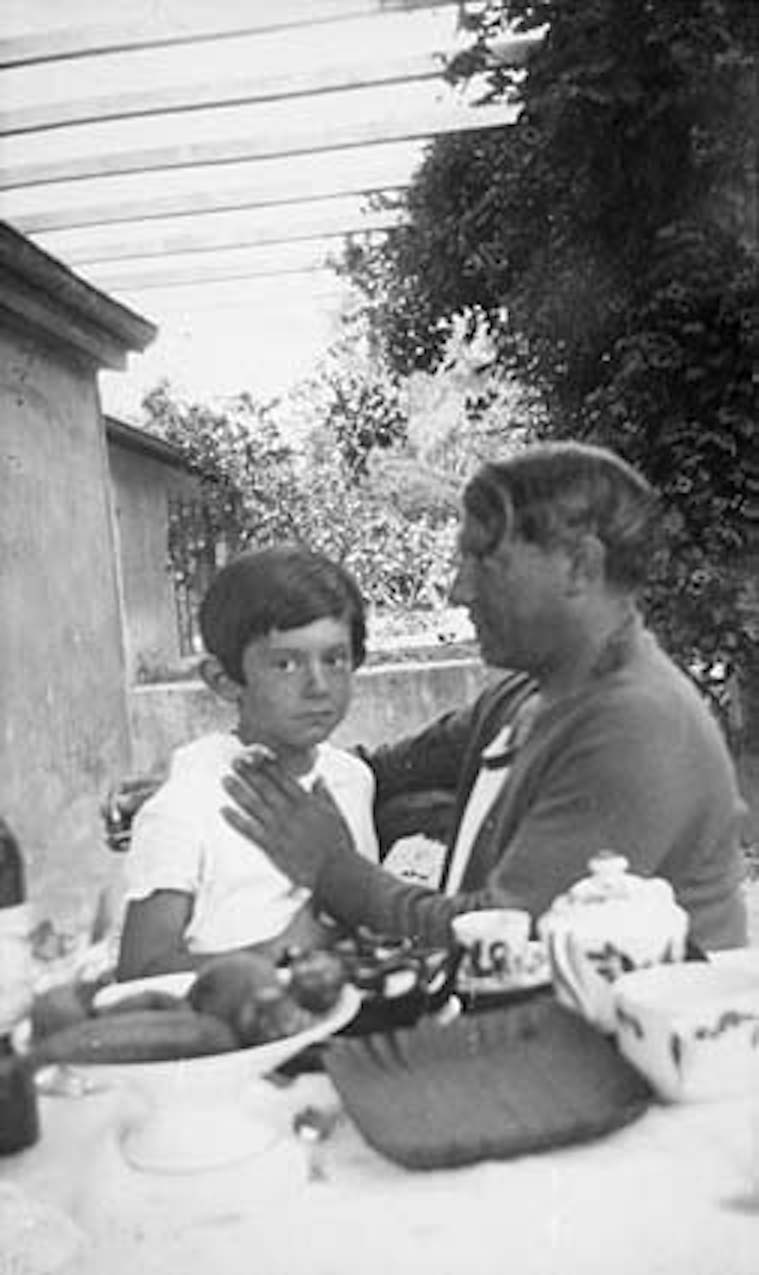
This photograph taken by Man Ray shows Picasso with his son Paul, from his first mariage with Olga Khokhlova, a dancer from the Russian Ballet. The pre-war Parisian bohème community was a tight knit milieu where most artists and writers knew one another, whether they got along or not. We can assume that the rapport between Corbellini and Picasso was friendly enough, as Picasso's son was sufficiently present with them to pose for Corbellini.
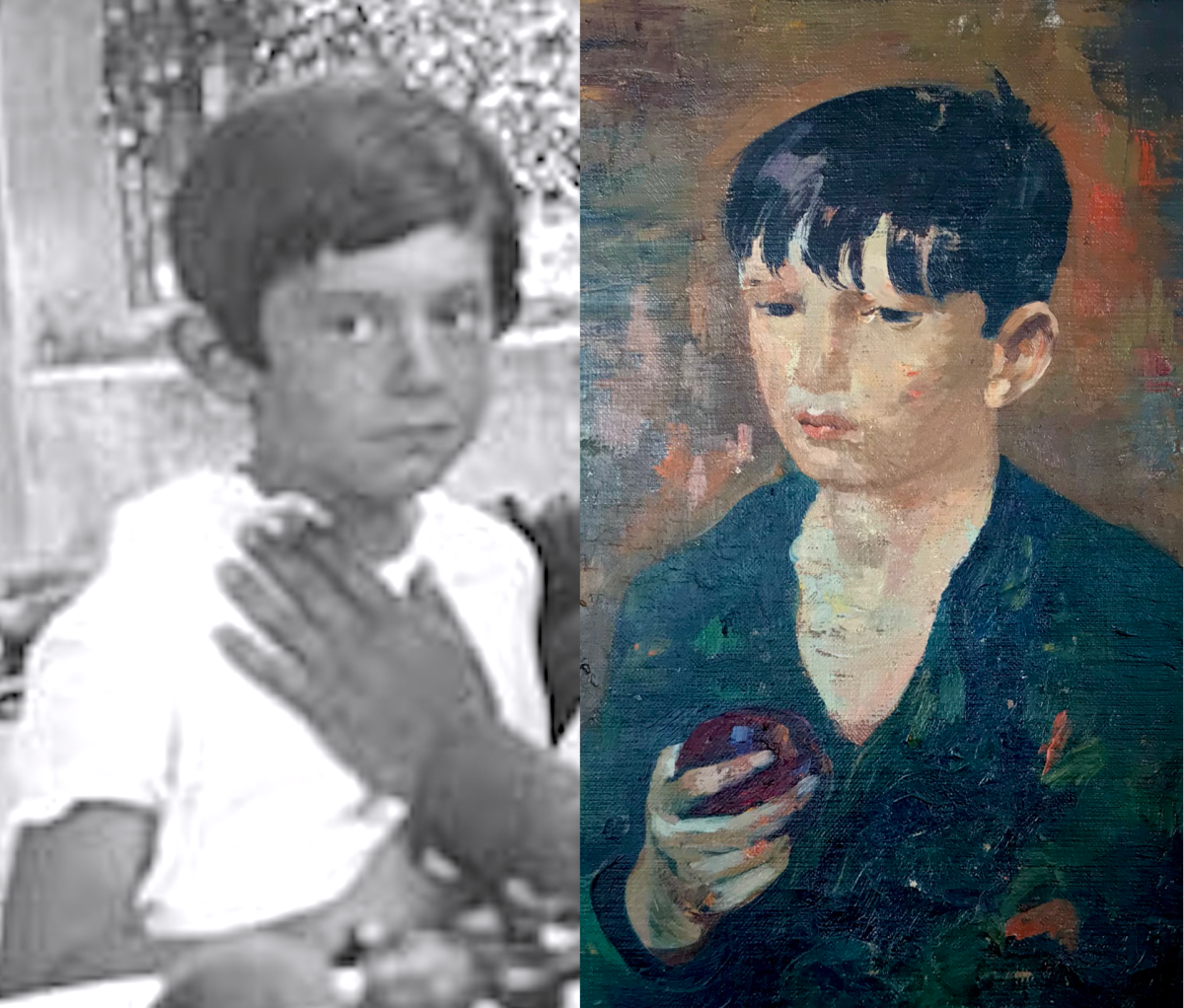
sitter identification
Portrait of Paul Picasso
Paulo Ruiz Picasso was born on February 4th 1921, making both these poses date to circa 1930. He is roughly the same age as the boy in our portrait, and we can notice that their features are quite similar. They have the same cranial shape, feature positions and proportions, an identical chin and pouting mouth, quite detached ears, a small nose and pronounced cheeks. Their hair is similar other than it being combed forward in our portrait. The poses are from opposite sides, the differences are due to artistic style.
Paul Picasso slightly older
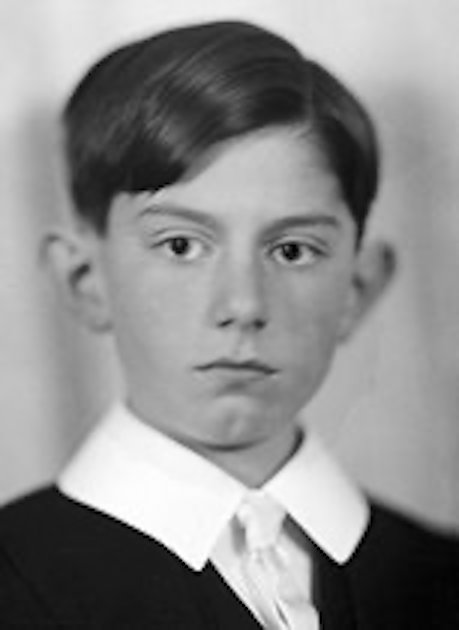
Another photograph circa 1935 shows Paul Picasso's features in better detail. Although a few years older than in our portrait, he is readily recognizable. His unique appearance could not be so perfectly matched were it another sitter. His identification grants our portrait an interesting historiographic view of how closely linked the artistic community of Montmartre and Montparnasse was in the 30s.
Surrealist portrait
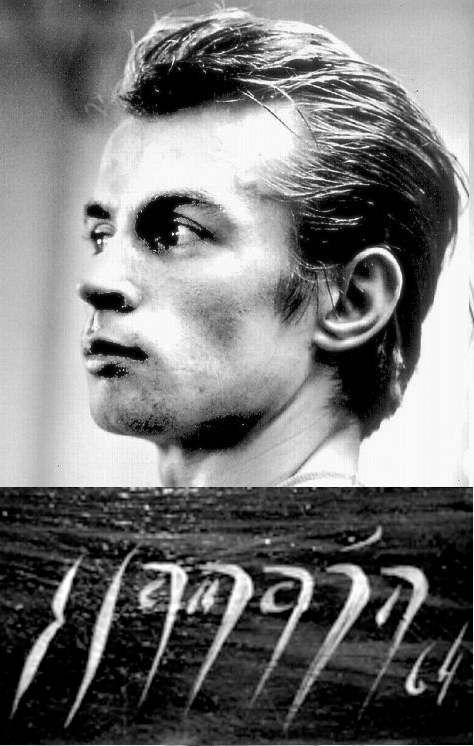
Rudolf Nureyev as Saint Peter
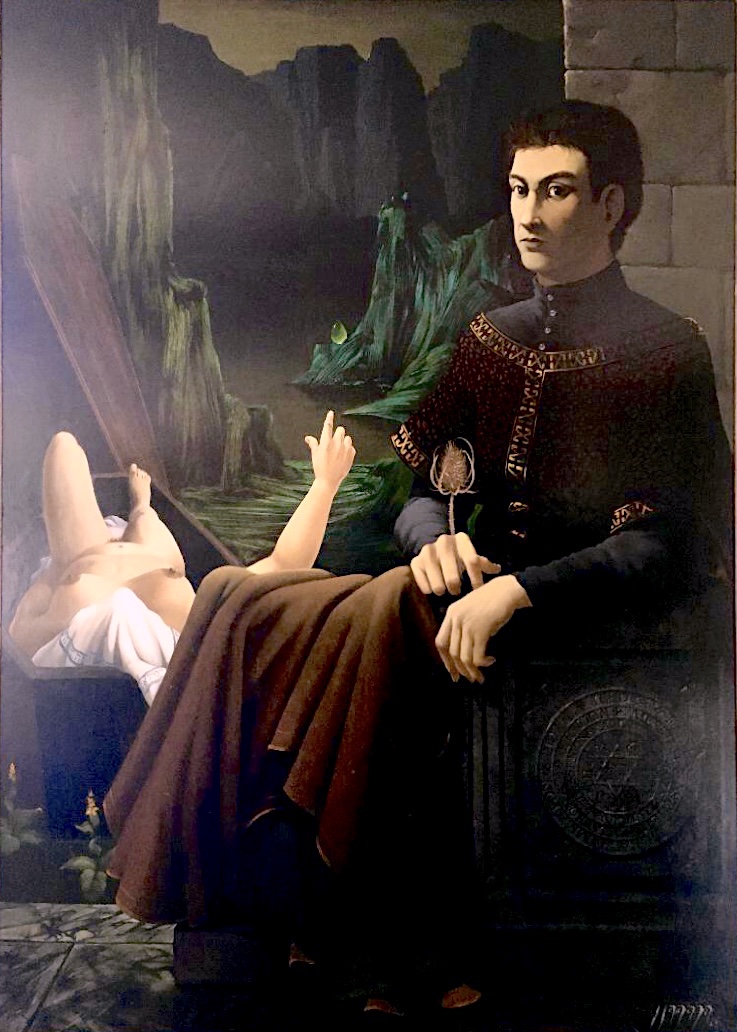
This large surrealistic painting represents Russian ballet dancer Rudolf Nureyev assuming the pose of Saint Peter guarding the gates of Heaven. We note that he is holding the husk of a flower representing eternal life. He is seated turned away from a woman laid out in a casket as she is resuscitated into the afterlife. Her face is covered by a cloth while she reaches her finger towards a drop of green life-giving essence emanating from the sky. We can only speculate whether she symbolizes Nureyev's Mother Russia that he had recently left behind, maybe with 'Heaven' before him to the West? This work was painted two years after he boldly evaded his KGB keepers in Paris becoming the first celebrity defector from the Soviet Union. This painting illustrates the sitter's exceptional destiny and historical relevance to the Cold War.
Sitter Identification
It is relatively easy to identify the sitter as Rudolf Nureyev as he had rather unusual facial features. A well-known means of morphological identification is the shape and size of ear cartilage. We note here that they are identical, as are the bone structure, eyebrows, forehead, nose, mouth and chin. This work was signed and dated 1964. The signature appears to be in Hebrew and we can note that Nureyev visited Israel in 1963. It may be a work by Romanian-born Israeli fantastic realist painter Baruch Elron. This attribution remains to be confirmed.
artist's study
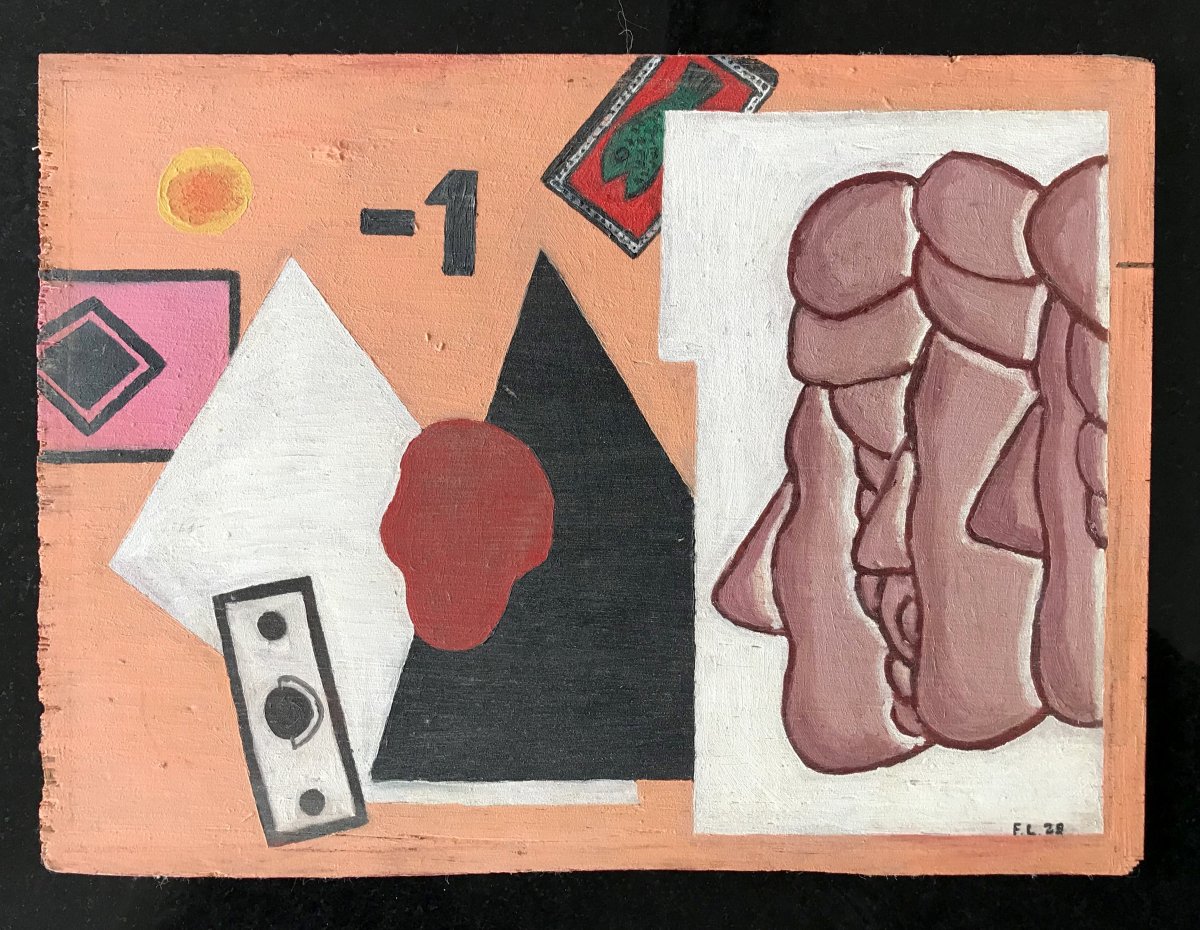
Fernand Léger's abstract Symbolism
This painted wood panel was relatively easy to identify from its artistic style and its period. If this weren't enough, it carries the inscription F.L.28 attributable to French modern artist Fernand Léger in 1928. It is a conceptual workshop trial, called an "essai" in French, and was probably not meant to be a finished piece that he would have exposed or sold.
SItter identification
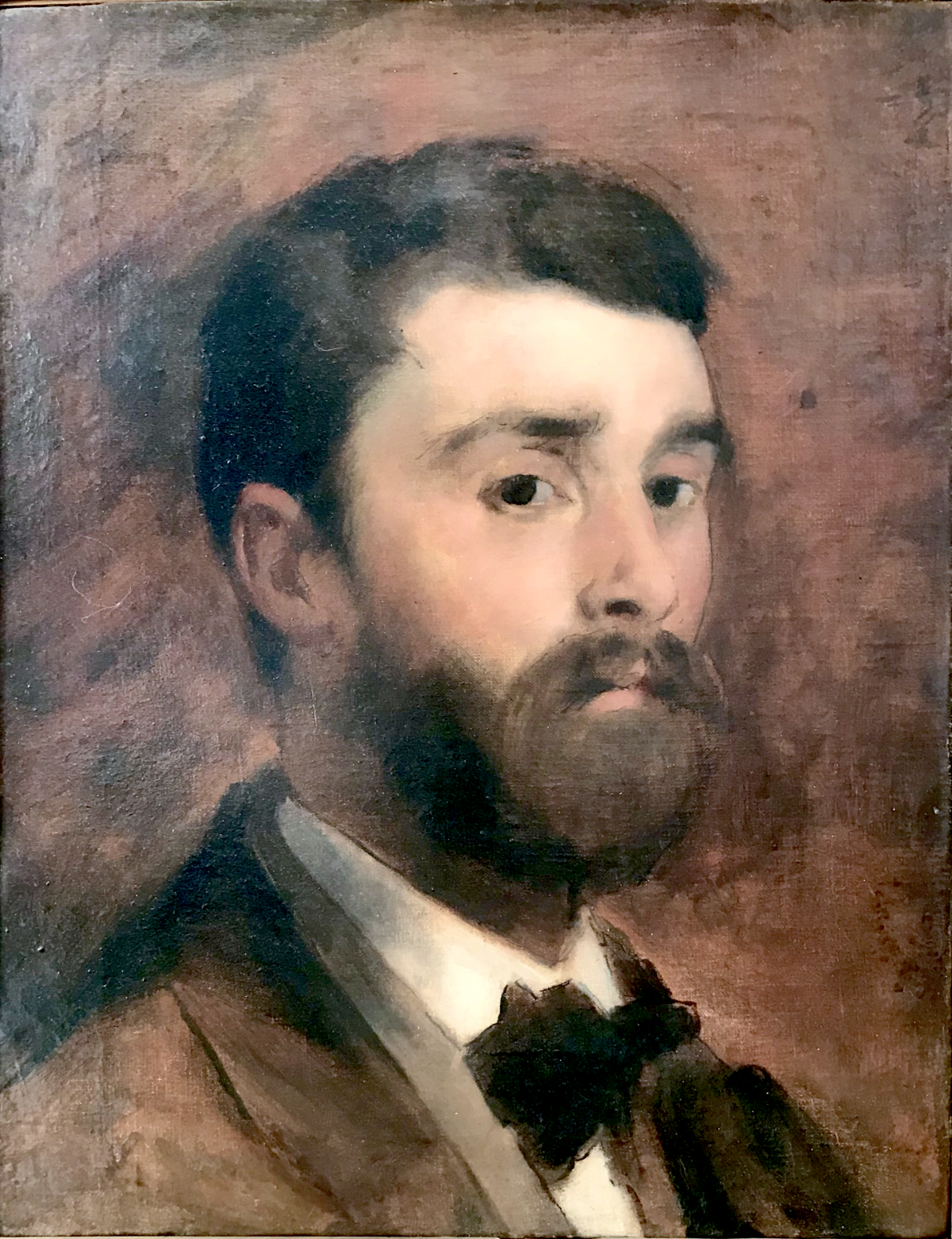
Edgar Degas portrait of Paul Helleu
This oil on canvas is a sepia and brown portrait that was crisply drawn before being painted. The rapid style and sure hand of the artist is characteristic of Edgar Degas. His friend, fellow artist Paul César Helleu, is the sitter at the approximate age of 25 circa 1886. In the usual formal style of Degas we see his features rendered precisely and Helleu's face expresses his gentle nature.
.
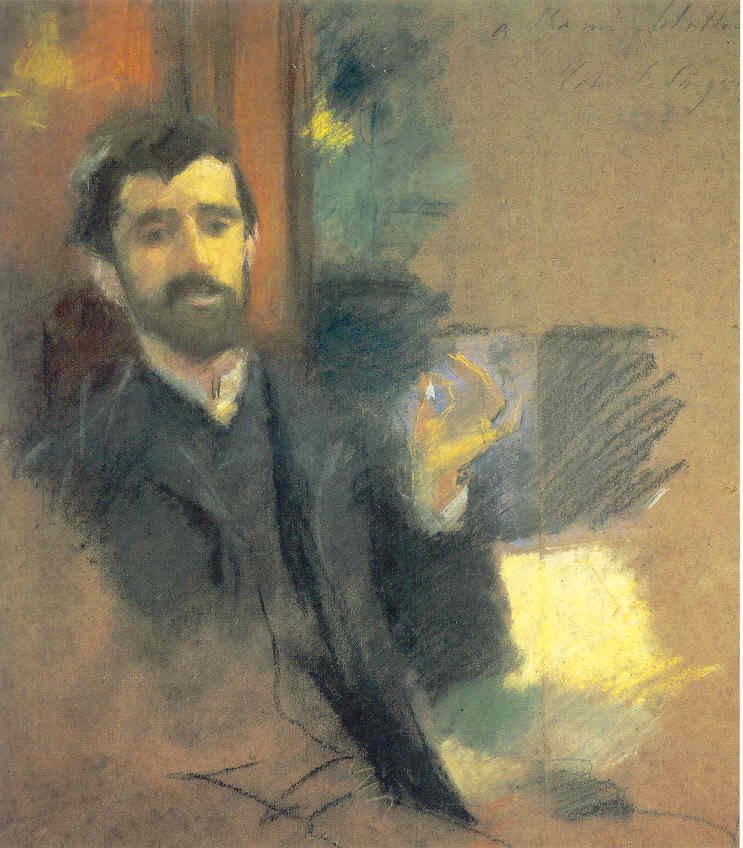
Helleu and the Impressionists
We can see here that at approximately the same time period as our portrait above, John Singer Sargent quickly sketched Helleu smoking a cigarette, he is quite recognizable. It was in 1886 that despite Degas' insistence, Helleu joined Claude Monet in refusing to exhibit their works at the eighth Salon des Impressionnistes.
Sitter identifiCAtion
Edouard Manet portrait of Alphonse Daudet
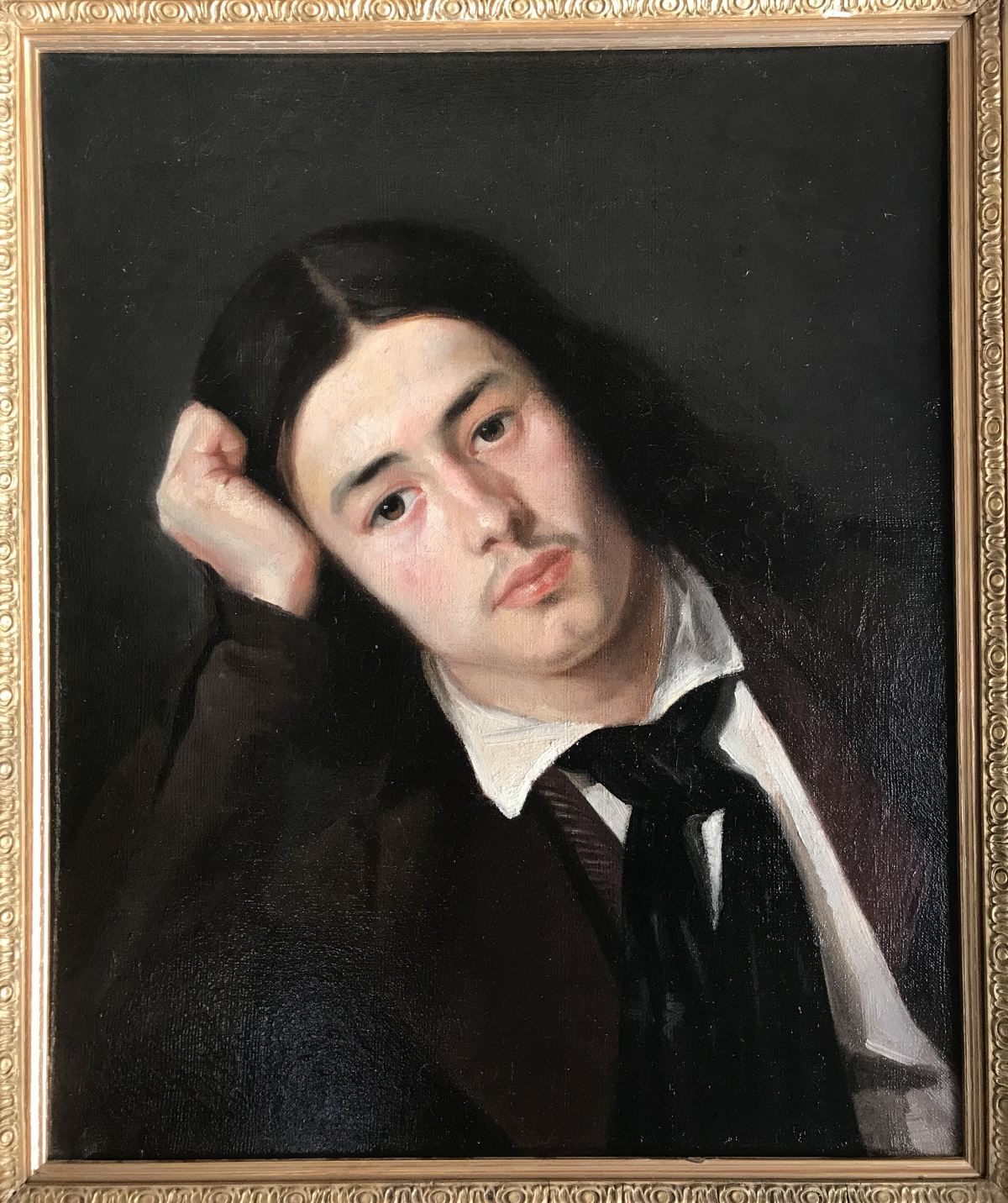
This painting similar both in technique and in expression to Edouard Manet's uncharacteristic and short-lived Velasquez period. Once this work was stylistically identified as to its author, it was then possible to identify the sitter as Manet often met up artists and writers in the the Paris salon's and at Café Guerbois, Grande rue des Batignolles or at Nouvelle Athènes, Place Saint Georges.. There he came across an upcoming poet Alphonse Daudet who lived in the same neighborhood. Daudet was rue d'Amsterdam, a few blocks from Manet's residence rue de Saint Petersbourg. Daudet's long hair, lack of beard, and romantic pose date this portrait to circa 1858 when his famous collection of poems titled Les Amoureuses was published.
Alphonse Daudet photographed by Nadar
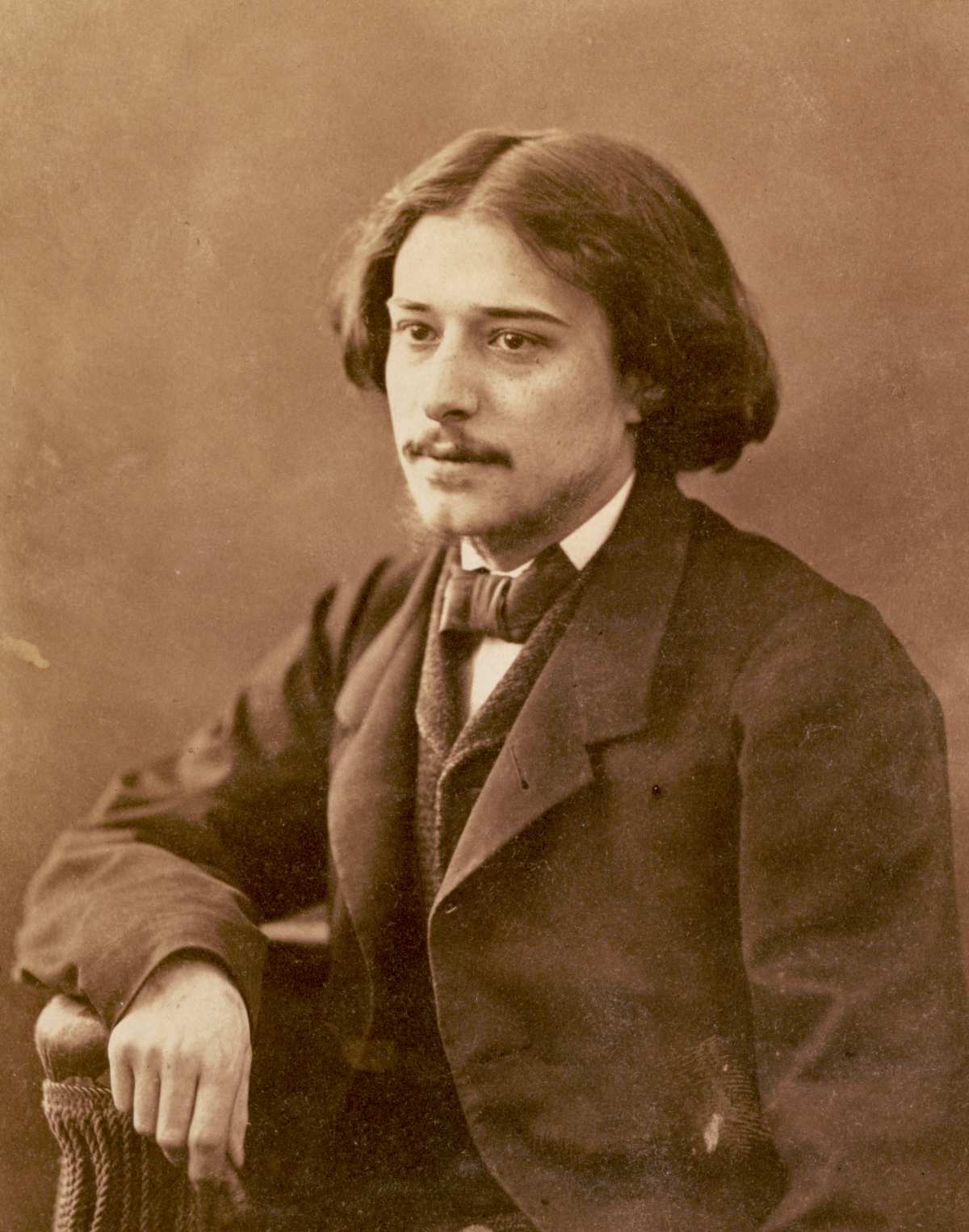
This photograph shows Alphonse Daudet circa 1860 with a fuller mustache and the beginning of a beard. His hair is parted slightly to the left, his high cheekbones and dimpled chin are recognizable, and his silk necktie is similar to the one in the painted portrait. He also wears a similar shirt, vest and jacket.
AUTHOR & SITTER IDENTIFIED
Eugène Delacroix portrait of Hector Berlioz
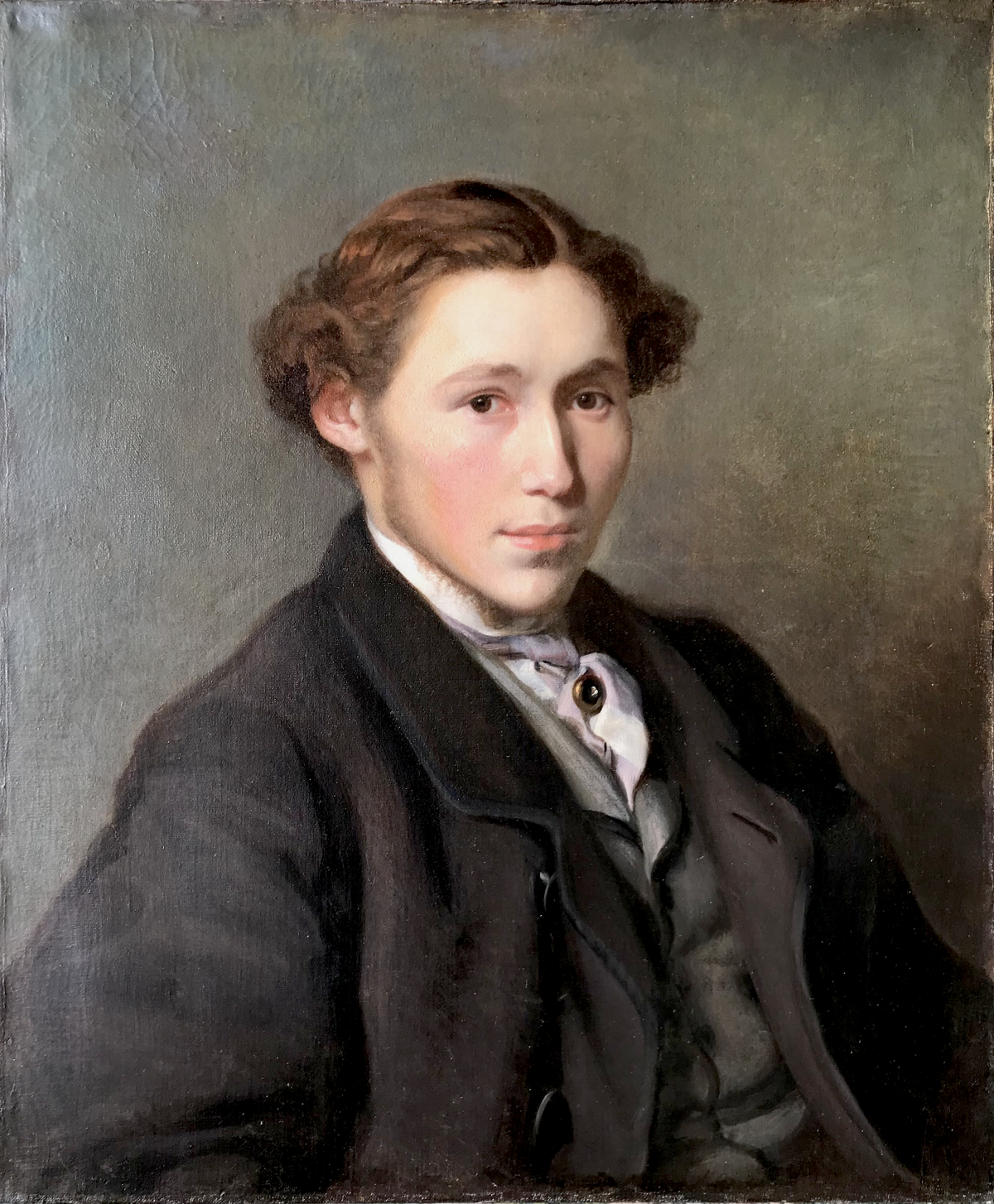
The three most distinguished artists of the Romantic period were Victor Hugo for literature, Eugène Delacroix for painting and Hector Berlioz for music. This painting shows a young redhead in bourgeois attire, Hector Berlioz, who was approximately 24 years old when portrayed circa 1828. His youthfulness combined with the self-satisfied demeanor make it most likely that it was painted upon the achievement of his very first concert, conducted by his friend Nathan Bloc in May 1828. Despite being a financial fiasco, this won him undisputed honor with laudations from the performers, the musicians in the audience as well his teachers. Let it be noted that our painting is one of the earliest known portraits of Berlioz, most others dating to later troubled times when personal tragedies had marked his features.
Delacroix's painting style
We can see that while the composition of our portrait gives homage to Ingres by its triangular composition, it is also an early precursor to certain Impressionists, such as Edouard Manet. When compared to Delacroix's 1828 portrait of Auguste-Richard de la Hautière, we see the same unusual, purposely imprecise painting of the ears to call attention to the face. The hair is similarly rendered and we can notice identical treatment of the facial contours, rosy cheeks, softened collars and agitated clothing. It can be noted that much like in Delacroix's Liberté guidant le peuple, here the clothes also speak to us in their cadenced rhythm of folds. Given that during this period he was a very close friend of Berlioz, this adds to the likelihood that this portrait is indeed by Delacroix.
SITTER IDENTIFICATION
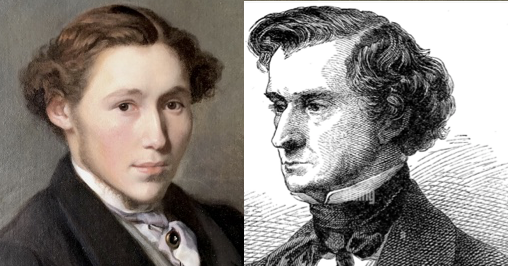
Idealized portrait of Berlioz
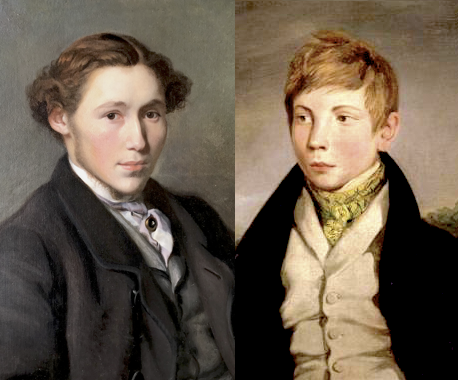
We can see here two very different renditions of the composer Hector Berlioz. In the engraving c.1845 some of his features were exaggerated to achieve a form of caricature distinguishing his appearance and making him more readily recognizable. He is looking straight ahead, while in our painted portrait he is looking up with his head tilted slightly downwards. However, we can recognize a number of similarities. The forehead and jawline are almost identical as are the brow, hairstyle and faint beard. In the engraving he is approximately ten years older than in the painted portrait, marked by a tragic love and bouts of melancholy. The painting shows him idealized, the pose was set at such an angle so as to reduce the visual impact of his nose to grant his face a more attractive aesthetic balance. And the folds of his clothing were used as so many tension lines to build a base for his image. This portrait is an idealized icon of the greatest Romantic composer by the greatest of Romantic painters, his friend Delacroix.
Posing for Delacroix
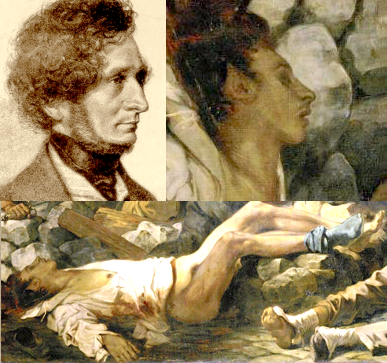
Both militant members of the Romantic movement, Berlioz was very close to painter Eugène Delacroix for whom he would have posed on occasion. In Delacroix's 1830 famed masterpiece, La Liberté guidant le peuple, a lifeless body lies in profile in the foreground. It was said he had been modeled after an academic study of Hector slain by Achilles. It is however more likely that a young conservatory student, Hector Berlioz, posed to assist his close friend. A limited comparison shows his nose to still be straight in 1827, as in our portrait. A later drawing from 1845 shows it was since broken. To demonstrate the bond between the two men, Delacroix painted the Death of Sardanapale in 1827. This became the theme of Berlioz's 1830 composition The Last Night of Sardanapale for which he was awarded the Prix de Rome.
Sitter identification
Anonyous portrait of Eugène Delacroix
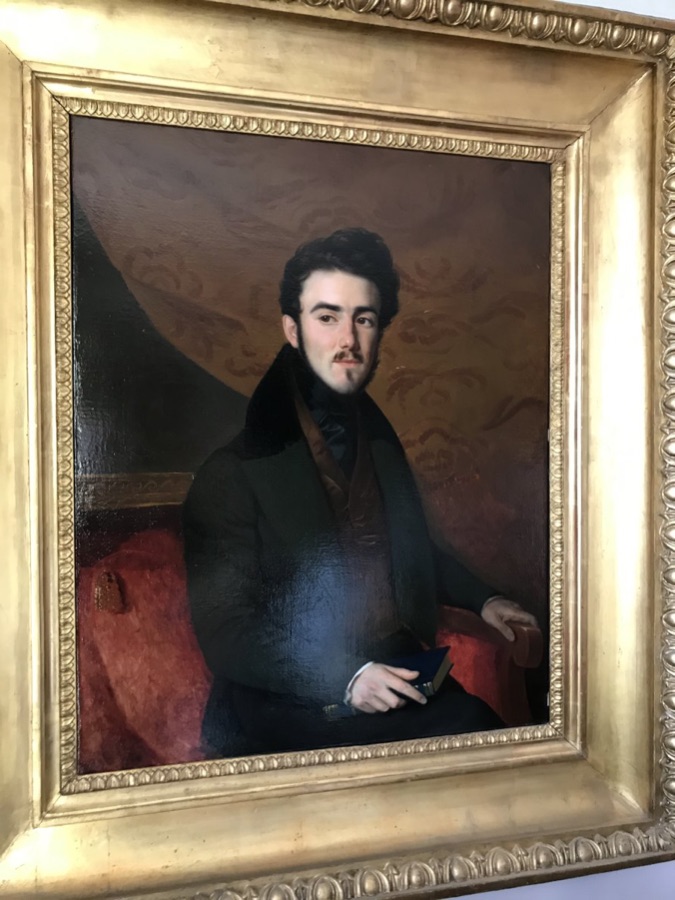
This large portrait is a memento that has historiographic merit. From his age we can estimate that it was painted circa 1825 in an opulent literary salon where Eugène Delacroix is seated on a red velvet couch holding a book broached in blue leather.The author of this portrait is presumably from Delacroix's entourage, the artist remains to be identified by further research.
Sitter identified, society portraitist unknown
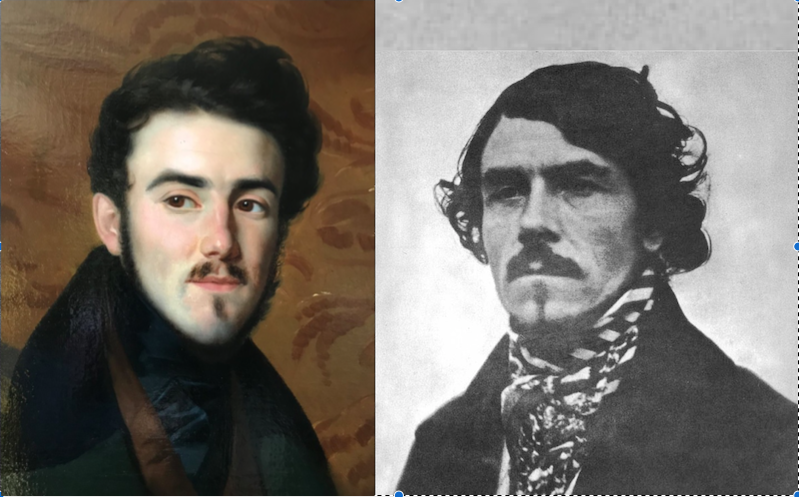
Delacroix wears a green waistcoat, a brown vest and a black scarf - sign of rebellious political views during the royalist Restoration where white scarves were the color code identifying conservatives. Known to the illegitimate son of Napoleon's statesman Charles Maurice de Talleyrand, he bore allegiance to the Empire and was not enthused by the return of the Monarchy. The artist who painted this work has not yet been identified. We can notice in this comparison that in our portrait he is approximately 15 years younger than in the 1842 Daguerrotype. Later, he still parted his hair similarly, wearing the same mustache and beard.
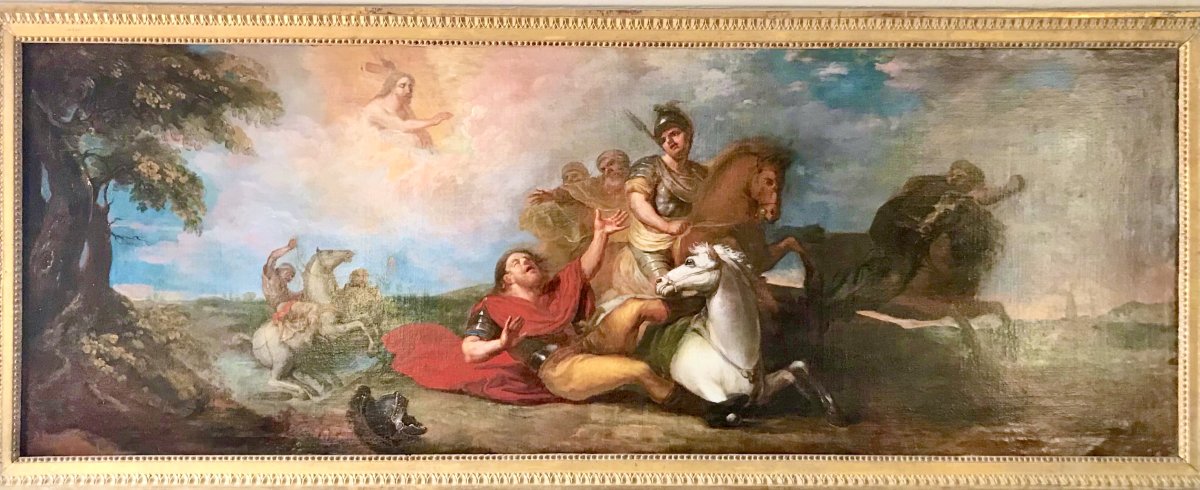
author IDENTIFIED
Religious allegory by Eugène Delacroix
Deeply spiritual, especially towards the end of his life, Eugène Delacroix painted this allegorical scene of the conversion of Saul, to become Saint Paul seen here on the road to Damascus struck to the ground, blinded by lightning. The format of this scene is identical to the width above doorways of prestigious buildings, such as the French Parliament where Delacroix's painted panels have survived, or those of the Paris Town Hall where Delacroix's works were destroyed by fire in 1871.
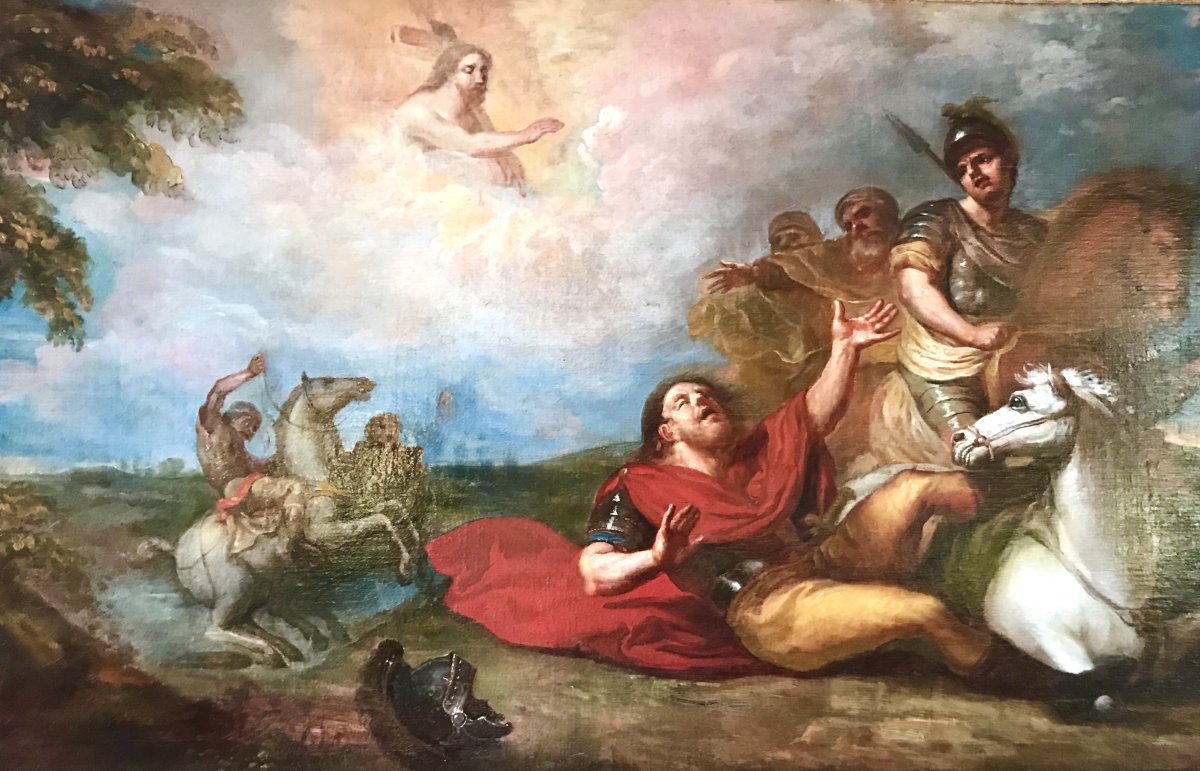
unique Artistic technique
Apogee of Delacroix's layered colors
This painting was stylistically influenced by Rubens' techniques that had inspired Delacroix. His approach to reach powerful color density was to layer multiple shades of different pigments delivering their final result upon achievement. Delacroix's writings on color became a reference for which he was revered by the Impressionists, who were overwhelmed at his demise.
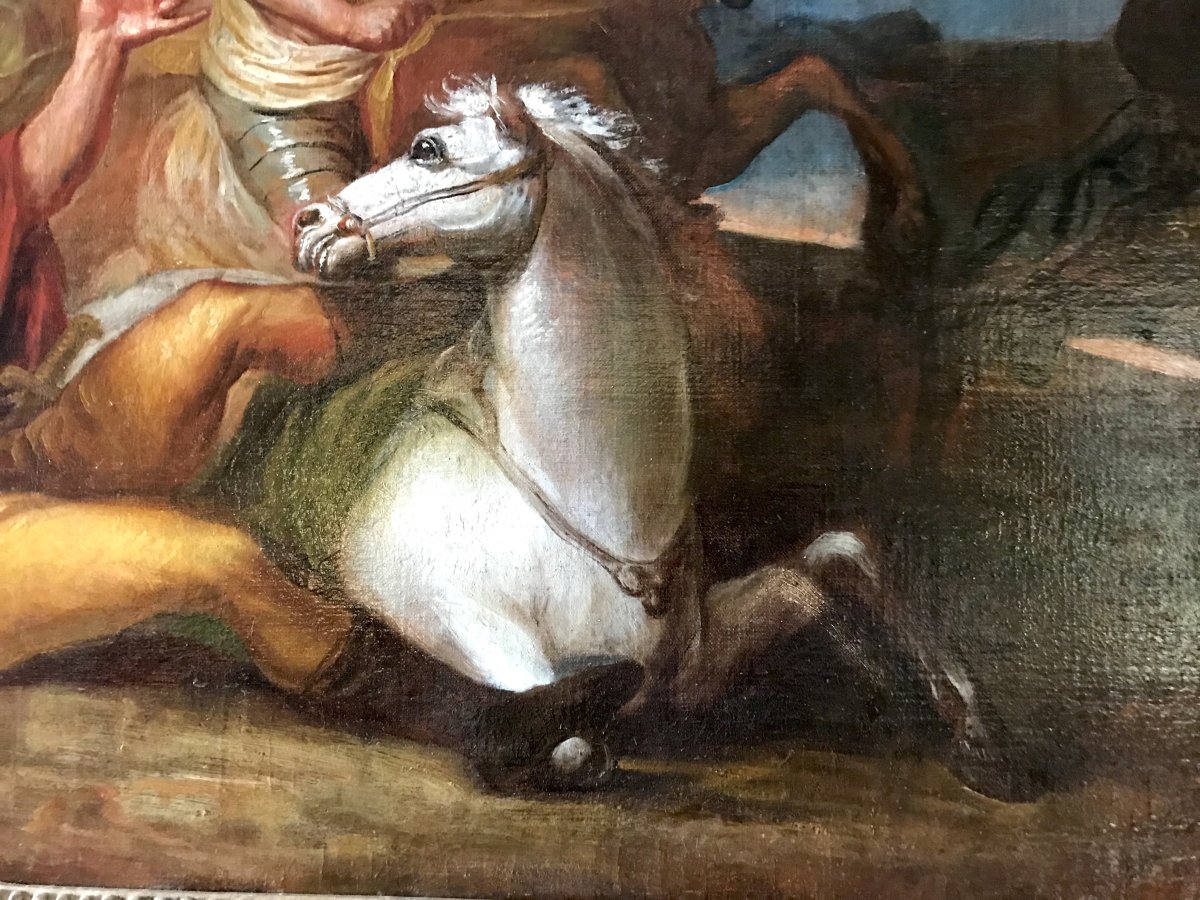
Delacroix's artistic repentance
While it might be construed that in painting such religious topics the artist sought repentance, we can note that in this allegory there remain traces of an artistic repentance. Saul's fallen horse at first had its front left leg painted in a different position, this earlier image was found when cleaning the painting and this first version was kept alongside the second one, as a revealing trace of the painter's repentance.
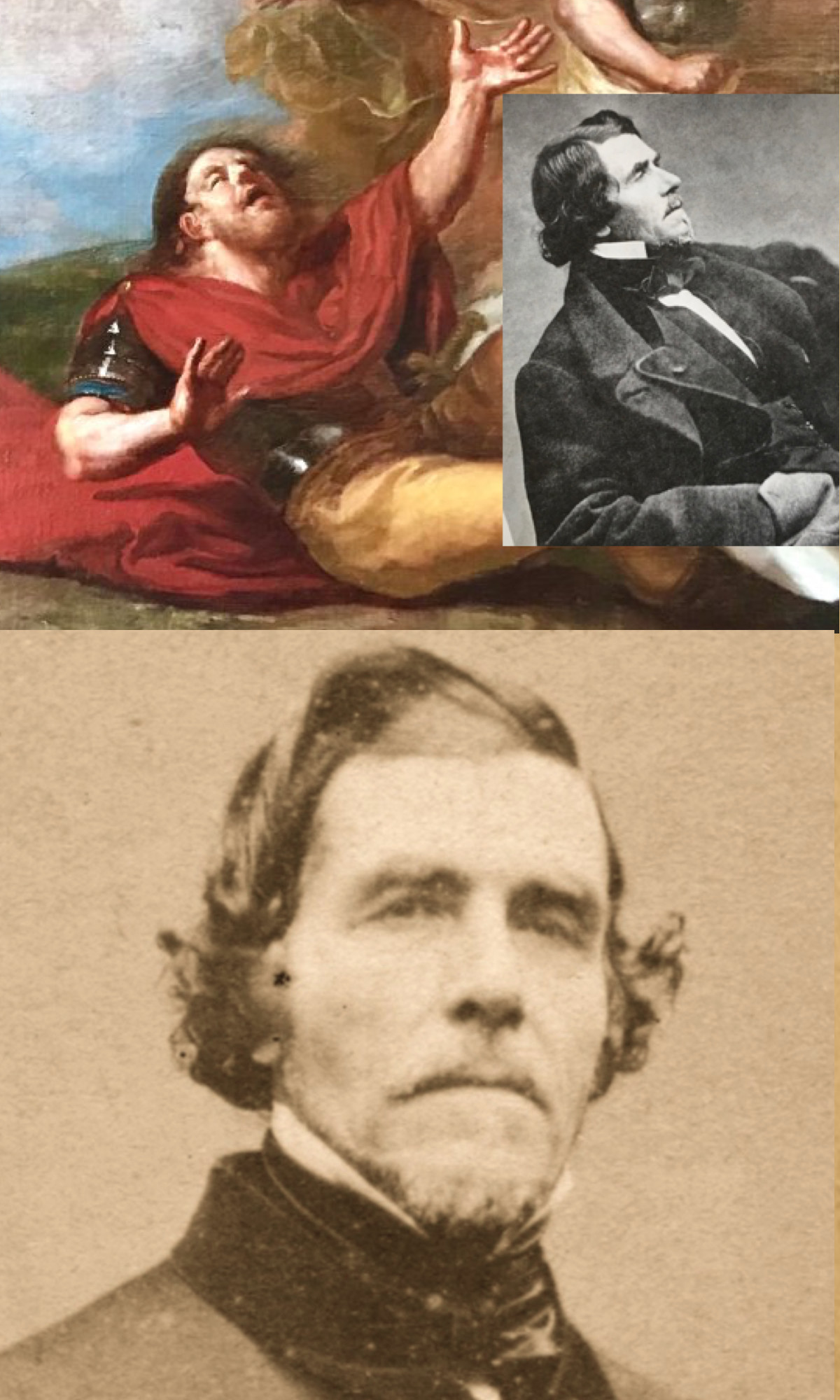
the ARTIST AS His Model
Delacroix as a model forSaint Paul in his allegory
There is a strong likelihood that in this late life painting Delacroix used his own likeness to depict Saul of Tarsus falling from his horse. We will note that in comparison to circa 1862 photographs he is roughly the same age. As he painted himself with his head back we will note that this perspective optically lengthens the chin and shortens the nose and forehead. Delacroix was deeply spiritual his entire life. This allegory was painted with religious fervor as a statement of faith, representing his own transformation by Divine grace.
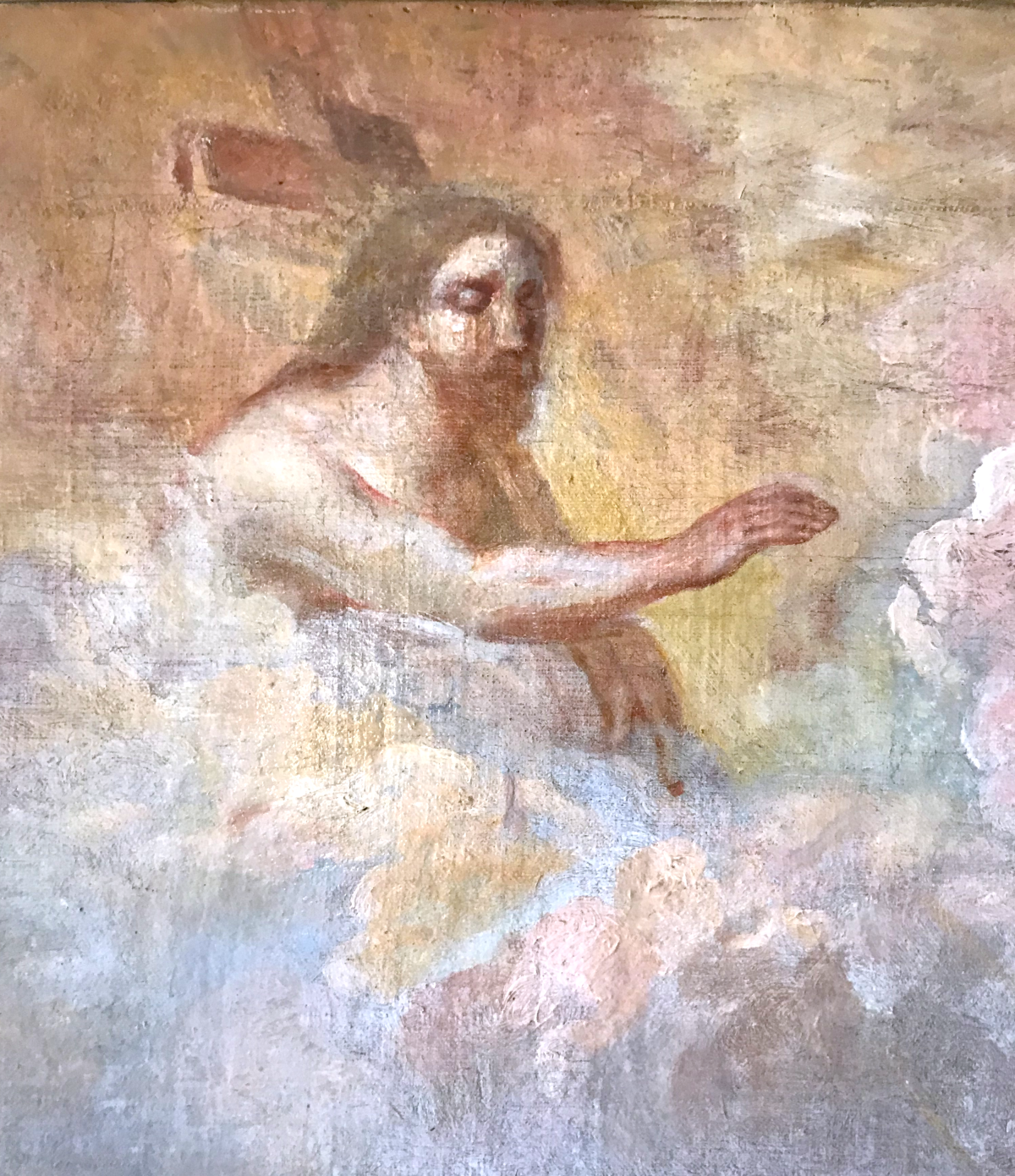
Delacroix's Christ
This rendering of Christ is quite similar to those in a number of other paintings by Delacroix. This painting was found in very poor condition and was painstakingly restored while retaining all its original splendor, applying small retouching only where absolutely necessary to ensure the readability of the scene while respecting the original artist's work.
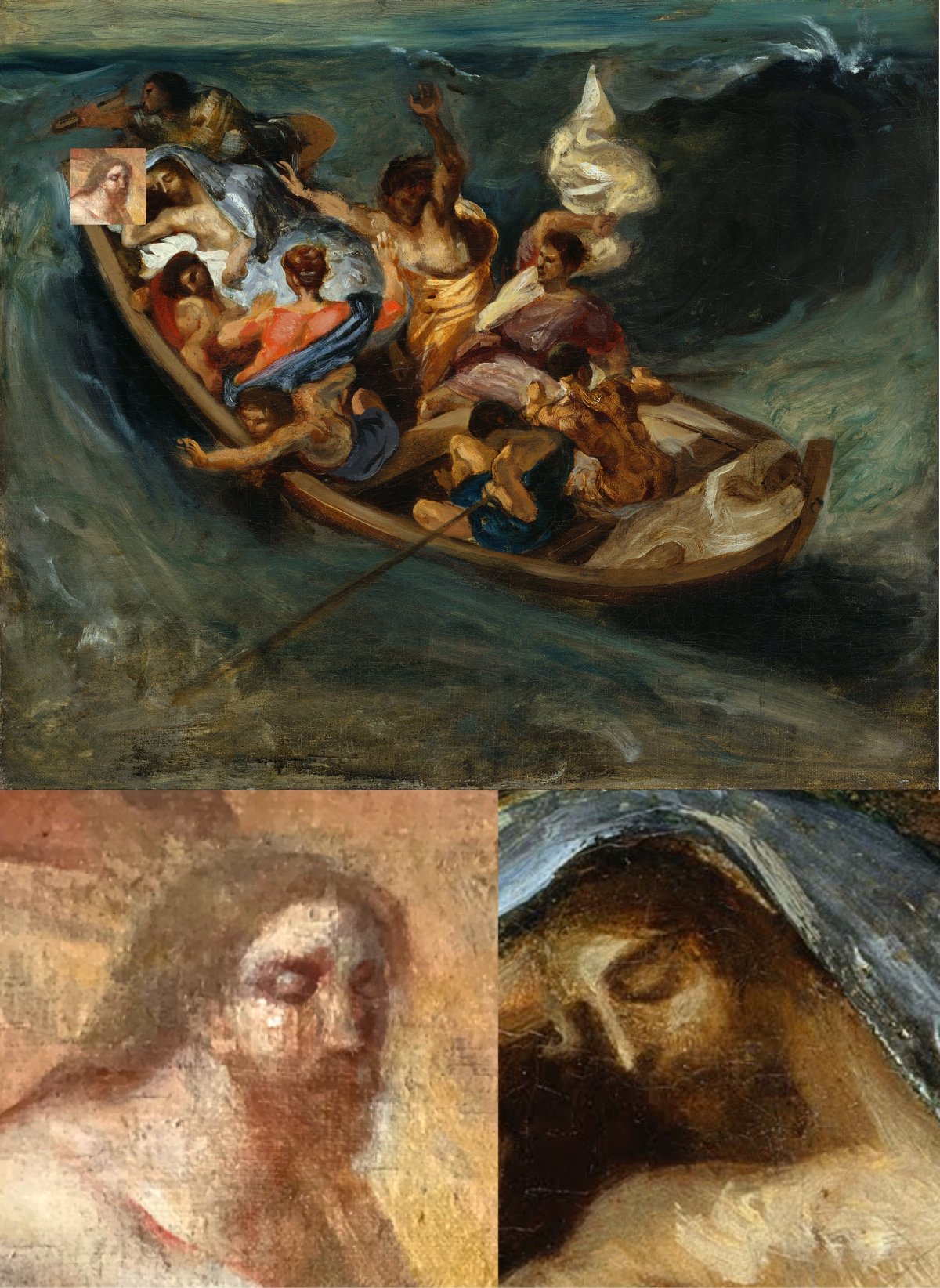
Second Model IDENTIFIED
Christ comparisons
We noted that many representations of Christ by Eugène Delacroix were similar, and in this comparison we can note that it is most likely that the same model served for many of these paintings. Here we have placed a detail of our painting, Christ's face, near that of the Christ in Delacroix's Christ on Sea of Galilee painted in 1841. We can notice the gaunt face and thin body of the model for that Christ looking in his mid-twenties. In the allegory, the model for Christ seems twenty years older and in his mid forties, with a correspondingly fuller face and heavier build, Close inspection shows them to have very similar features and bone structure, pointing to the likely use of the same model for these two works painted many years apart.
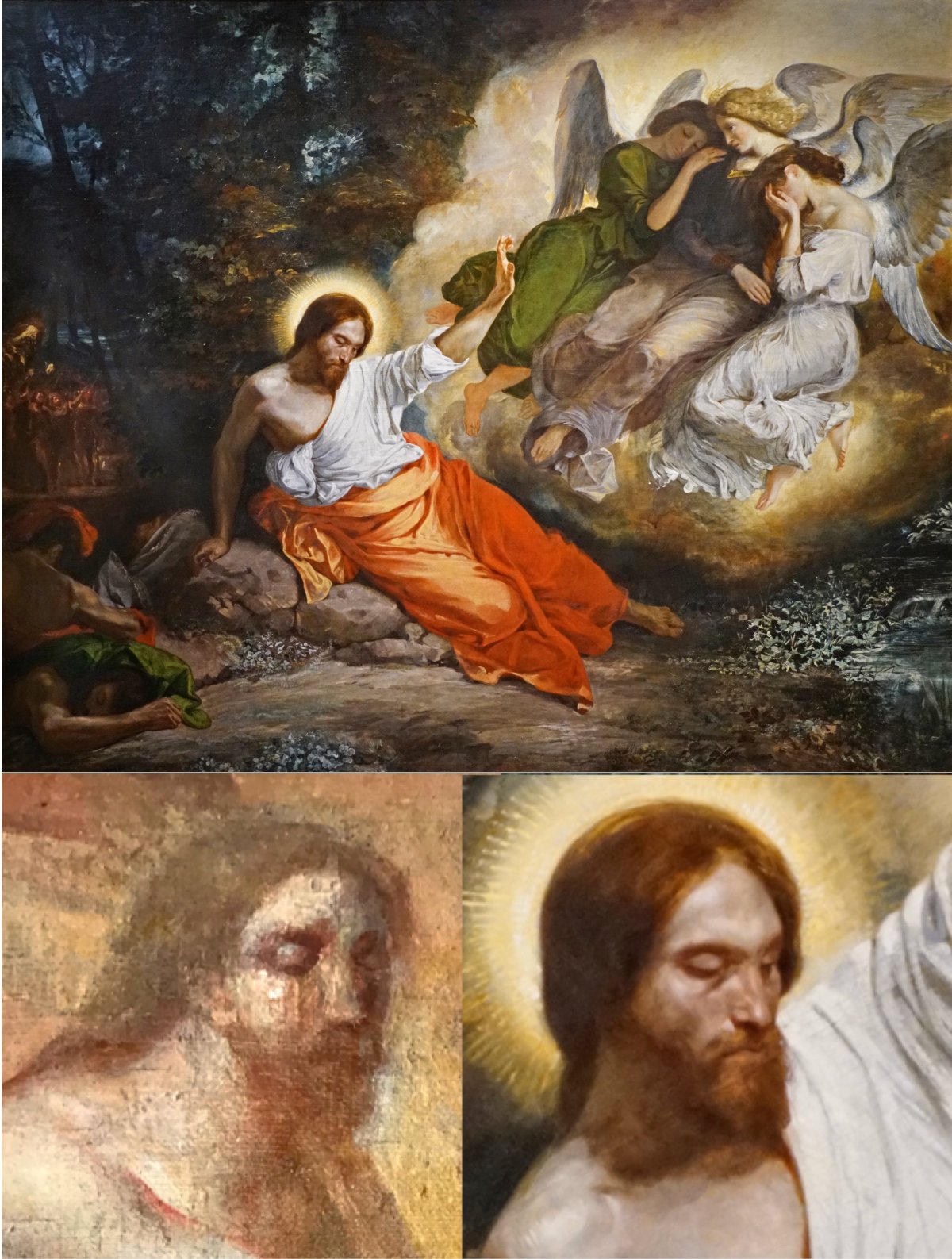
Another Christ comparison
In 1827 Delacroix received a commission for a very large religious painting that is now conserved at the Grand Palais in Paris. That great work is more accomplished and has been extensively restored. Our allegory suffered from the elements and was purposefully only partially restored. Comparing them we can notice that the model could very well be the same person. He has similar facial features although in the allegory he is not seen from above, but in the sky from below. Corresponding to this perspective his forehead looks shorter. He is also older and fuller faced than in the much earlier painting.
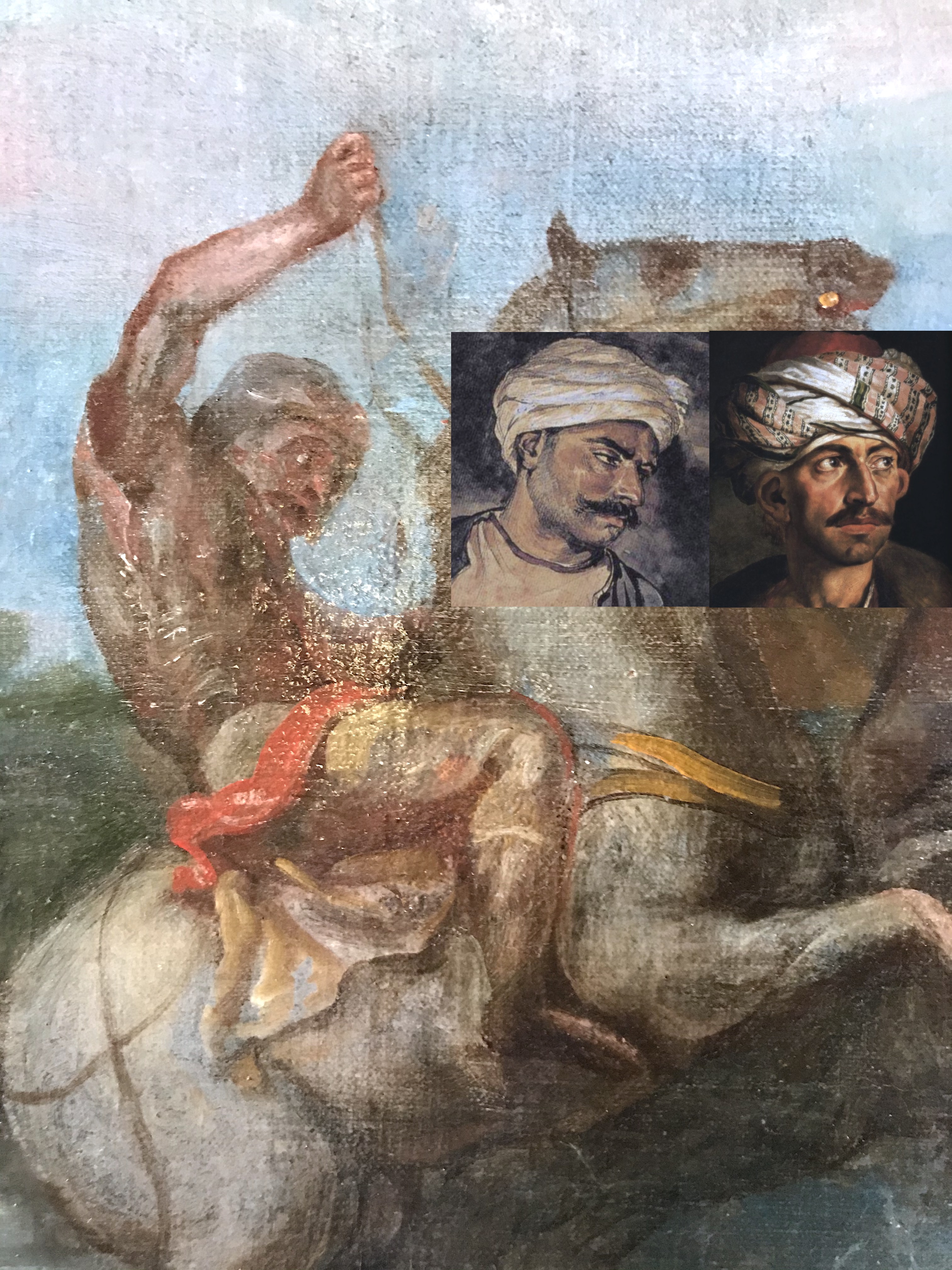
Third Model IDENTIFIcation
Théodore Géricault's valet Mustapha as model
The painter Théodore Géricault was a close friend of Delacroix. He had a Turkish manservant named Mustapha whom Delacroix had surely often encountered. We can see that the horseman to the left of the allegory bears a close resemblance to two portraits of Mustapha by Géricault. We can note that this late period painting by Delacroix regroups a number of images from his past.
fourth Model IDENTIFIED
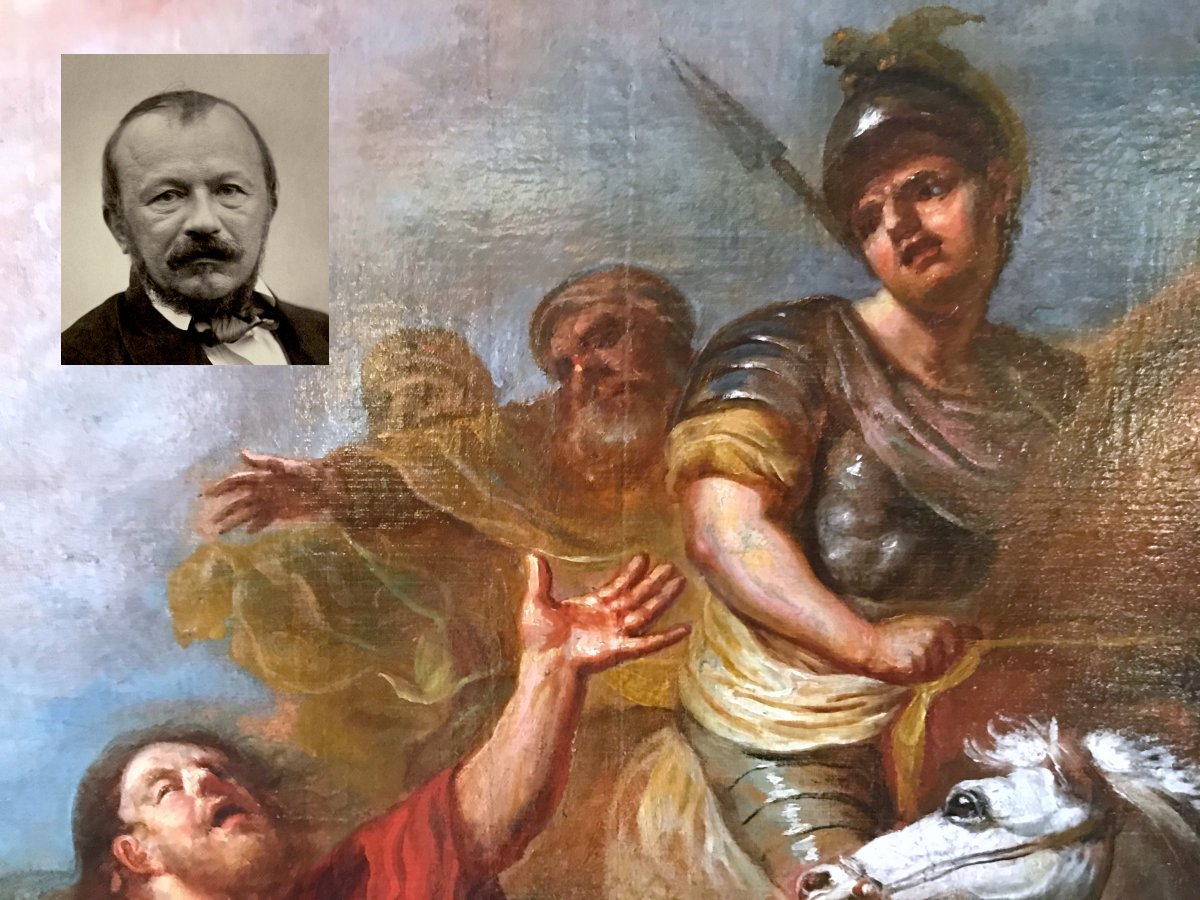
Gérard de Nerval as themodel for Saul's general
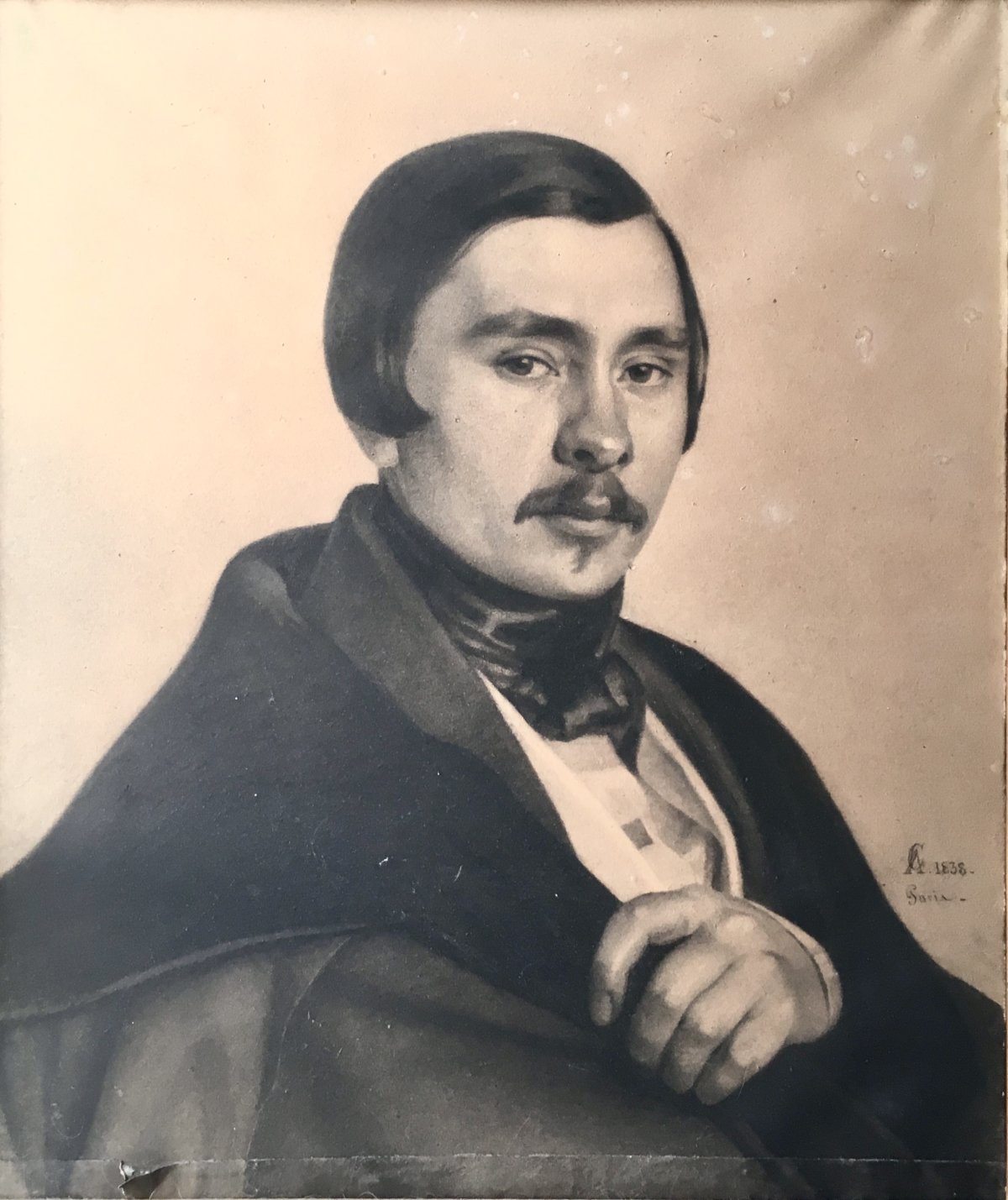
To portray Saul's main general, Delacroix chose, as a model from memory, his lost friend Gérard de Nerval. Delacroix's hand extends towards his lost friend who had suffered a tragic death some years earlier taking his own life. Nerval is seen here wearing a helmet. The unusual trapezoid facial shape of Nerval points to this being more than a coincidence. We can confirm this feature below from a charcoal drawing of Nerval in our collection.
SITTER IDENTIFIED
Portrait of author and poet Gérard de Nerval
This charcoal portrait dated 1838 shows a young Gérard de Nerval who still has a full head of hair. Later portraits show him to have lost much of its garnish, making this a unique testimonial to his earlier appearance at the time he translated Goethe's Dante, much to the approval of that author. We can see here his peculiar facial contours that were later painted in an allegory by his friend Delacroix.
Author signature to be identified
This drawing awaits restoration in our collections. It's paper carries traces of mold stains and a damaged lower edge was covered by a drawn replica of the bottm of his cloak.A monogramed signature CA or AC dated 1838 Paris is yet to be researched to identify the artist.
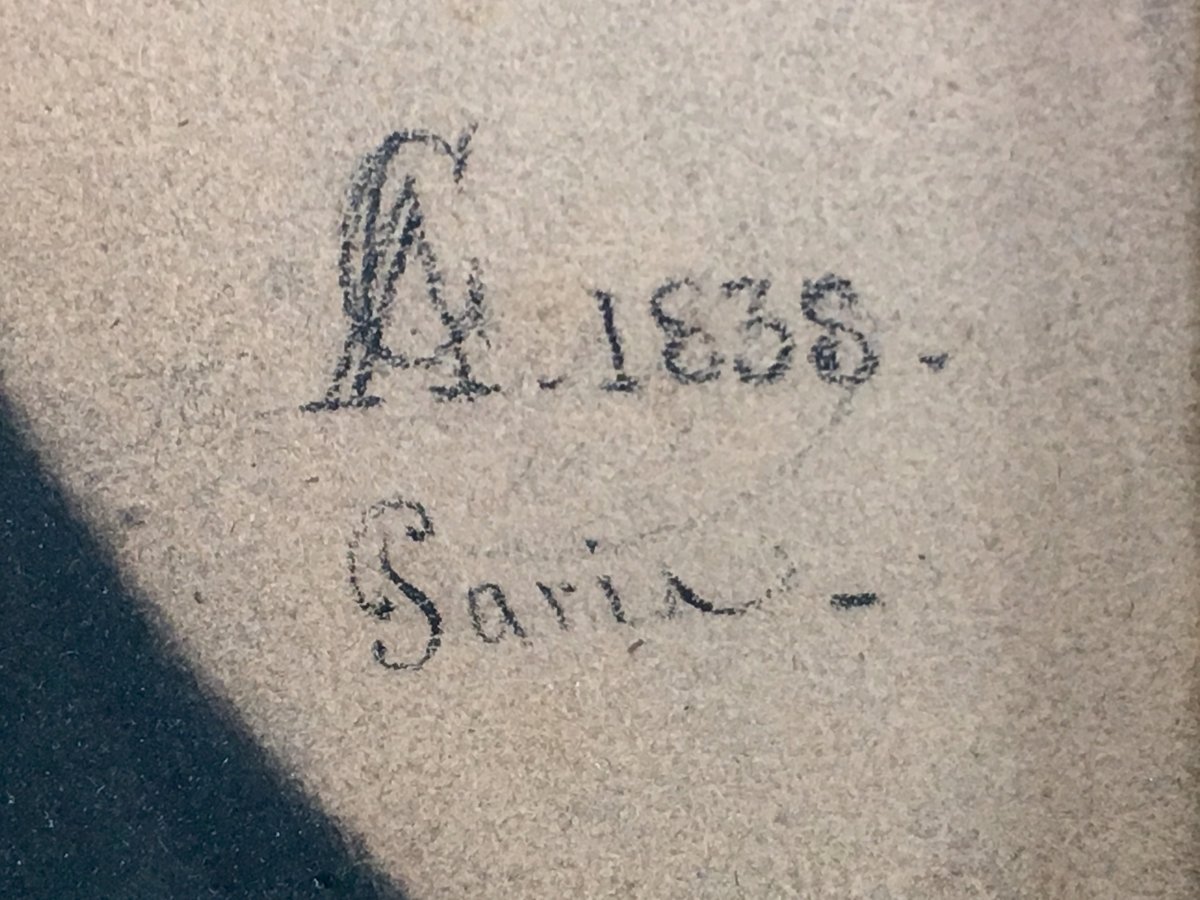
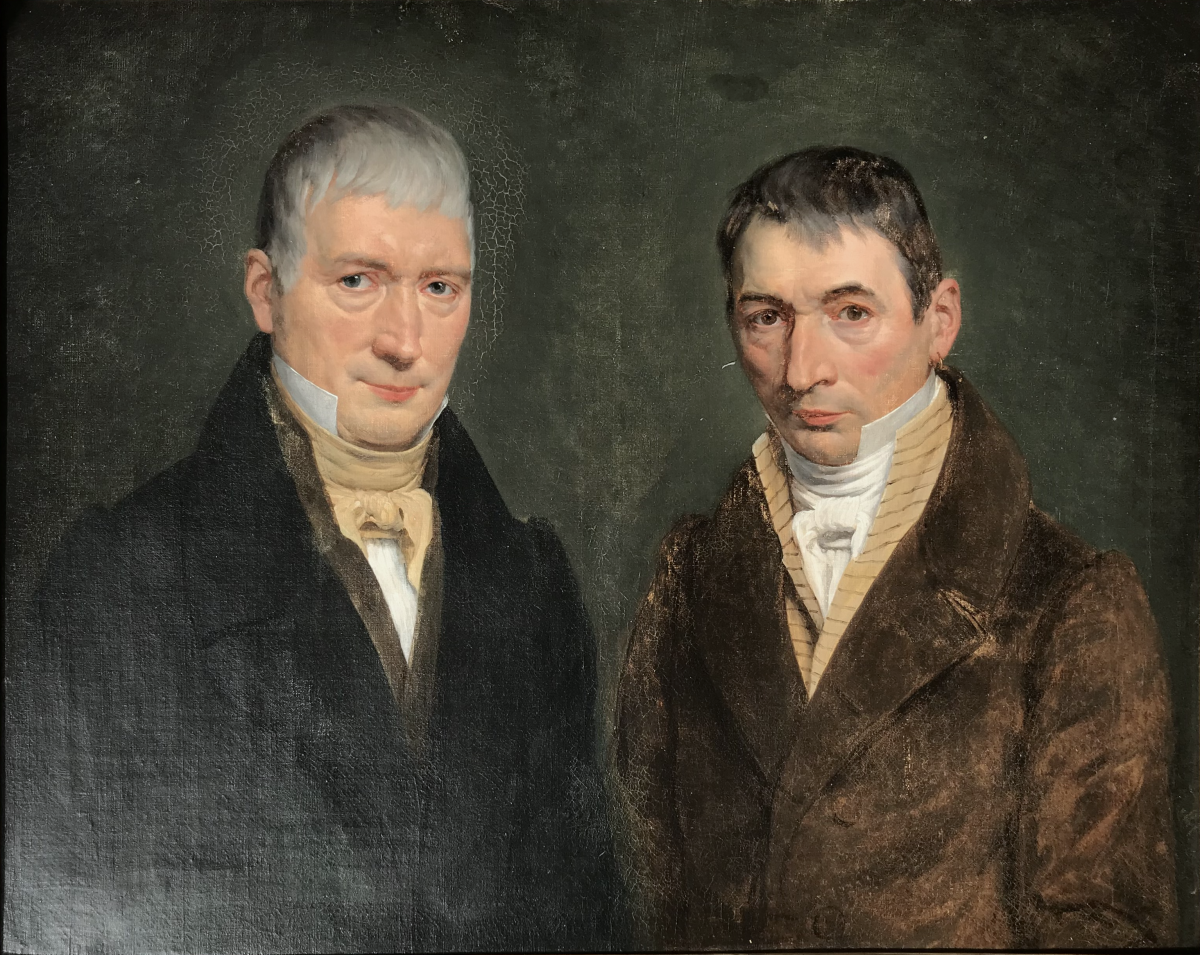
Sitters & AUthor identified
Jacques-Louis David double portrait
This double portrait painted by Jacques-Louis David during the French Revolution portrays two members of the Convention Government when the pair were jointly nominated Proconsuls tasked to repress the population of Lyon. They became notorious for executing families of royalists by cannon fire in the public square, earning them the nickname "Les mitrailleurs de Lyon". Painted in 1793 by their colleague, also a member of the Revolutionary government. David is one of the rare artists of the time known to venture into painting double portraits. That requires a special skill, not only capturing on canvas the spirit and humanity of each sitter, but also showing the psychological interaction between the pair. Painted rapidly before the sitters were dispatched to their new duties, this painting was not as intricately finished as most of his other works. However, this is arguably the best known rendering of either of the sitters, Weathered by time and the elements, this painting currently awaits full restoration.
Jean-Marie Collot d'Herbois
A theater actor quite familiar with the stage in the French city of Lyon, Jean-Marie Collot d'Herbois participated actively in the French Revolution and was briefly appointed President of La Convention, the first Revolutionary government, During a stint governing Lyon as Joint Proconsul with Joseph Fouché, he settled scores with his former royalist enemies, Fallen out of favor he was arrested in 1796 and deported to forced labor in the Cayenne prison colony where he died of the yellow fever.
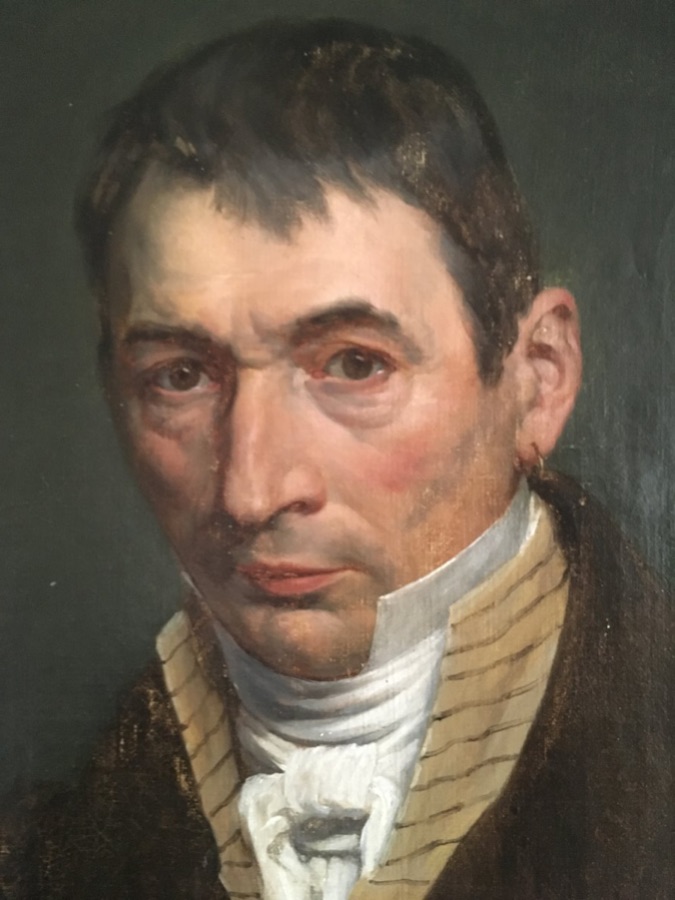
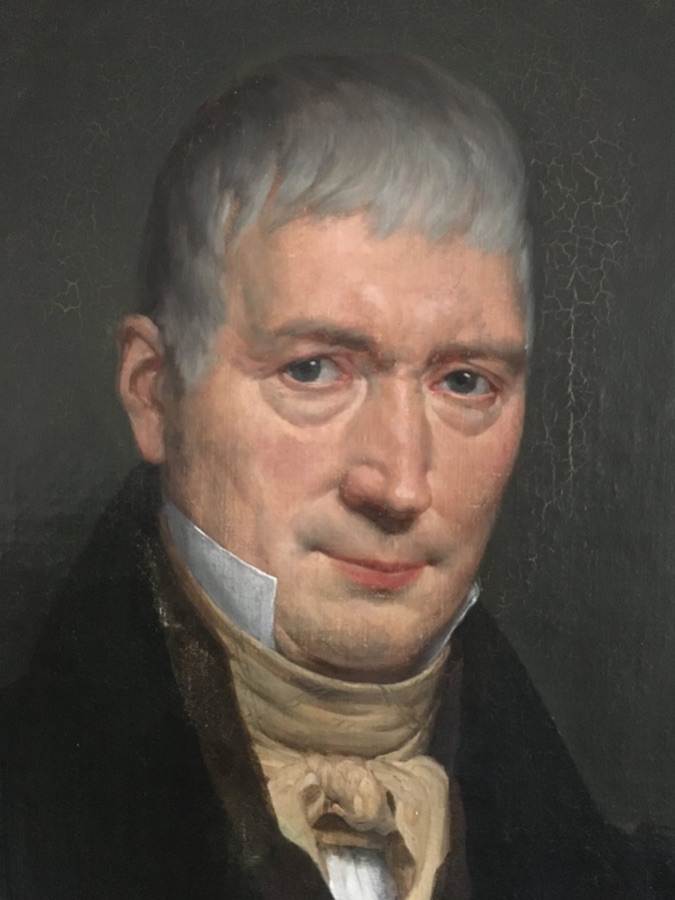
Founder of the secret service
Joseph Fouché
Educated by Oratorians and an early protagonist of the French Revolution, Joseph Fouché is famous for a number of reasons. It was he who convinced other members of the Revolutionary "Comité du Salut Public" that their names were on a list of men slated for execution. This disinformation led to the immediate arrest and execution of Maximillian de Robespierre, who was blamed for their crimes in a redacted version of events. Conspirator Joseph Fouché is also known for creating the first Secret Police network in Europe, using servants as spies and compiling blackmail files on every major figure in France and overseas. A rival of famed diplomat Talleyrand, Joseph Fouché was feared by Napoleon who had him appointed as his Minister of Police until he was able to distance himself by showering Fouché with gifts and sending him far off to the new lands granted him as Duke of Otranto.
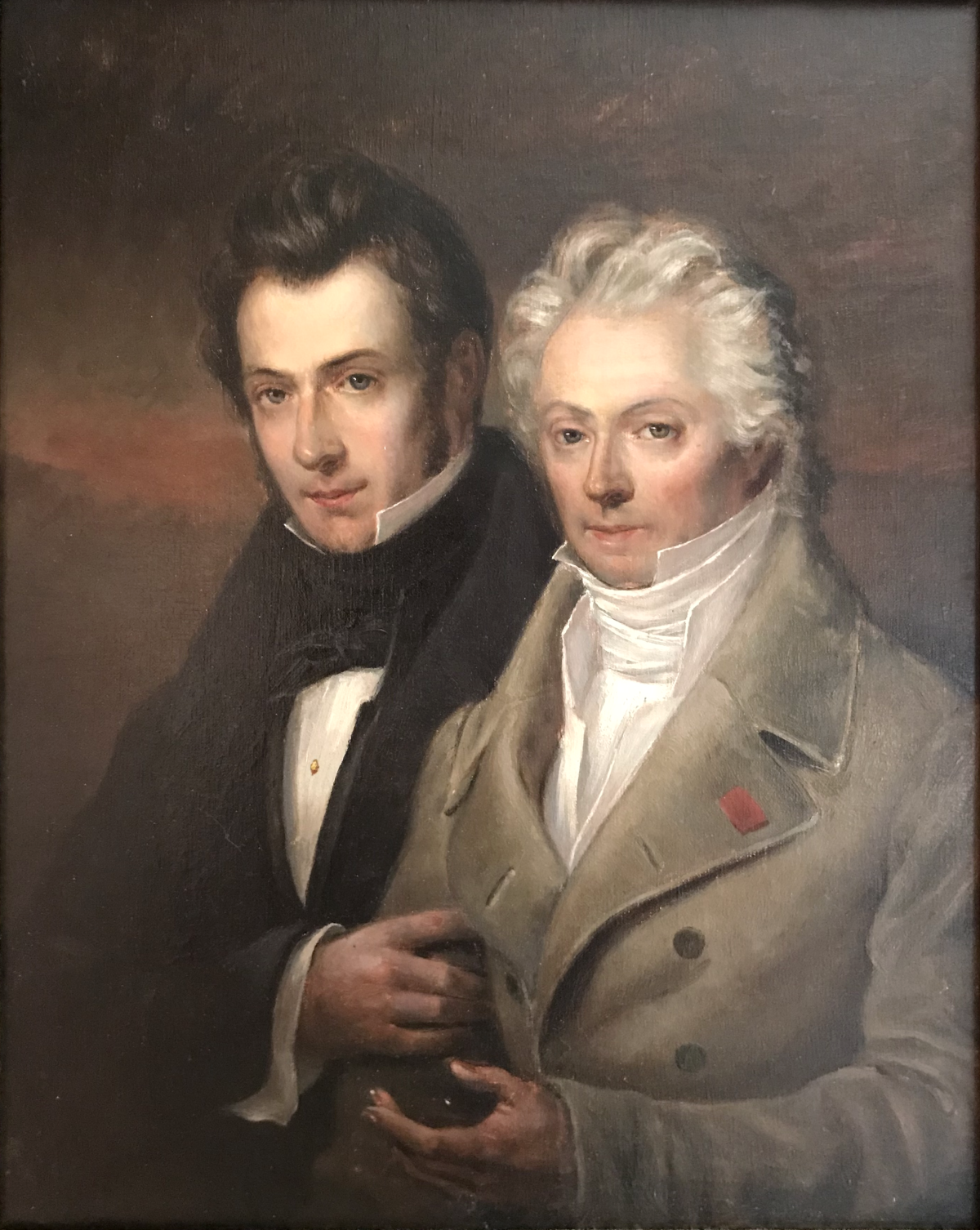
AUTHOR AND SITTERS IDENTIFIED
Sir Thomas Phillips double portrait of Lord Byron and his father
This small travel-size portrait is in the characteristic style of English painter Thomas Phillips, Lord Byron's favorite portraitist. What is exceptional in this work is that it shows poet George Gordon, best known as Lord Byron, in the company of his father who was reported to have died when his son was a young boy. This leaves only three hypotheses. One that he posed with a lookalike of his father, which is quite a stretch. Two that he asked the portraitist to paint an imaginary scene where they stand arm in arm, also highly unlikely. Three his father would have been incorrectly reported dead for undisclosed reasons. There could be a father and son association with British espionnage throughout the tumultuous periods of the French Revolution and Napoleon's Empire up to Restoration of the Monarchy.
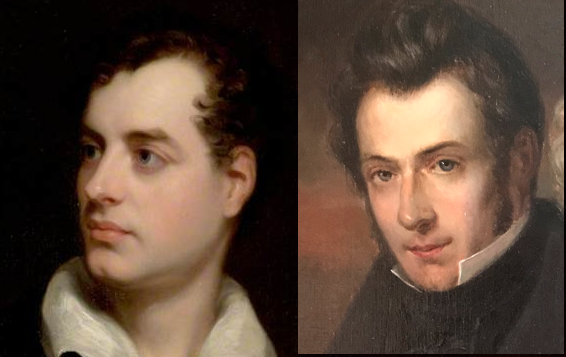
IDENTIFICATION OF Byron
Byron Portraits by Thomas Phillips
We can .see compared side by side our portrait of Lord Byron next to a detail of an 1812 portrait of Lord Byron by Sir Thomas Phillips. While in one portrait the sitter looks away and in the other he looks at us, we can plainly see it is the same person sitting for the very same artist.
Captain Mad Jack Byron
We can notice by comparing the person to the right side of the painting to an engraving of Lord Byron's father, that this sitter is indeed his father. What is even more unusual is that he is wearing a French honorary decoration in the buttonhole of his coat lapel. This points to his having received this honor in France, perhaps for some sort of paramilitary operations such as those which had earned him the evocative nickname of Captain Mad Jack Gordon. This may also lend credence to the theory that perhaps Lord Byron had followed in his father's footsteps and served his England by penetrating international high society's literary salons and traveling to meet with political figures such as General Paoli in Corsica. This might also cast light on his role in the Greek revolution against the Ottoman Empire. Byron used his personal funds to finance the Byron Battalion, much in the way today's intelligence operatives deploy assets and mercenaries to intervene in theaters of war.
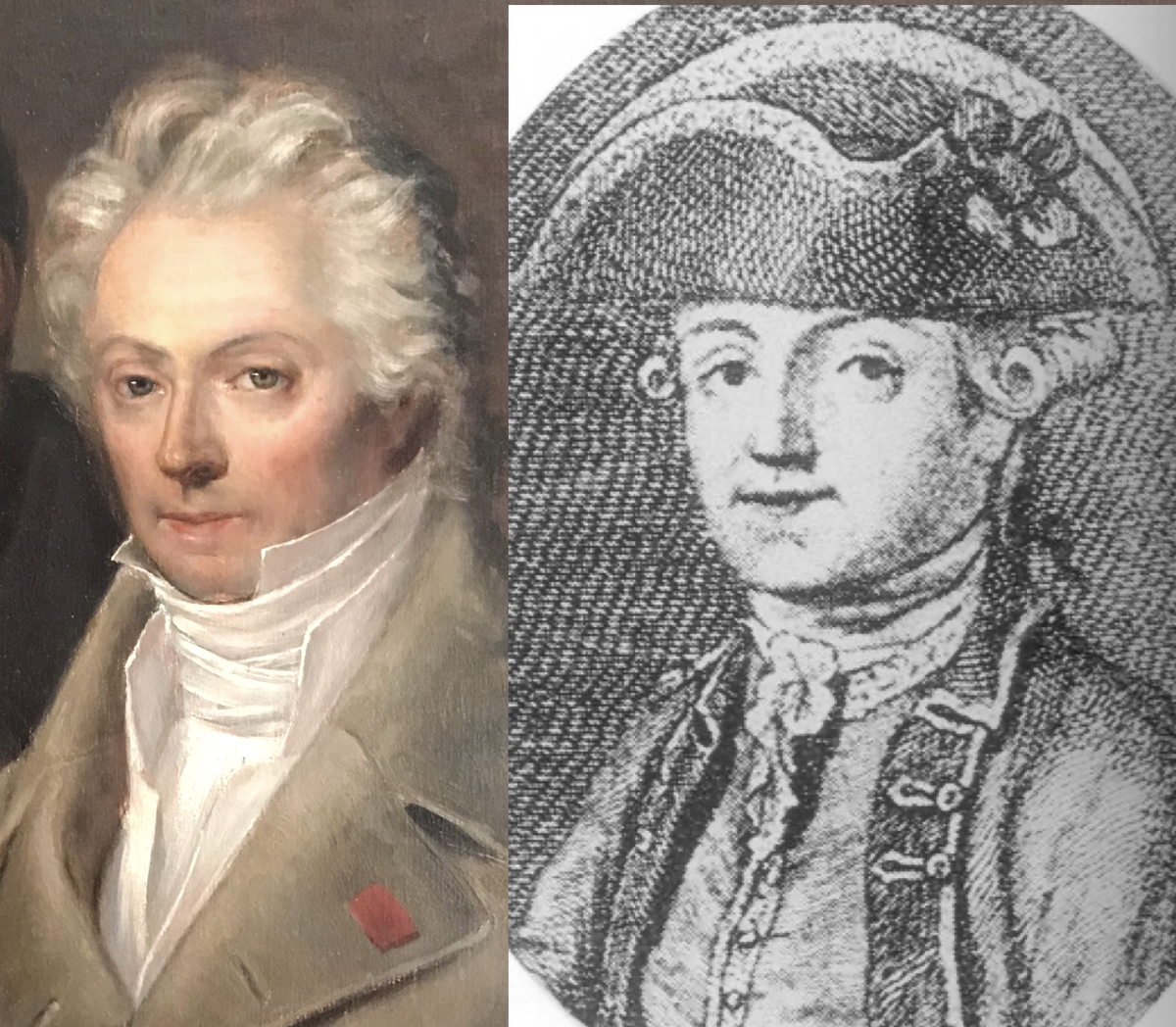
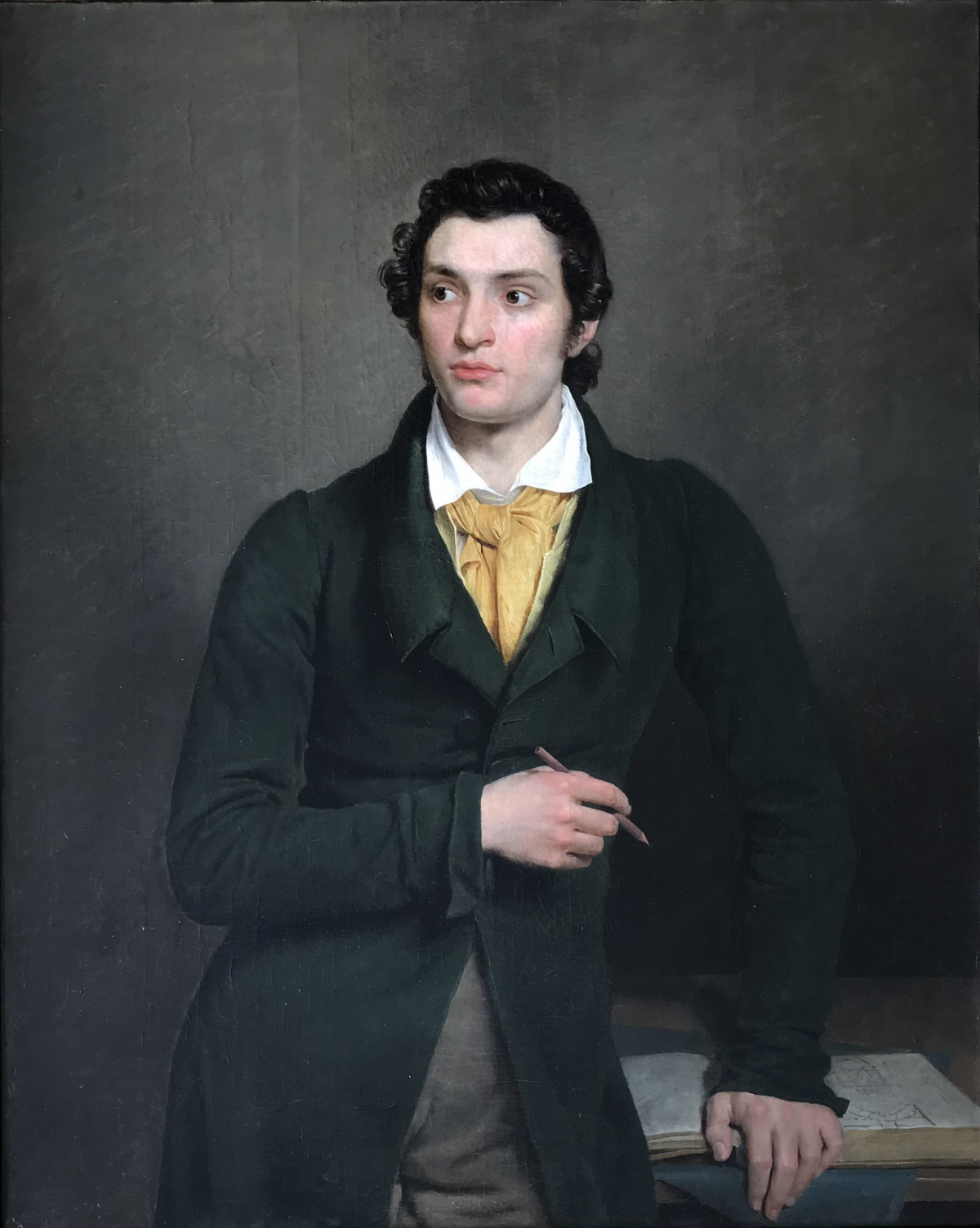
AUTHOR & SItter identifiED
Ingres portrait of Jean-François Champollion
This large portrait shows a gentleman standing next to his desk. a young person who has used his pencil to draw a sketch in a workbook. The illustration implies that he was likely tasked with a project involving architectural installations that were important enough for him to wish to be remembered in their company. His clothing dates the work to the early 19th century and the artistry points to a major work by a highly accomplished French painter, commissioned for a successful person worthy of his esteem. Further analysis will demonstrate that this is a portrait of the French egyptologist who decoded the hieroglyphs with the Rosetta Stone, Jean-François Champollion. This portrait was painted circa 1827, his hand rests upon a book open to an architectural sketch that is likely illustrating the Egyptian department he was tasked by King Charles X of France of designing for the Louvre.
Sitter feature comparison
A detail of our portrait is viewed next to a statue that can be seen at the French Oriental Archaeology Institute in Cairo. The head shape, bone structure, proportions and position of facial features, hairline and hair volume are very
similar. The sitter for the sculpture and the portrait can thus be identified as one and the same Jean-François Champollion.
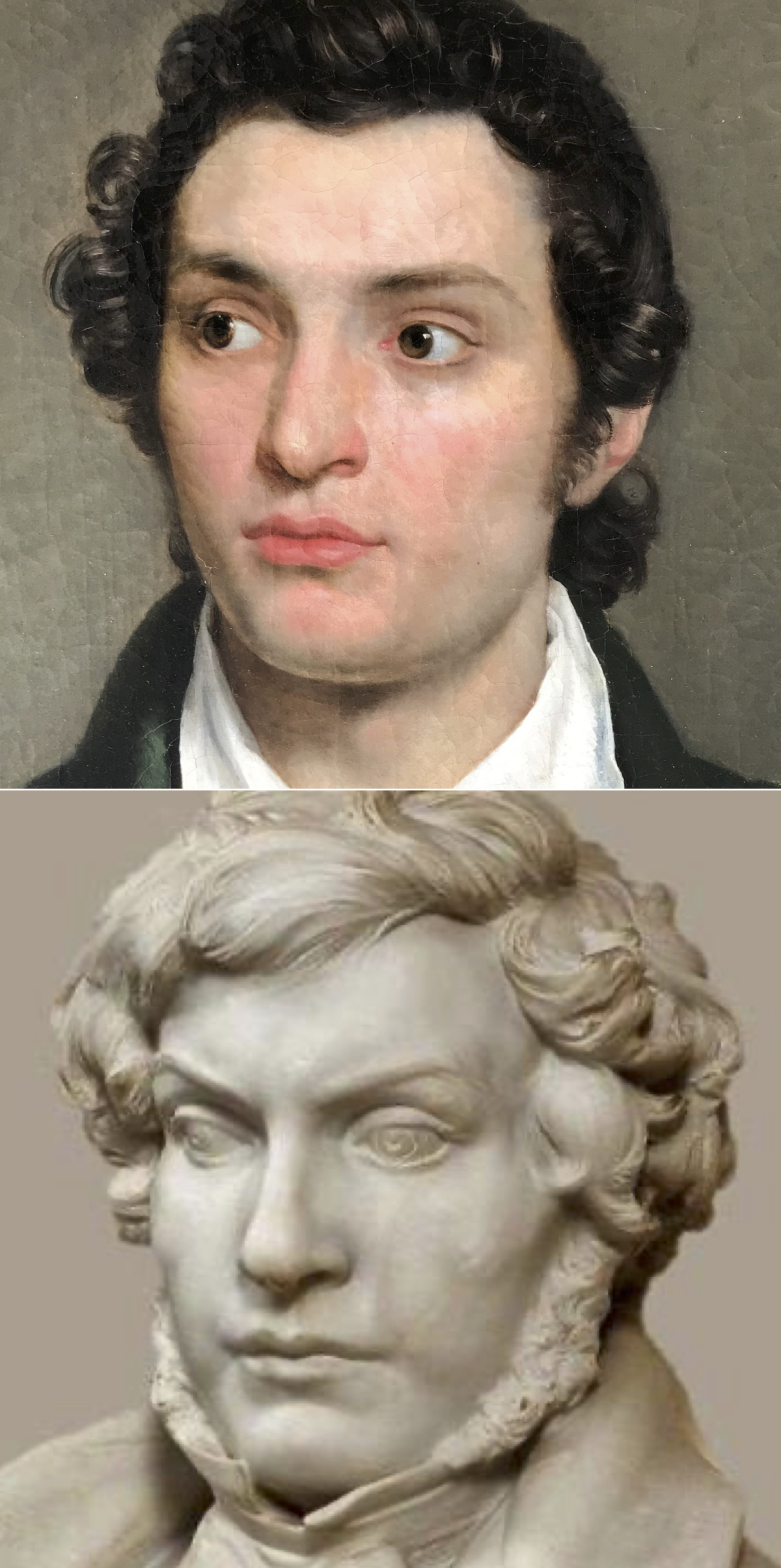
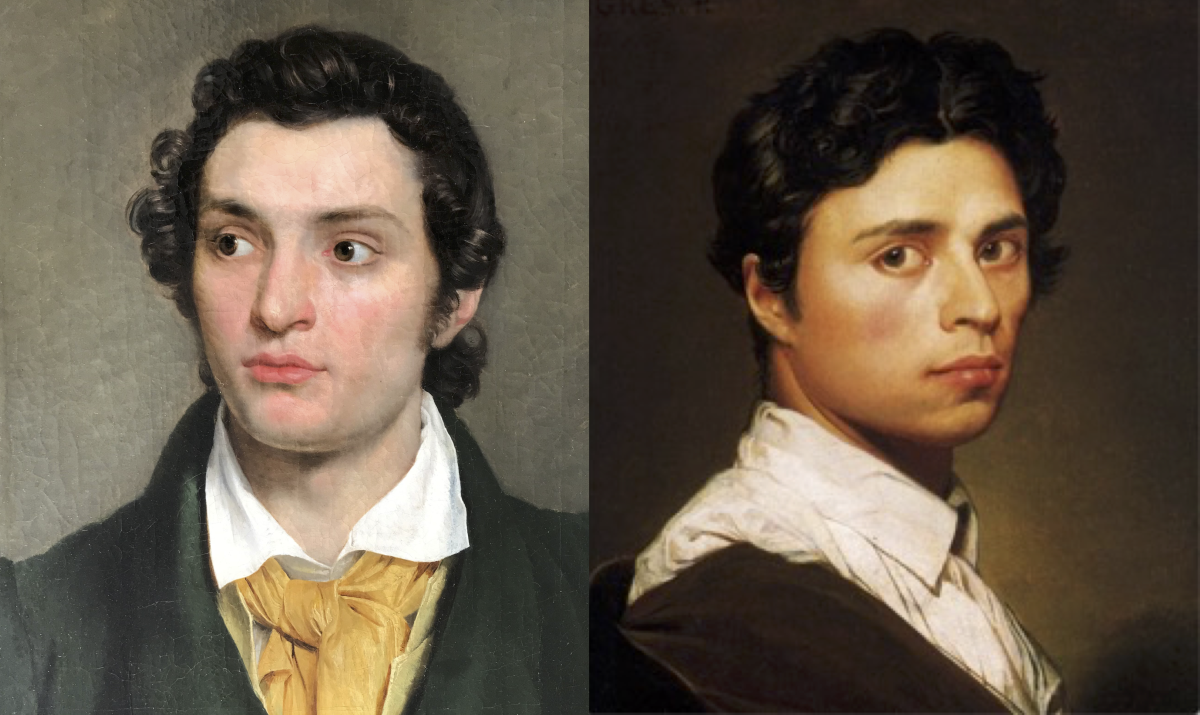
Artistic style comparison
A detail of our portrait is viewed next to a self-portrait of Ingres painted in 1805. The stylistic similarities are remarkable. They have similar sculptural modeling of shapes and shadowing, and almost identical outlining of the jawline, lips and nose. While they are not the same sitters, they seem to something of a family air due to the marked and very personal style of the artist. We can also denote the same highly contrasted treatment of hair in both portraits, as well as salient eyes conveying a strong sense of presence. In both paintings the hands are painted with identical mastery and the clothing is always rendered in soft but precise touches, all pointing to establish a work by the painter Jean Auguste Dominique Ingres.
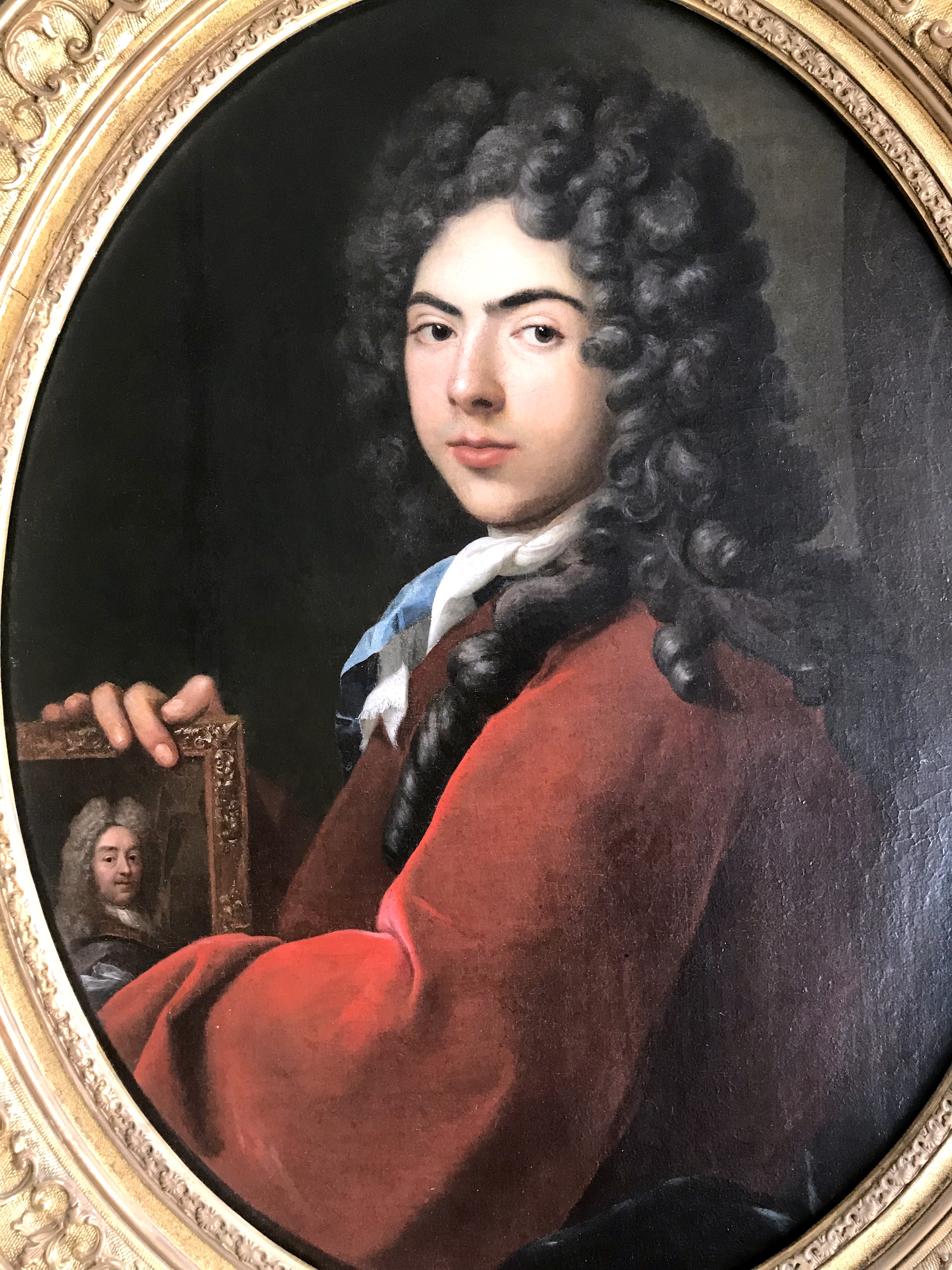
Self-portrait in a mirror
Molière by Charles Le Brun
This portrait is possibly the earliest known image of Jean-Baptiste Poquelin better known as Molière, the famous playwright of Louis XIV. We will note that Molière's father was entrusted with tapestries for King Louis XIII. Hoping to prevent his son from being a stage actor, he feigned an imaginary illness to trick him into taking over his three month tour of duty. This ws in 1642.Molière was approximately 20 years old when he was painted by his colleague Charles Le Brun, at that time also in the King's service. He holds a small gilded mirror where we can see the painter at work. It reflects the image of a fairly young Charles Le Brun, best known for his later work at Vaux le Vicomte and then at Versailles.
Sitter identification
Molière was a notoriously homely person and many of his portraits were attempts to remedy his somewhat ungracious appearance. This may be why he chose to wear a mustache most of his life, to distract the eye of onlookers. Another rare portrait shows him without that adornment. It was painted almost 20 years later, in 1658, by Pierre Mignard. We can see them compared to one another. His face is slightly thicker, which happens often in middle age, and each artist painted the eyes a different shade. Eye color often can change in different lighting conditions, but also throughout the ages artists tended to paint eyes a variety of colors according to the effect sought by a painting. The wigs are also of a different color. In our portrait he is quite young but also dressed for appearances in court at Versailles. In the later portrait, painted during his travels, it was a casual intimate pose. While there has been much controversy about what he really looked like, due to the modified aesthetics of many of his portraits, here we can see they both have identical head shape, chin, mouth, eyebrows and bone structure.
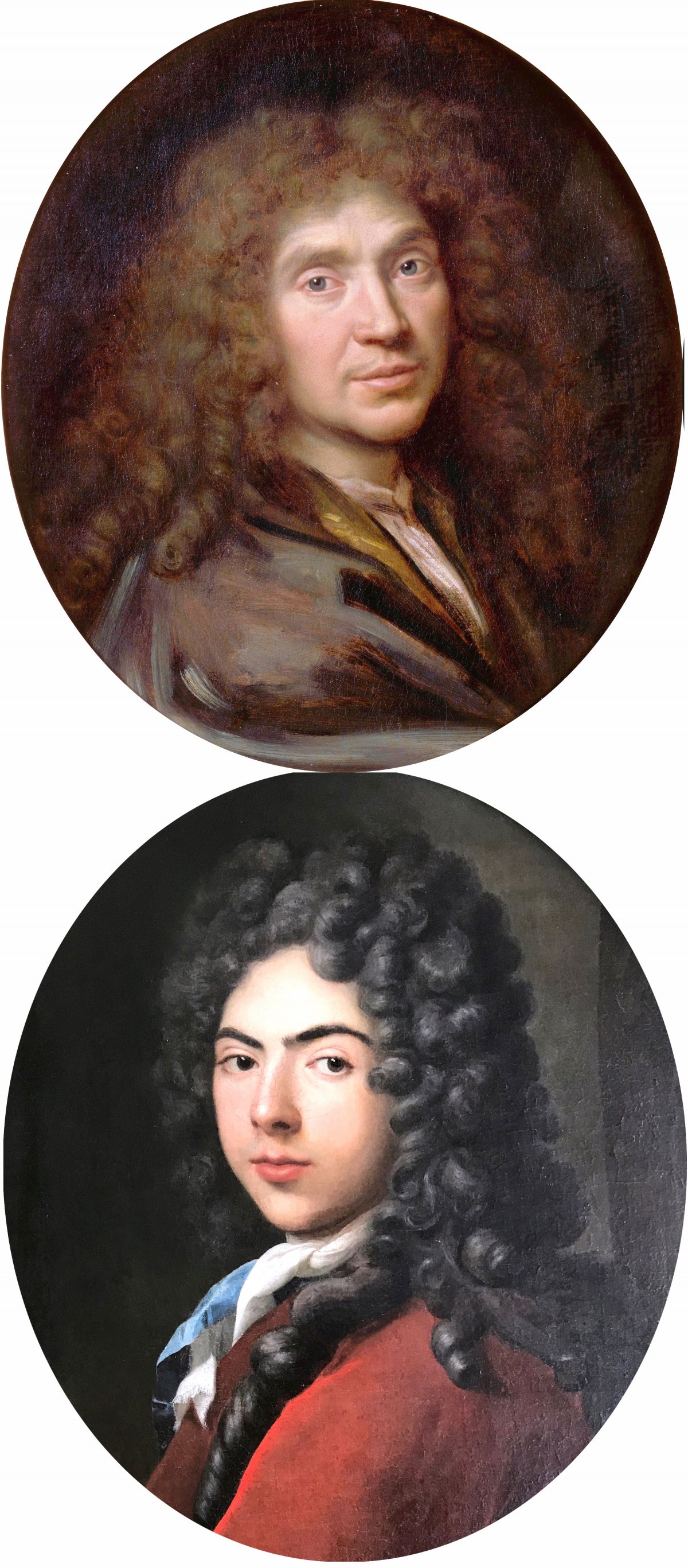
Charles Le Brun self-portrait
In the Italian tradition of placing "a painting within the painting" started with Giotto, Charles Le Brun has added a small self-portrait within this portrait, It shows his reflection in a small mirror held by Molière. The amicable gaze expresses a bond between them. Le Brun is seen here much younger than in any other known portrayals, smiling with jovial enthusiasm.
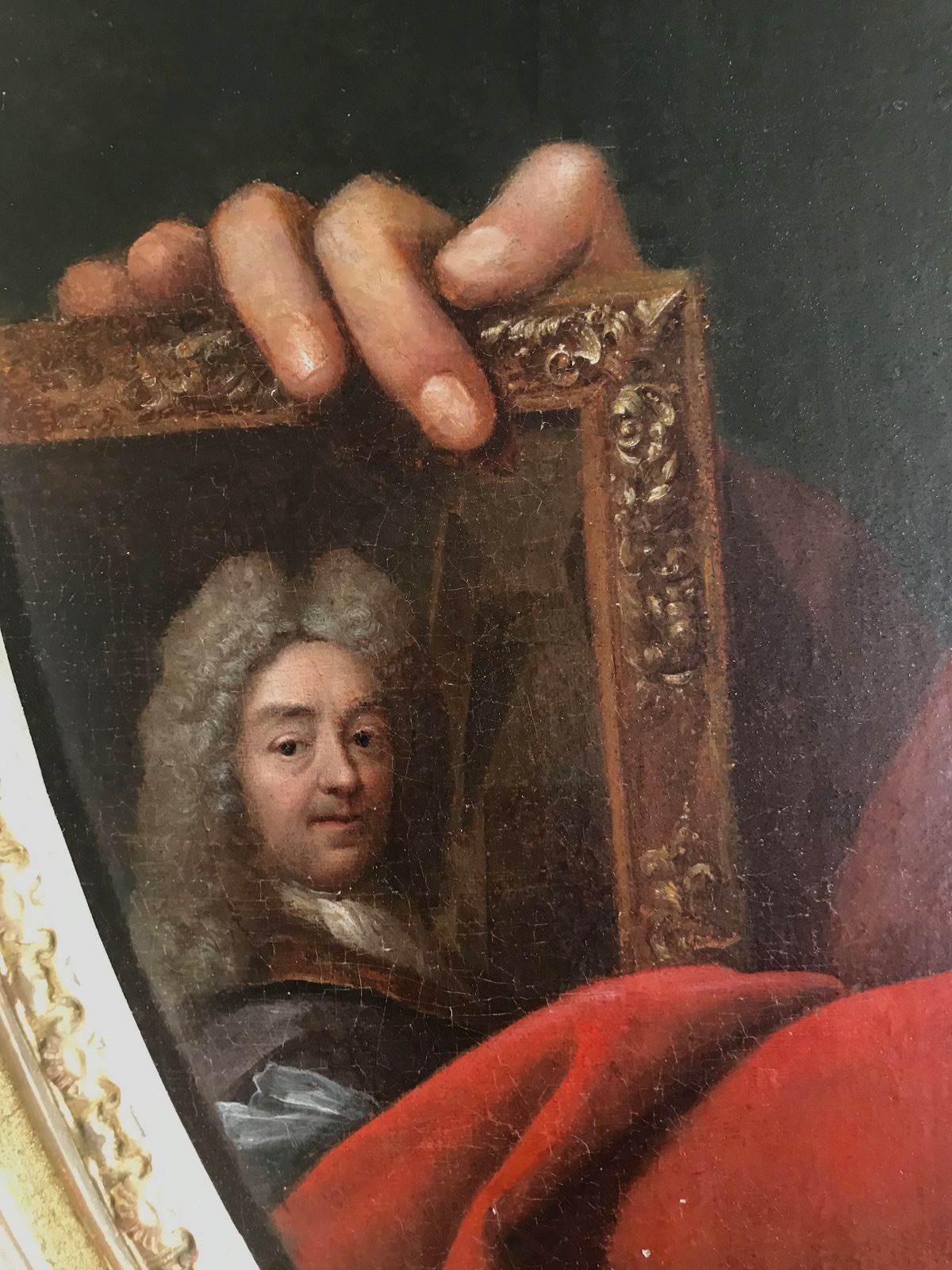
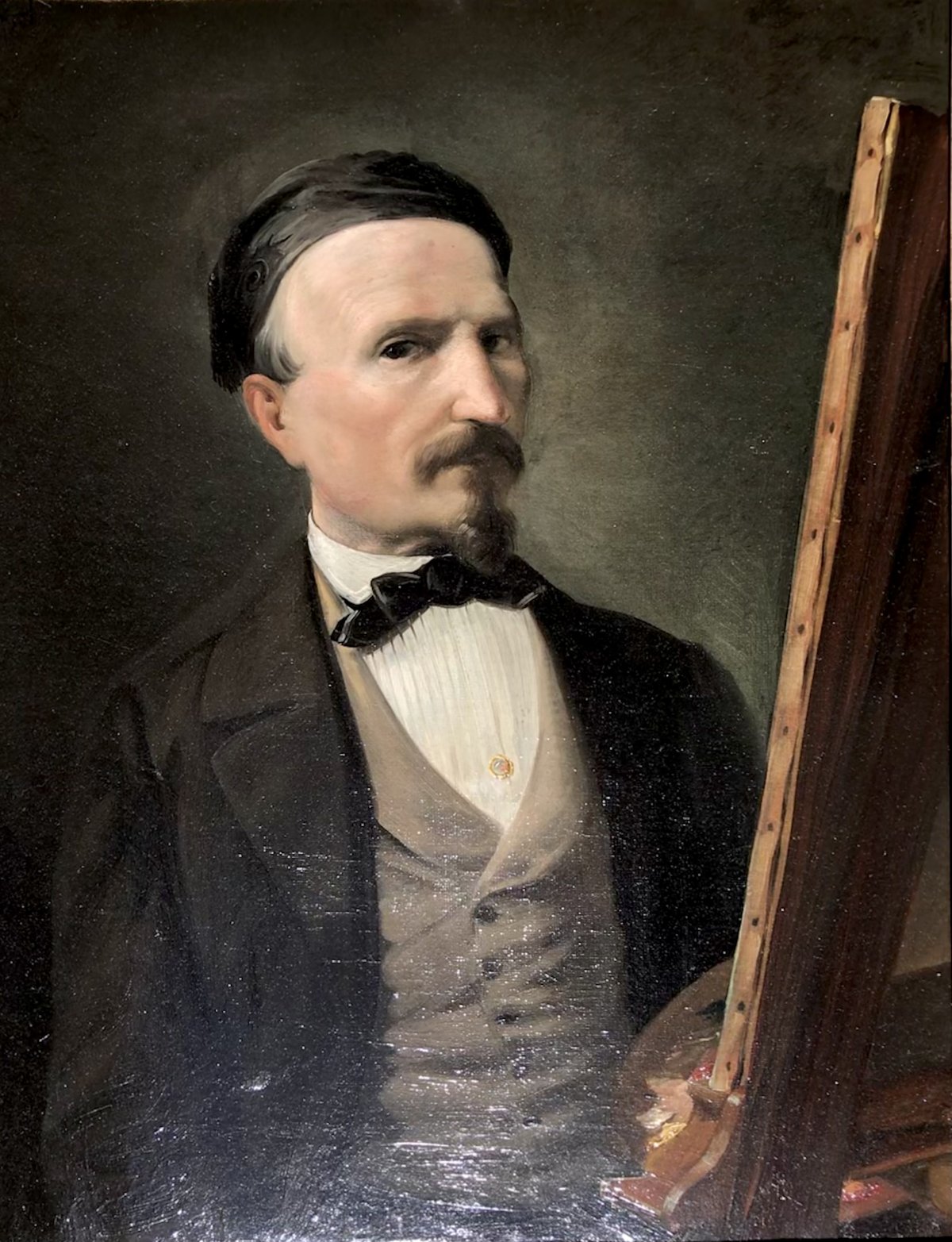
Portrait or Self-Portrait
Horace Vernet in his studio
This portrait of a painter is in a classical French realism style of the 19th century. Comparisons of the sitter to known artists of the period show him to be historical painter Horace Vernet, best known for his work at the Versailles palace. His pose is very focused and concentrated, There are rare cases of earlier painters reversing their self-portraits to appear as they are seen by others. Also, the size and format of the canvas he is working on is identical to that of this portrait. Despite his being right-handed, these indications make it conceivable that this is perhaps a self-portrait. A deeper stylistic study would be required to validate this.
Horace Vernet Identified
We can see that Vernet is approximately 40 years old in our portrait, painted circa 1830. His posture and bearing are similar to other portraits and drawings from the same period. The two images here show him at a similar age.
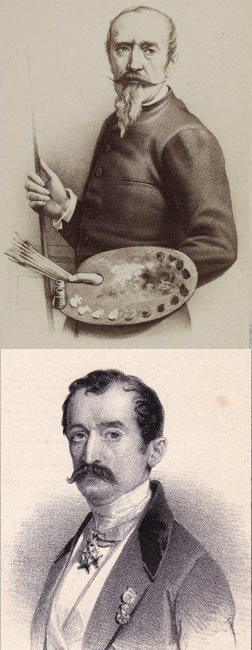
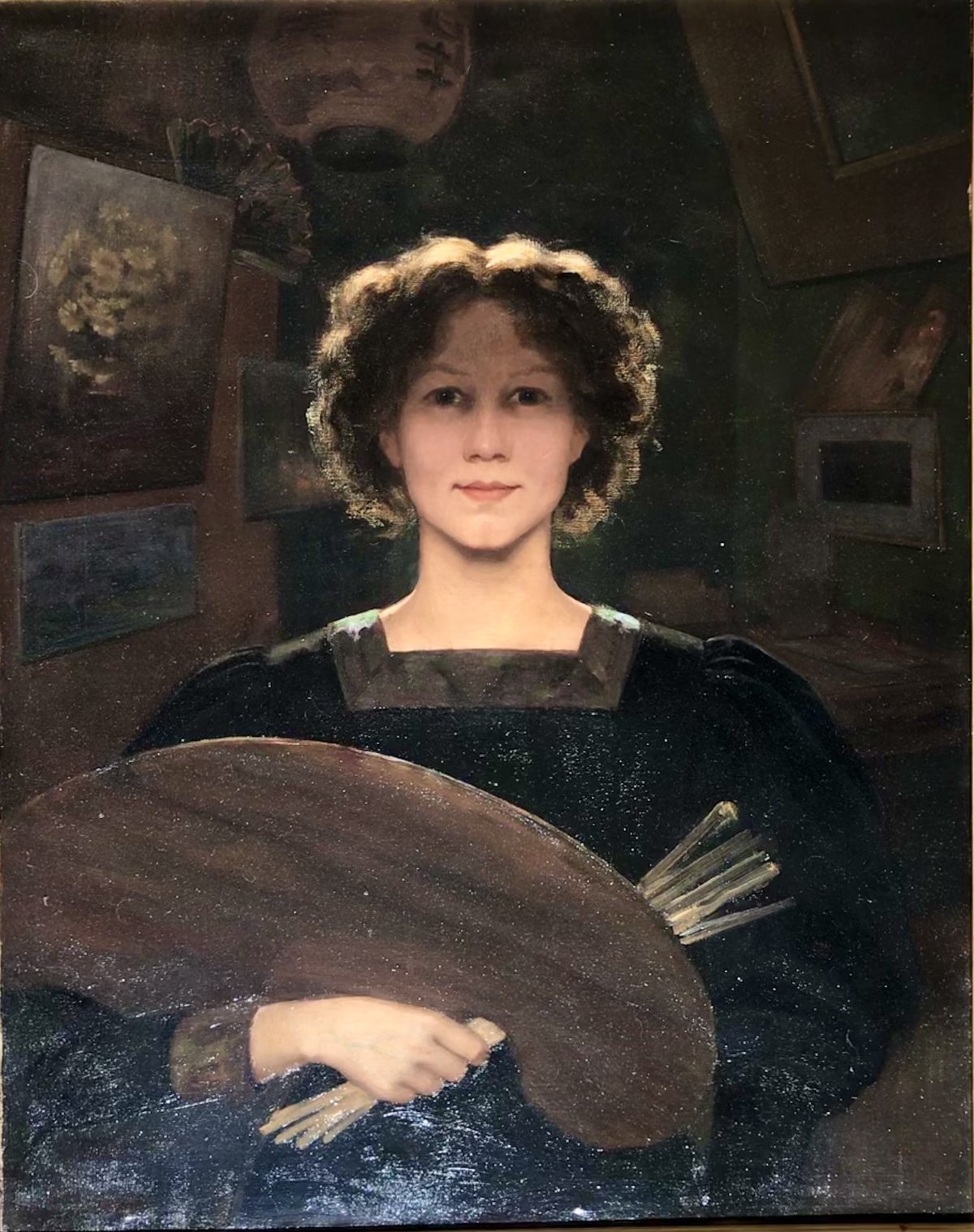
Artist & SITTER identified
Portrait of Jeanna Bauckby Bertha Wegmann
This large portrait of an artist represents Swedish painter Jeanna Bauck. It shows her youthfully holding her palette in the same Parisian artist studio she shared in the 1880's with Danish painter Bertha Wegmann. This makes the portrait likely to be by the hand of Wegmann, given their proximity, the similarity of artistic style, and the fact that Wegmann painted her more than 20 times. Bauck is lit by a skylight above her head, giving her golden hair a halo and casting a shadow across her face. In the background we can see a number of paintings adorning the wall as well as another palette, an oriental lamp and a fan. On the table behind her there is a vase and a notebook, possibly a diary.
Sitter and Author Identified
We can see in this other pose of Jeanna Bauck painted by Bertha Wegmann that her hair is again lit from above, in a similar halo effect. The artistic style is also quite similar, pointing to a work by the Danish artist. We will notice that these two women painters were ahead of their time, even if they didn't mingle with the French Impressionists who were maybe too bold in the presence of women? Their styles are of the northern schools, as they worked closely together under one another's influence.
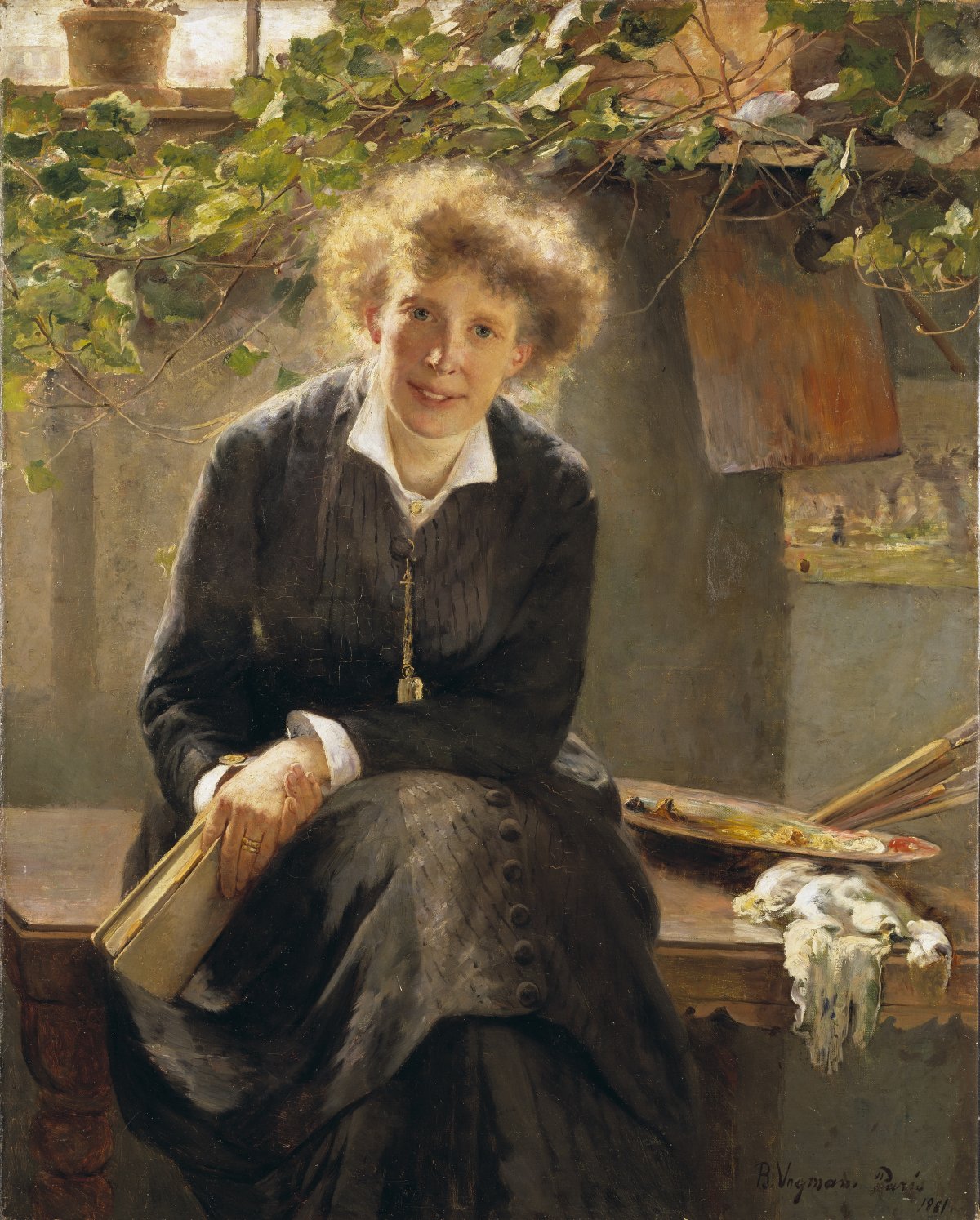
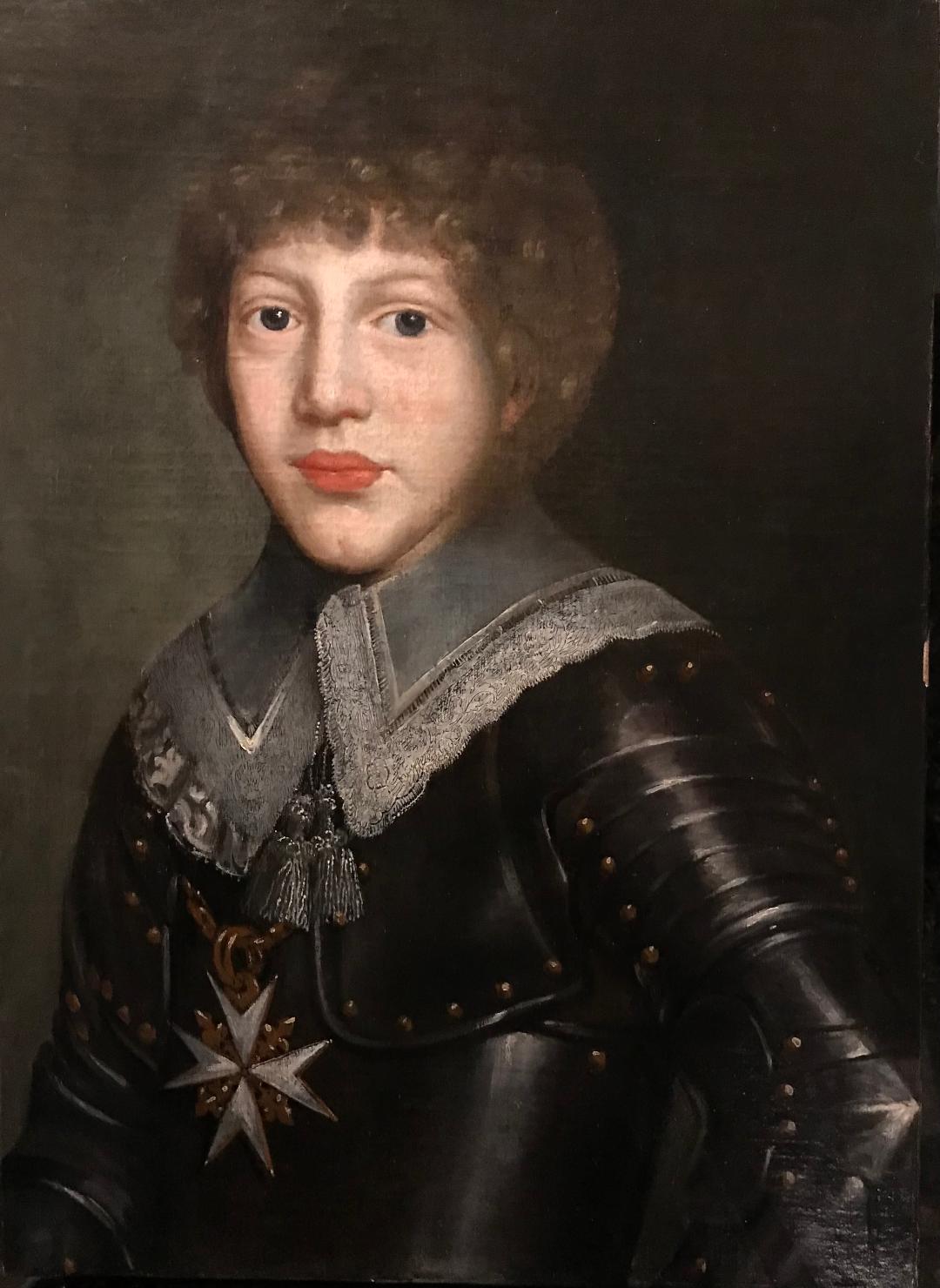
AUTHOR & Sitter identified
Portrait of Louis XIII
This portrait depicts a young man in armor. His rank is visible, as the decoration of the order of Saint Michel was only granted to the highest royal entourage. His face is quite recognizable, given that his features take after his father's. King Henry IV of France hid his angular chin beneath a beard. Louis XIII had been entitled to wear this decoration as Master of the Order of Saint Michel after his crowning at age 13.
Sitter identification
Our portrait of Louis XIII can be seen next to another one by Rubens, dated 1622. His younger features and body proportions show our portrait likely to have been painted some years before, circa 1615. That year he traveled to the Spanish border to meet his bride to be, infant of Spain Anne of Hapsburg, at the Exchange of the Princesses. This explains the armor worn for safety during travesl. He would have been 14 years old here when painted.
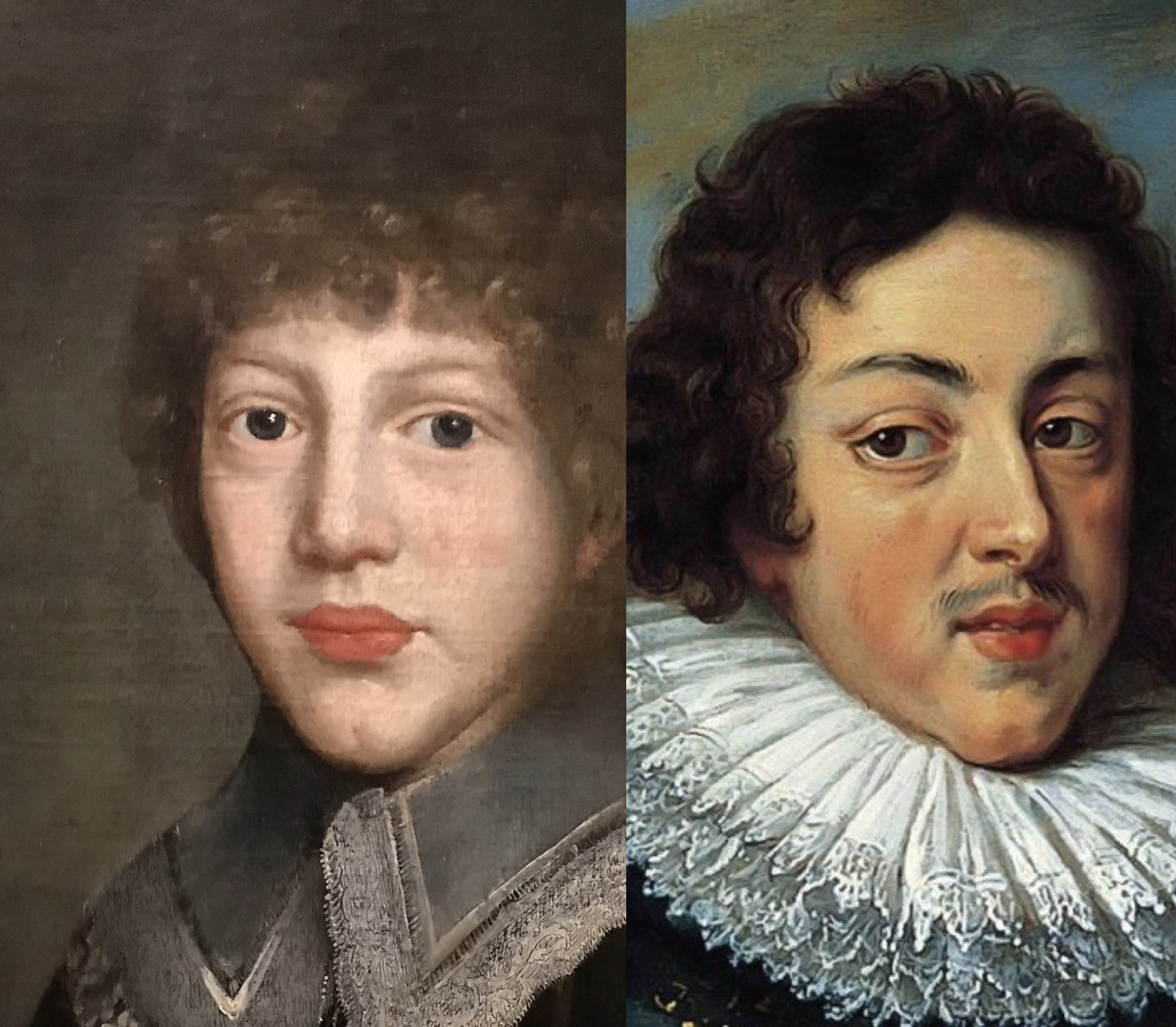
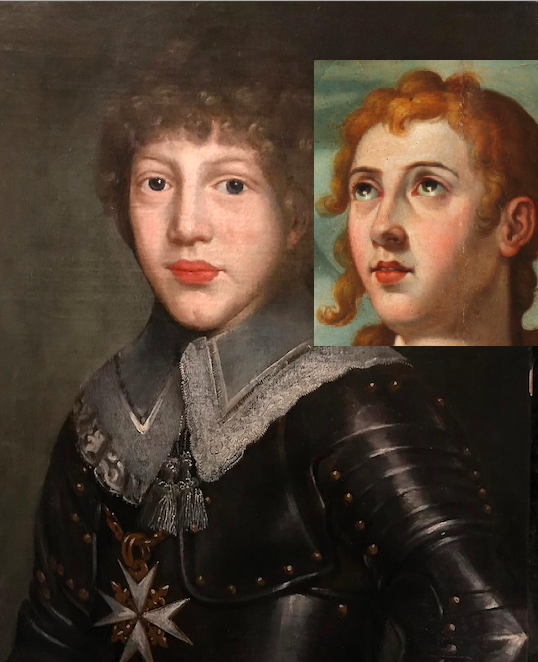
HIS MASTER'S INFLUENCE
Diego Velasquez student of Pacheco
Diego Velasquez first studied painting when apprenticed to artist Francisco Pacheco whose daughter he later married. We can see our portrait of Louis XIII by a young Velasquez compared to a religious work painted in 1608 by Pacheco. We will notice that the technique and contrasts are similar in both works, pointing to a strong influence of his master on a young apprentice Diego Velasquez whose stylistic imprint is unmistakable in the rendering of the face and hair of Louis XIII. While mastery had not yet been acquired by him at that early age, the artistry that later inspired Manet was already present, the depth of gaze of the sitter and a great sensitivity. Dating the work with the sitters' age also tells us that it is a an early work by Velasquez.
The fate of Royal siblings
Our portrait of Louis XIII has been rejoined in our collection by a portrait of his most beloved dear sister, Elisabeth de France. At a very young age these siblings were separated by their simultaneous forced State marriages between France and Spain.Betrothed to the future King Philip IV of Spain when she was 12,, Elisabeth was sent to Spain with her brother Louis for the famous "Exchange of the Princesses." She fell dramatically ill on the way and had to halt in Bordeaux, leaving her unconsolable brother Louis to continue alone. That situation possibly explains his grave expression during this pose.
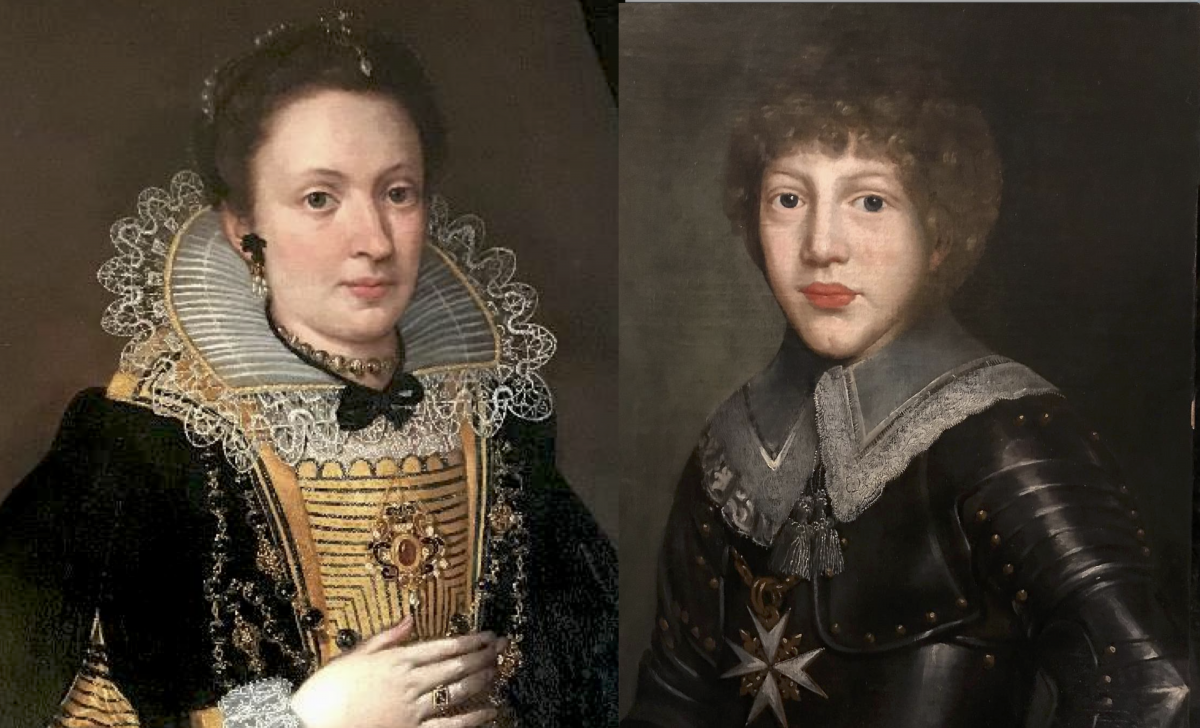
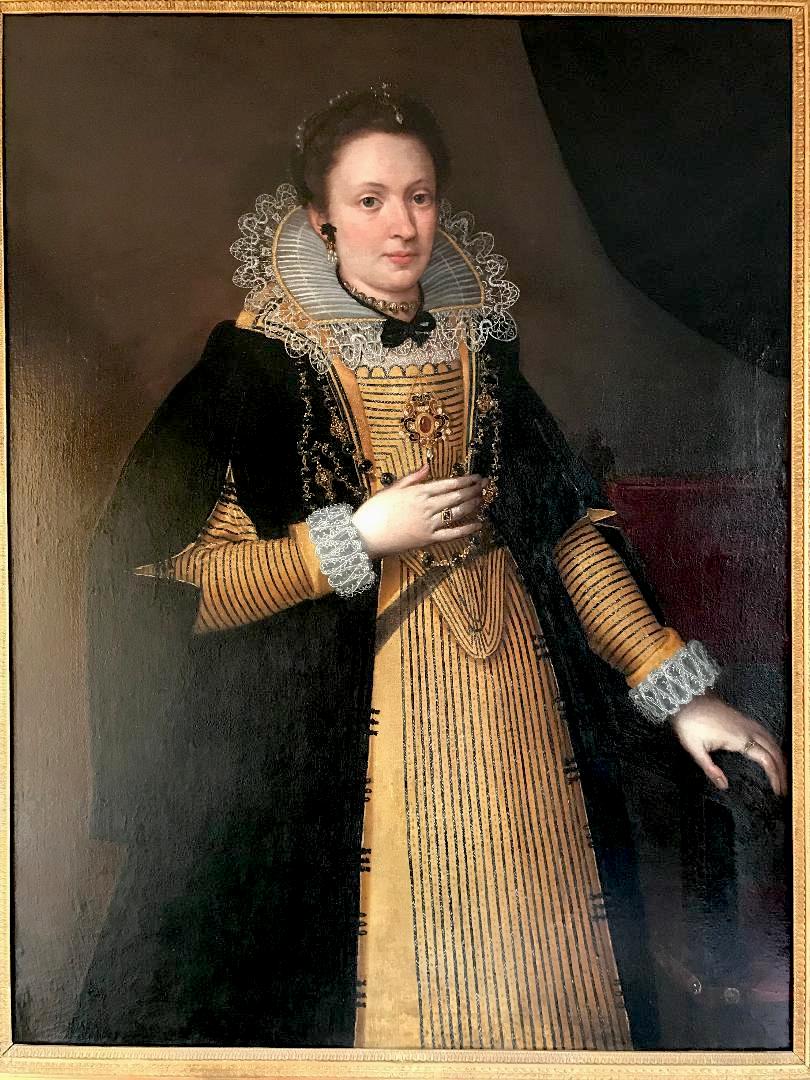
AUTHOR & Sitter identified
Frans Pourbus portraitof Queen Isabel
This large three quarter length portrait depicts a young lady standing against a neutral background. Her high rank is manifested by her pose with a hand resting on the arm of a chair and also by the jewels she wears. Study of the period clothing reveals it to be a portrait from the beginning of the 17th century. The billowing dress shows her awaiting a child. Her tiara of pearls and the adornment of her dress point to the fashion influence of Marie of Medici, then Queen of France and the sitter's mother. Marie of Medici's favorite painter was Frans Pourbus the Younger, the painter of this portrait. Indeed this work follows the rigorous instructions of own master Antonis Moro: three quarters length, a plain background and slightly larger than half of life-size dimensions. The pose holding the arm of a chair symbolizes the power of the throne in royal portraiture.
Elisabeth de France to become Isabel de Borbon, Queen of Spain
In a family portrait showing Henri IV with his wife and children, painted
circa 1608 by a follower of Jacob Brunel, we see Elisabeth in a red dress standing next
to her brother the future Louis XIII. Even at a very young age we can note her distinctive bearing, and identical arm position and gesture to our portrait. The lower comparison is a detail of a painting by Peter Paul Rubens commemorating the Exchange of the Princesses leading to her precocious marriage to the crown prince of Spain. His work shows Elisabeth at the age of 12, albeit painted seven years later in 1622. We nonetheless notice strong similarities in her facial features and their position. Pourbus is surely the author of this work. He was the favorite portraitist of her mother and this distinctive artistry corresponds to no other court painter of that time period.
first duke of marlborough
John Churchill by Sir Godfrey Kneller
This large portrait can be dated to circa 1720 thanks to the short lived fashion of such elaborate wigs. The pose is classical along the standards of earlier 17th century portraiture pointing to an experienced artist who had painted portraits decades earlier. The sitter poses in a heavy mantle and in the background there is a red drapery and a large column symbolizes his social stature, it also represents his beloved residence of Blenheim Palace. It was named after one of his victories over King Louis XIV. The First Duke of Marlborough John Churchill is today considered to be the greatest military leader in the history of England. A close friend of King Charles II he retained considerable stature in court, as well as through his wife Sarah's close friendship with Queen Anne.
John Churchill portraits
Sitter comparison
In comparing the sitter in our portrait with a Mezzotint engraving conserved at the National Portrait Gallery of London of John Churchill after Michael Dahl, we note the same facial shape and identical features and proportions. The forehead, eyebrows, eyes, nose, mouth, chin and cheeks are quite the same even if the pose for Dahl took place some years earlier. We can therefore conclude without hesitation that this is indeed a portrait of the First Duke of Marlborough John Churchill.
The Churchills by Godfrey Kneller
A portrait of Sarah Churchill painted in 1700 by Godfrey Kneller is conserved at the National Portrait Gallery in London. While it was painted some twenty years before the our portrait, and the sitter is an elegant young woman rather thant a stately older gentleman, there are stylistic resemblances between the two works. Customarily, poses were the sole prerogative of portraitists, who would place the sitters in ways they would be best portrayed. In these portraits we can see the same person at work, bringing the sitters to carry themselves with precise gestures. In each painting the arms participate as lines of tension that lend structure to the composition, Also, their hands are very expressive each in their own way, as if entering into a dialog. When exercised so strongly such stylistic characteristics are unique to Godfrey Kneller.
Stylistic comparison
It was usual for the most celebrated portraitists to have their apprentices or assistants participate in their works, painting the background or fabrics. The main artist would focus on the face and hands, leaving lesser elements to others. However, in these two portraits we can see that the artist instead rapidly brushed the clothing himself, using the lines and sharp angles of the folds to capture and release the eye of the viewer. His depiction of the clothing was simplified for several reasons, one being that in so doing the contrasted shapes could better participate in the composition. Another was that Kneller was avant-garde and brought focus to the interior presence of the sitter by avoiding to belabor their surroundings. We will not see similar graphic power utilized in the clothing of other portraits from the period, pointing to the same authorship by Sir Godfrey Kneller.
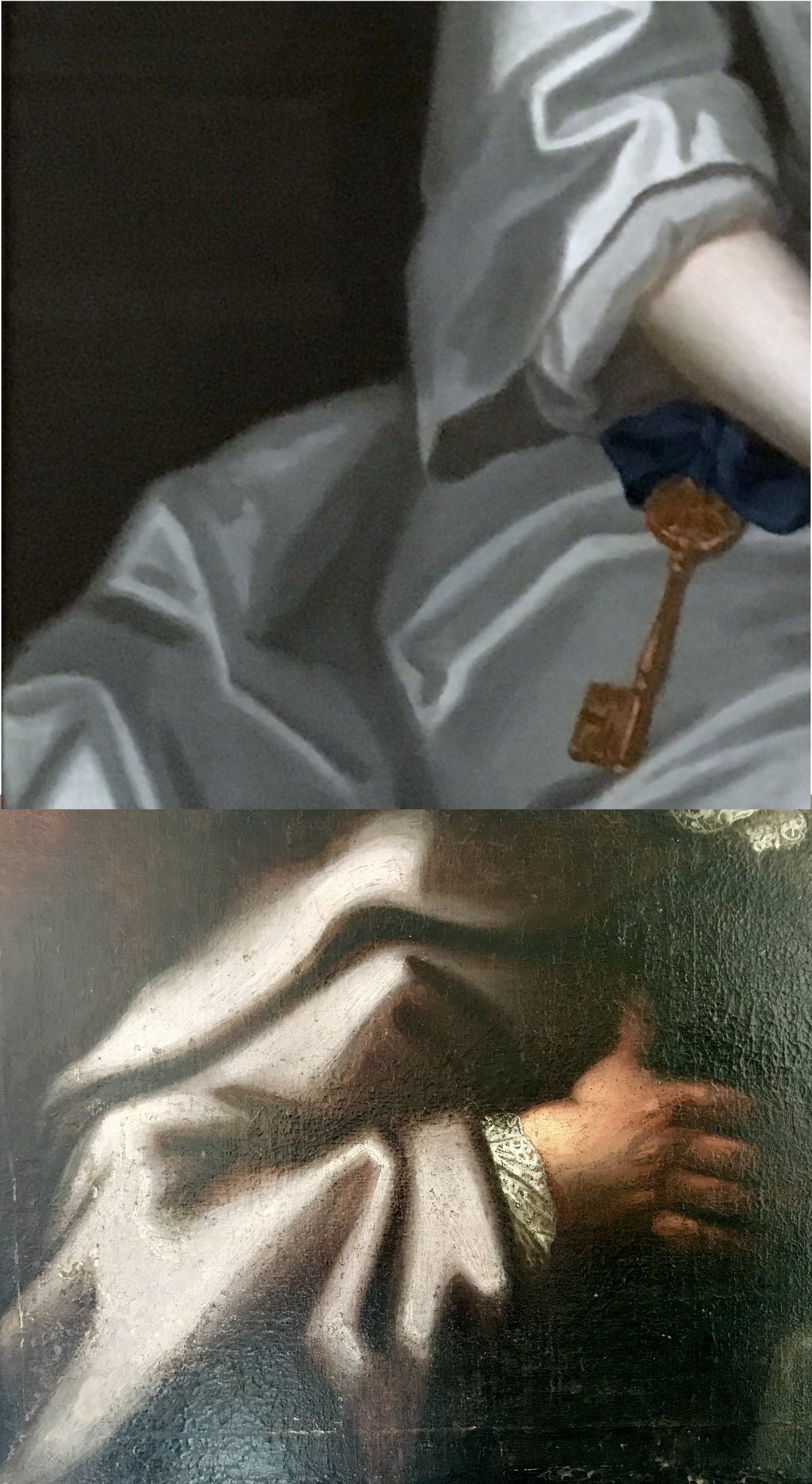
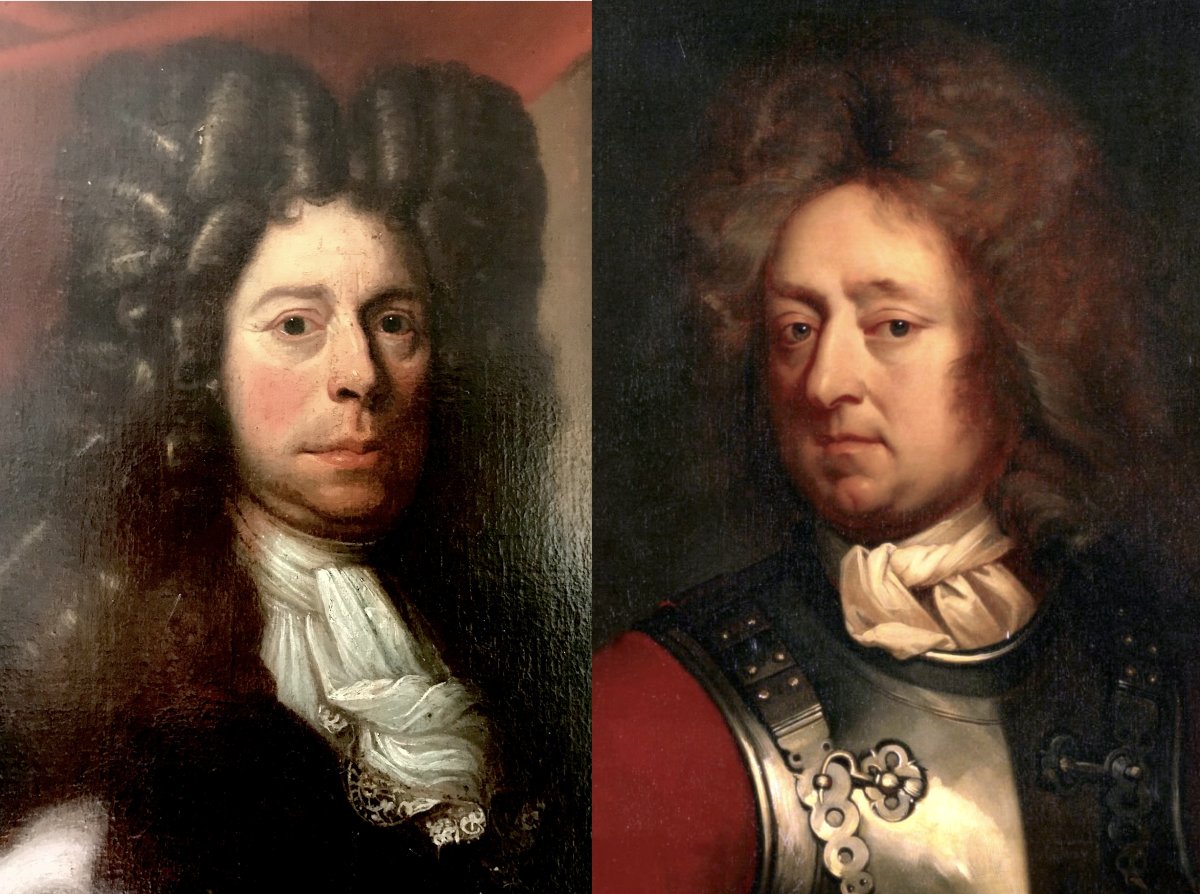
Kneller portraits of Churchill
The same artist the same sitter
A portrait of John Churchill by Godfrey Kneller painted in 1705 and conserved at the Palace of Versailles. shows him with identical features except for the angles at which they posed. In our later portrait he is facing us and his head is slightly tilted back, making his nose look a bit shorter and his upper lip a bit taller. We can recognize very similar artistry in both portraits that were painted fifteen years apart., Both the sitter and artist were older, explains a number of differences in demeanor and style. Our portrait was painted in their final days, both for the sitter and for the artist.
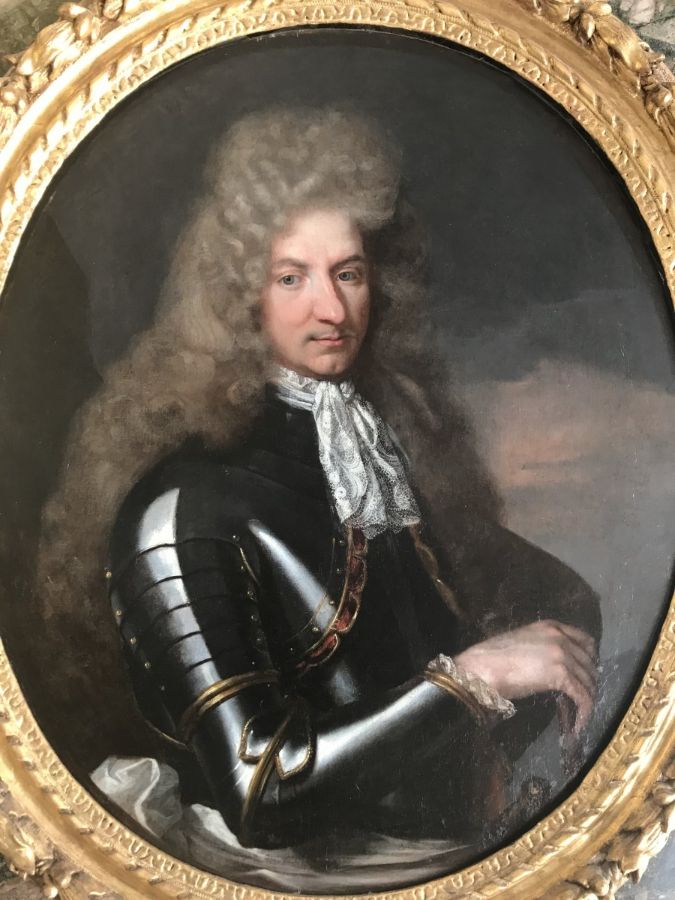
Art revealed by Restoration
Frederick IV of Denmark and Norway
This oil on canvas painting circa 1710 represents King Frederick IV of Denmark and Norway. To his left we can see represented the low flat scenery of Denmark while behind him we notice the high cliffs of the Norwegian Fjords. His face had been repainted, but not to hide damage as is often the case. It was to render the sitter similar to most other portraits of this king. His face was quite asymmetrical with his nose leaning left. This gave him a less prominent profile when viewed from that side, in his most usual pose. Here he s portrayed viewed from the right. This rare and original portrait has be restituted by removing his repainted face and showing once again the subtle artistry that had been concealed by rudimentary repainting in the 19th century. This work has not yet been attributed to a given artist.
Frederick IV's left profile
We can note that his left profile is somewhat more flattering and therefore it was more often rendered in his portraits. Here he is painted in 1693 by Hyacinthe Rigaud when still a year-old Prince. A similar face was painted on top of the above portrait, where he is approximately 20 years older.
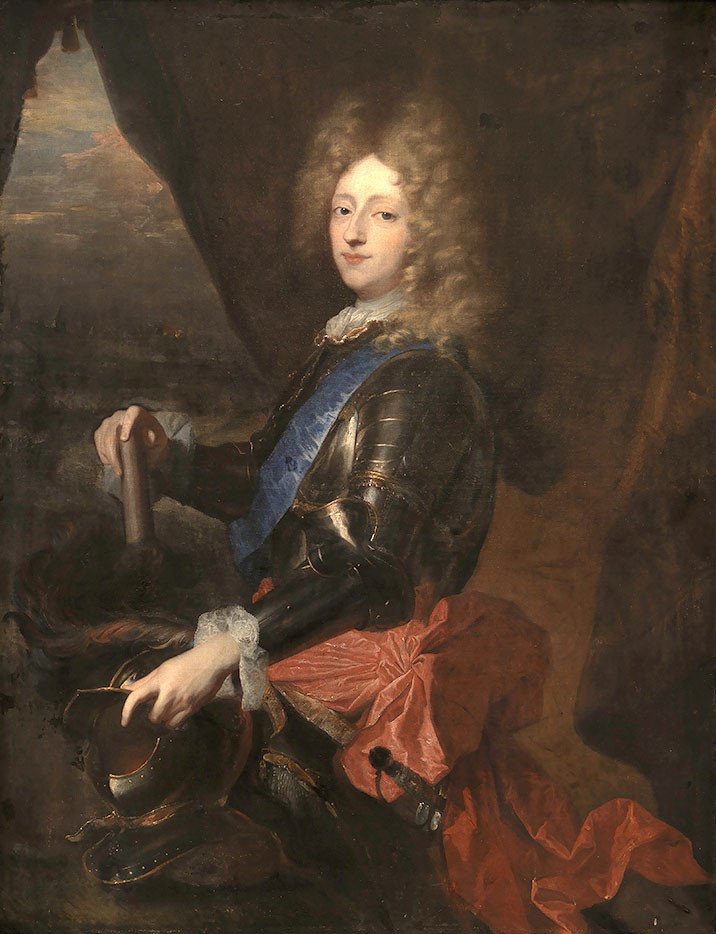
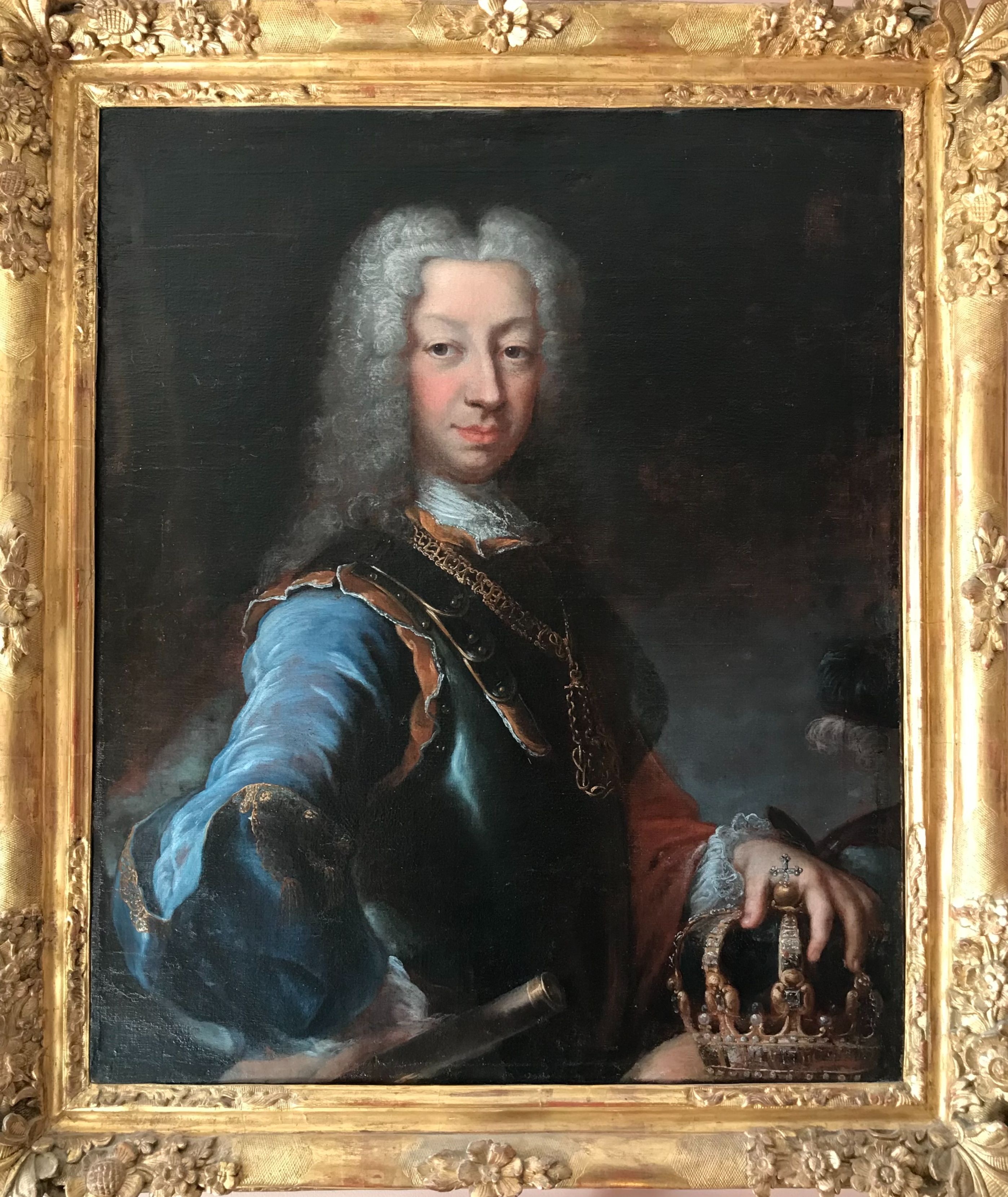
AUTHOR & sitter IDENTIFIED
Charles Emmanuel III by La Clementina
This portrait circa 1730 shows a young man standing with his hand on a crown and a command baton in the other hand. He is in light armor and wears a gold necklace. He was identified thanks to these elements as Charles Emmanuel III Duke of Savoie and King of Sardinia. This portrait was authenticated by the curators of the Palazzo Real of Torino as being a work by his court painter Giovanna Battista Clementi, known as La Clementina.
Charles Emmanuel III
We can see here another portrait of this Duke by the same painter kept in the galleries of the Royal Palace of the Dukes of Savoie. The Duke is more casual in this artistic pose representing his rule over his realm. We can note the same gold necklace of great symbolic importance for the family of Savoie.
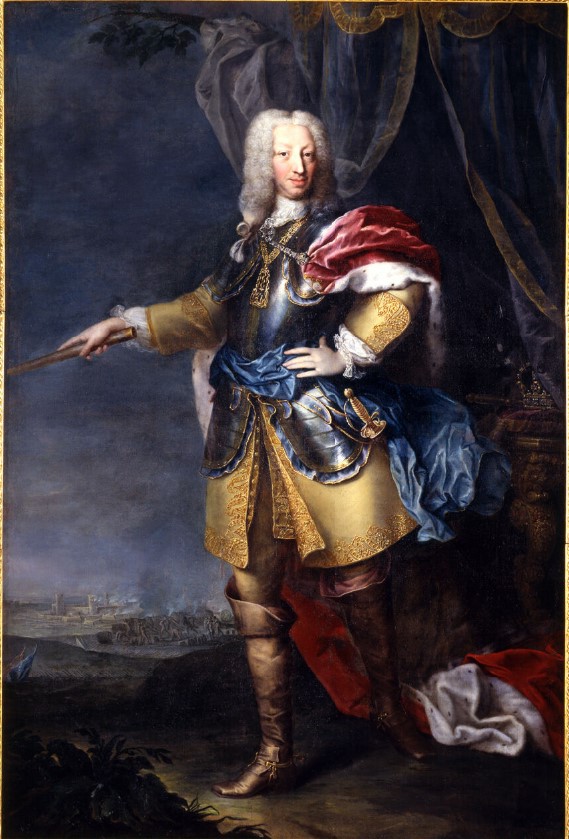
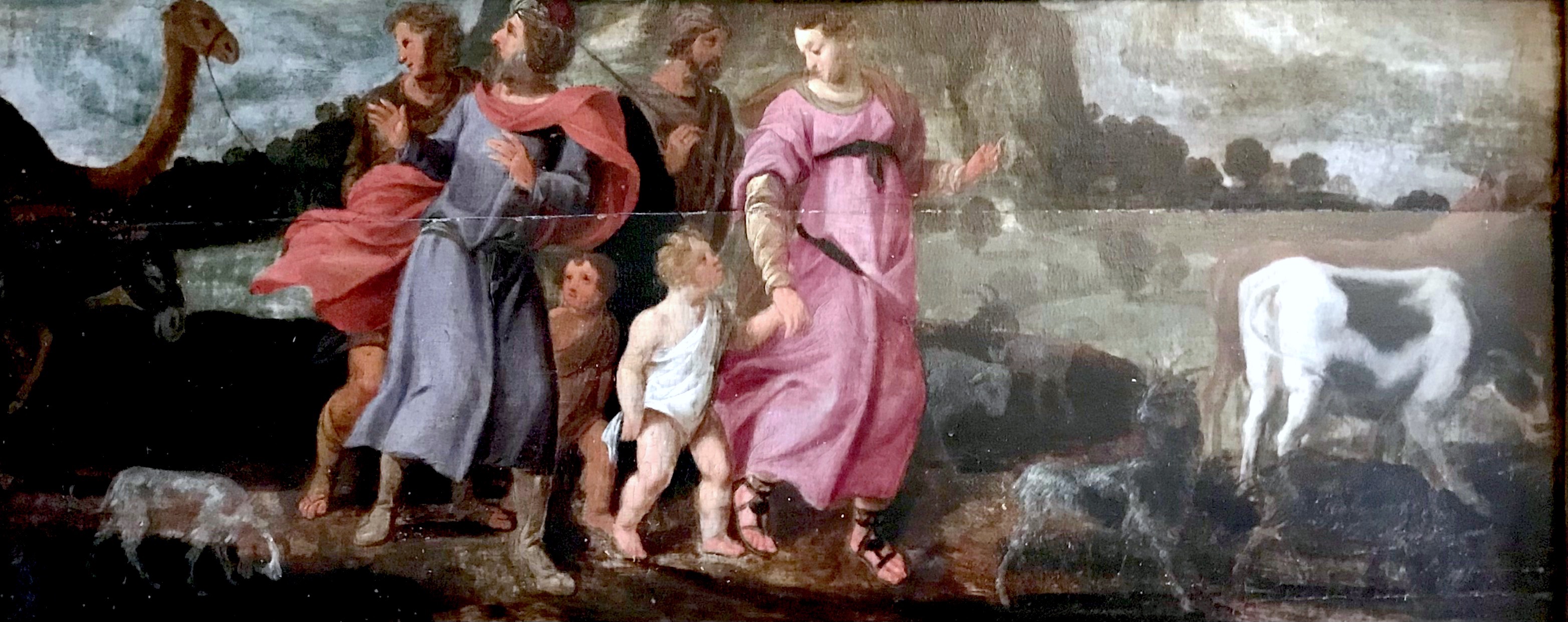
Renaissance Religious Allegory
Abraham's journey to Canaan
This painted wood panel dating back to circa 1580 is a religious allegory showing Abraham with his family on the road to Canaan. It is currently under restoration in our collections. Infrared photography revealed that several small animals in the cortege were later added atop the original layer of paint in the 18th or 19th century. These will of course be cautiously removed during restoration to its original state.
Author identified by HIS Models
Carracci's early style
This small work quickly painted by Annibale Carracci. was identified thanks to his use of the same models who posed for many of his other works. Given his rapid brushstrokes and the speed of execution it was most likely a preliminary study for a larger painting, potentially commissioned by members of the clergy.
Regular models of the artist
Observing the face and gestures of Abraham, we can see that his rendering is quite similar to that of the same model used in Carracci's Temptation of Saint Anthony, with almost identical hand gestures and highlighted fingertips. We can also see that Sarah was painted from the same model as Carracci's Madonna Praying. The same two young children were used as models for Isaac and Ibrahim as for the Cherubs playing in the shade in Carracci's Sleeping Venus. Additional characters in this allegory can also be found in several other Carracci paintings.
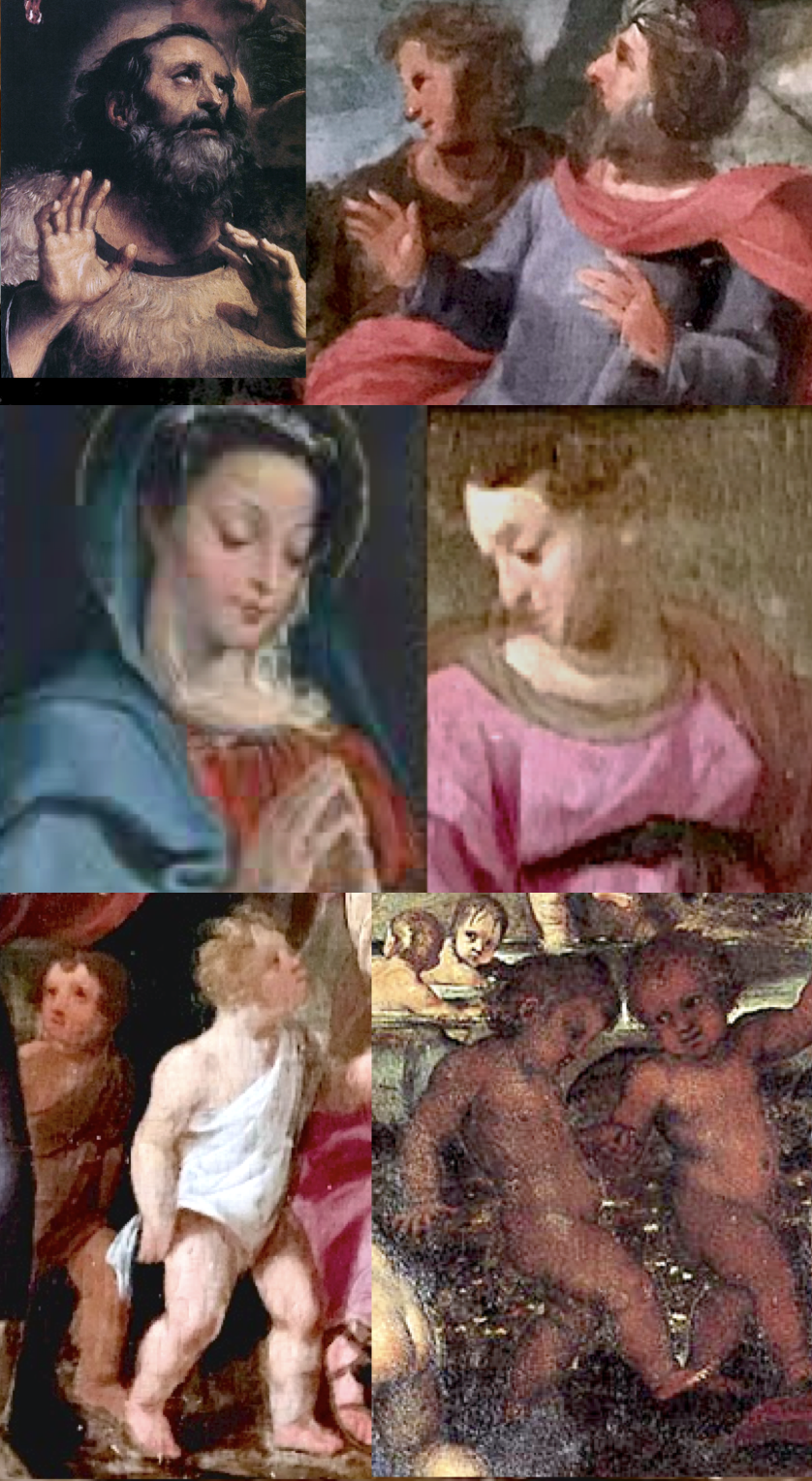
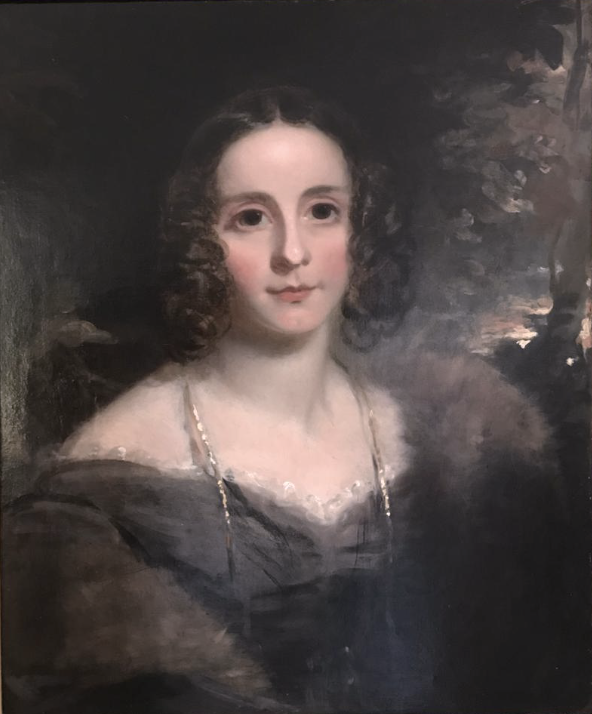
SITTER identified by INSCRIPTION
Betsy Bonaparte by Sir Thomas Lawrence
This portrait, readily recognizable as by the hand of British court painter Sir Thomas Lawrence, bears an inscription on its back: "Miss Elizabeth, Lady in Waiting to Queen Caroline". This allowed the identification of the sitter., the young spouse of Jérôme Bonaparte, a transfuge from the Americas stranded in London. The young heiress from Maryland had married Napoleon's youngest brother Jérôme but was prevented from debarking in France by a naval blockade. She sought refuge in England where she gave birth to a son, Jérôme Napoleon Bonaparte. Elizabeth Patterson Bonaparte, Princess of Montfort, was hosted in London by Queen Caroline of Brunswick, herself estranged from her spouse King George IV. Sir Thomas Lawrence was often present in the Queen's entourage. This brought about this informal 1805 portrait painted for a lovely lady in his social circle.
Miss Elizabeth, Lady in Waiting
Elizabeth Patterson Bonaparte is seen here in an 1804 triple portrait by American painter Gilbert Stuart. This was painted when she was still joyous and carefree, betrothed to a member of the French imperial family. Her later portrait above, in our collections, shows her more sullen and saddened by her broken dreams. Despite the very different moods and painting styles, we can recognize a number of her features such as the prominent ridge of her nose, her high forehead, her narrow mouth, her delicate chin and a long neck surmounting sloping shoulders. Her low-cut décolleté seen in both portraits is daring for the period. Since meeting Jérôme, she was known for her provocative dress and for shocking polite society with revealing attire.
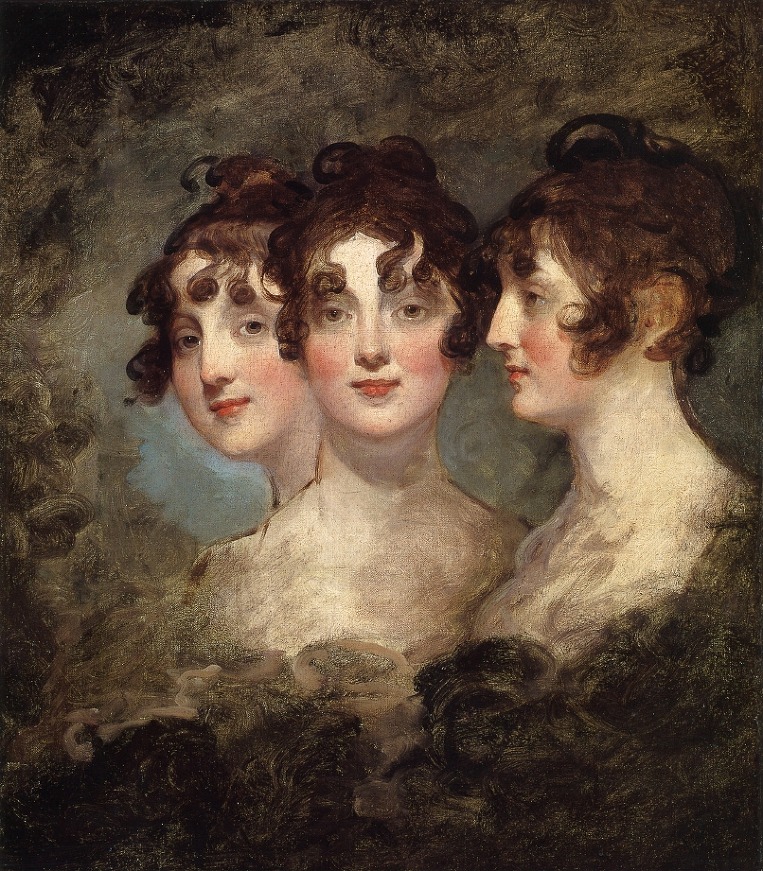
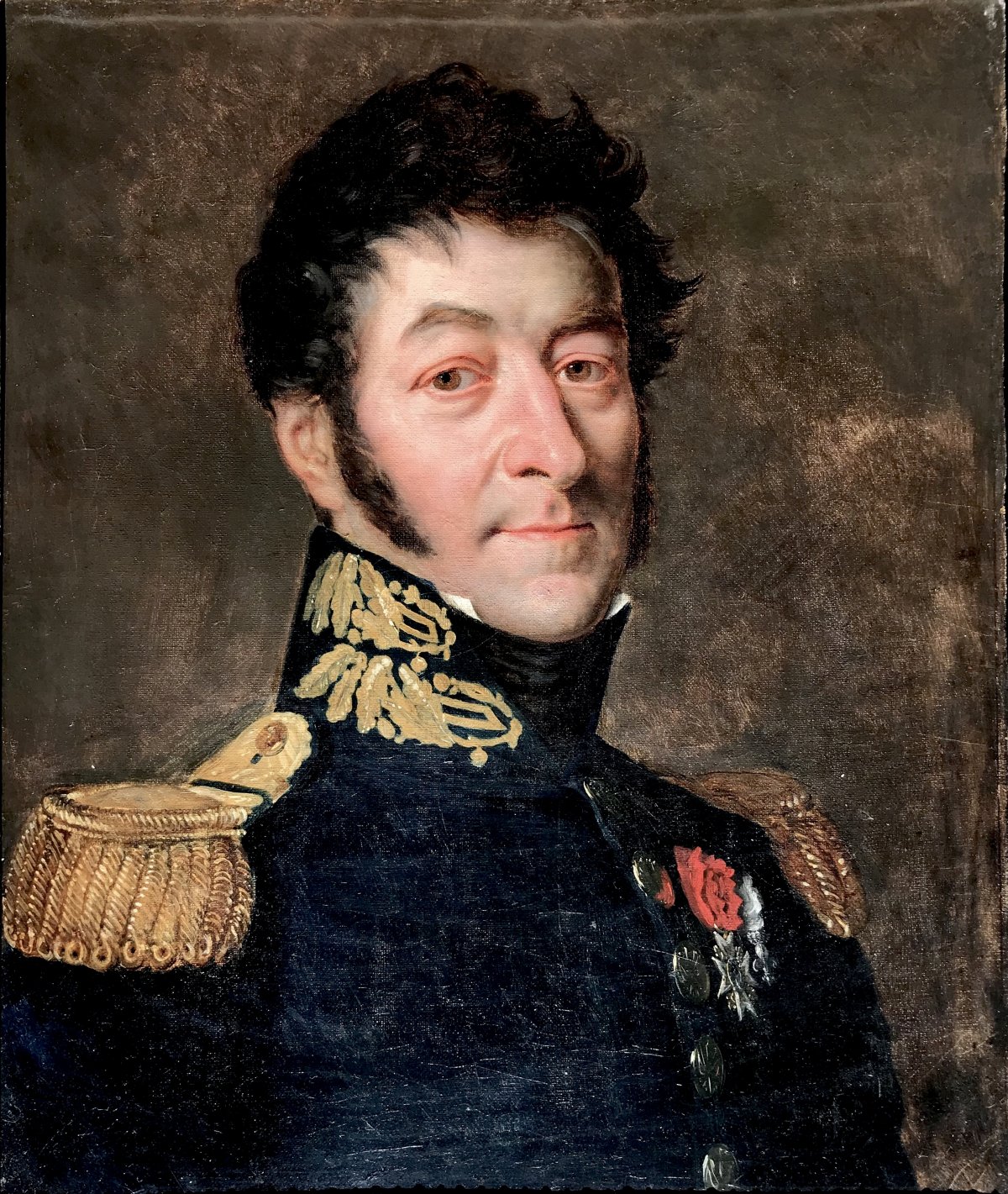
AUTHOR & Sitter identified
Portrait of Maréchal Marmont by Baron Antoine-Jean Gros
This is the portrait of a man with a rare destiny. At the military academy of Brienne Auguste Frederic Louis Viesse de Marmont protected a frail young bullied classmate, Napoleon Bonaparte. This brought him Napoleon's lasting debt of gratitude. Marmont was a brilliant military strategist and Napoleon's Aide de Camp in the Campaign of Italy. In Egypt he led the artillery to victory at the battle of the Pyramids. Marmont necessarily knew Napoleon's battle painter Antoine-Jean Gros who accompanied them in their military campaigns. Thirty years later he was to paint a portrait of Marmont, then in his 50s. Field Marshal Marmont had became Governor General of Dalmatia and then Duke of Ragusa where he was long remembered by the local population for his humane rule and useful public works. After the battle of Waterloo Marmont was convinced that the tides had turned and that the war was lost. He hoped to save France from foreign occupation. With two other Field Marshals and several generals he surrendered to the Czar, forcing abdication upon Napoleon. Exiled to the island of Saint Helen, Napoleon later wrote: "Vanity was Marmont's downfall, posterity will rightly diminish his life. Yet his heart is worth more than his legacy.."
Marmont by Gros
After the fall of Napoleon, painter Jacques-Louis David had to flee Paris due to his role in the French Revolution and the fact that he had voted the death of Louis XVI. At the Restoration of Louis XVIII, Antoine-Jean Gros took over as head of the art school while Marmont became Governor of Paris and Major-General of the Royal Guard. In our portrait we note a similar depiction of medals and uniform buttons as in Gros' portrait of Napoleon at the Arcole bridge. We can also compare his features to those in a rare life portrait with him as sitter in 1810 by Jacques-Luc Barbier-Walbonne. It commemorates his promotion to Field Marshal. Later portraits of Marmont were painted when he was in exile, using likenesses of a young Marmont. In our portrait he was indeed the sitter. We can tell from his features and expression that he has suffered injuries and scorn, from his thin lips it looks as though he may have lost his teeth.
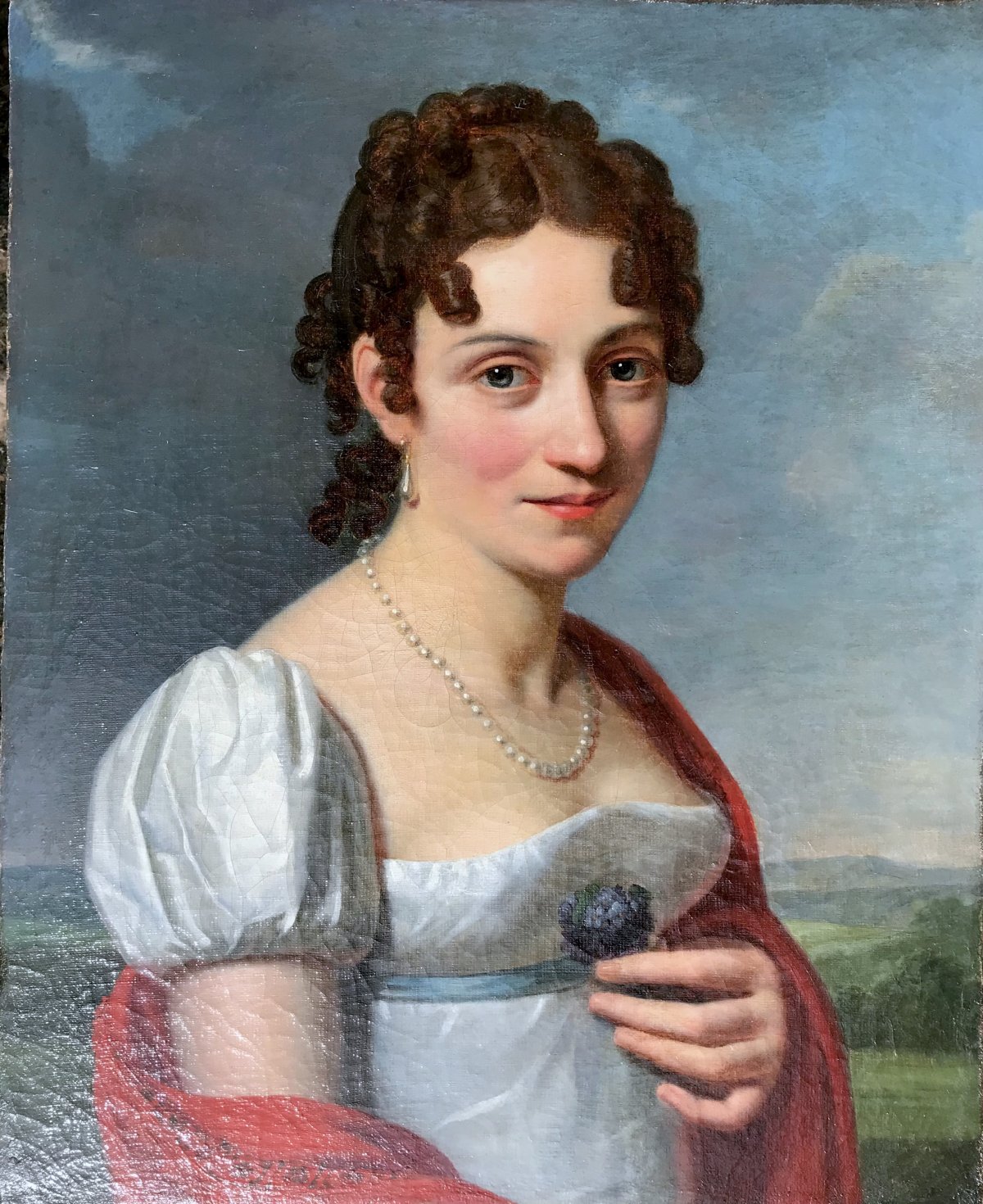
Sitter identified from the AUthor
Portrait of Pauline Bonaparte
This intimate romantic portrait is signed Germain and dated 1812. Further examination revealed that the sitter is not just any young woman, she bears a striking resemblance to one named at that time "the most beautiful woman in the world." Lending to this reputation she was sculpted by Canova as Venus, the Goddess of Love. Pauline Bonaparte, sister of Napoleon, was known for her tumultuous episodes with artists. We can imagine that the painter of this portrait may have himself entertained such thoughts, as she poses holding a violet, the symbol of romantic love.
Identification of Sitter
We will notice that in the painting from 1809 by Robert Lefèvre her ears are identical in size, position and pattern. Despite the very different artistic style, Lefèvre's painting being idealized, she has the same head shape, eyes, mouth and chin. We recognize her nose especially well from Canova's statue, as well as her facial shapes and hairstyle. Unlike these other representations, Germain's portrait is more realistic, showing her features as those of a simple, charming young woman.
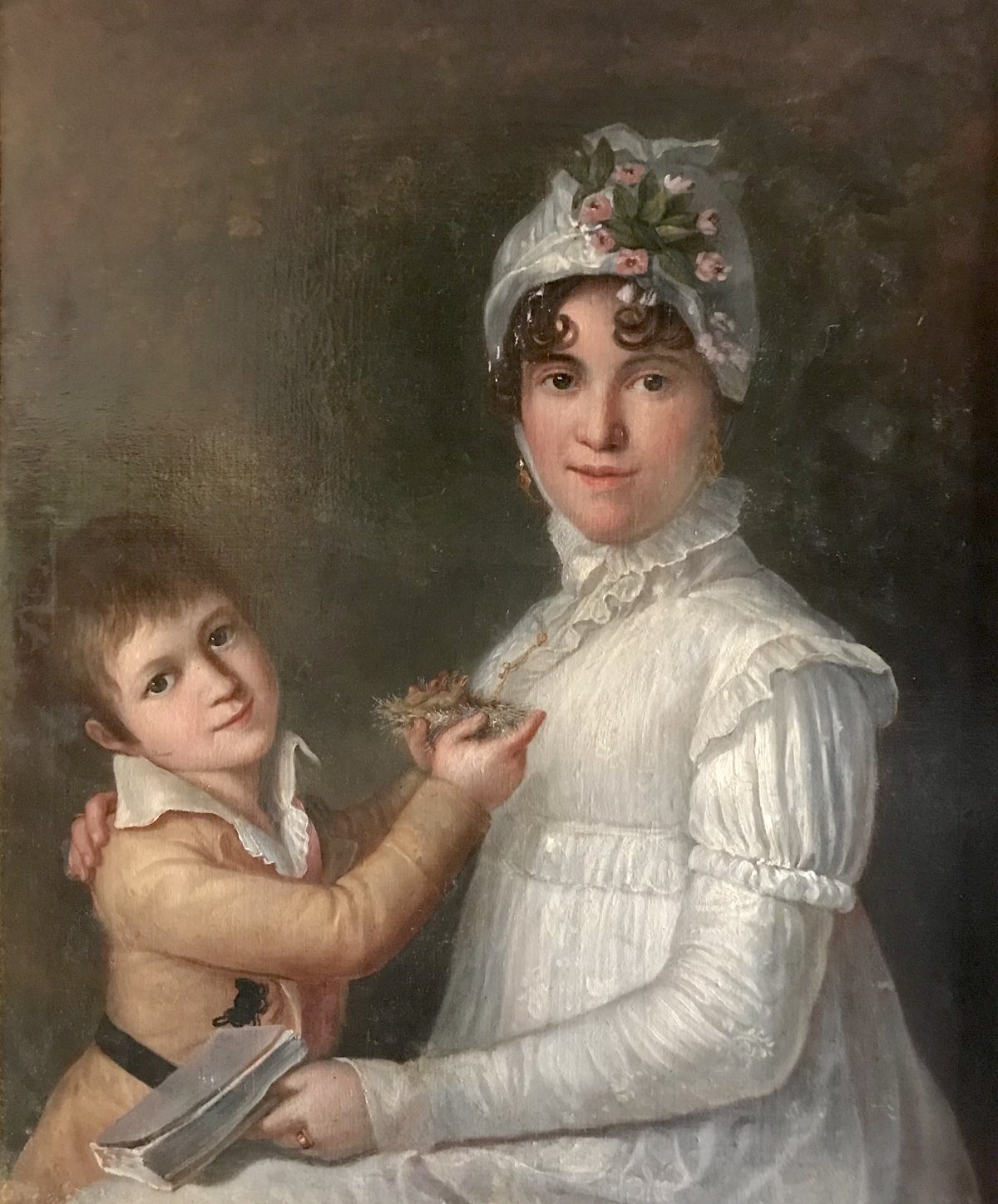
AUTHOr & sitters identified
Joséphine and Eugène de Beauharnais by Elisabeth Vigée Lebrun
This double portrait, currently under restoration, shows a mother with her son. Several details betray the identity of the sitters. One can recognize the facial features of Joséphine and her son Eugène. Their respective ages date the painting to circa 1787, she would have been 26 at the time, making this perhaps her earliest known portrait. Josephine often wore rose buds in her hair and had a passion for birds, later building an aviary in the garden of her manor La Malmaison. Her dressing gown is early neoclassical sytel. Posing in intimate attire was the fashion in the final years of Louis XVI. According to her memoirs, painter Elisabeth Vigée Le Brun claimed she was the first artist to place curls on her sitters' forehead to frame their face. This is one of the earliest of such instances. pointing to her authorship of this double portrait.
Empress Josephine by Firmin Massot
Painted 25 years later in 1812, we can note that Josephine has changed very little. In this portrait she holds a striking resemblance to ours, with identical eyes, head and body shape as well as the same pursed lips.
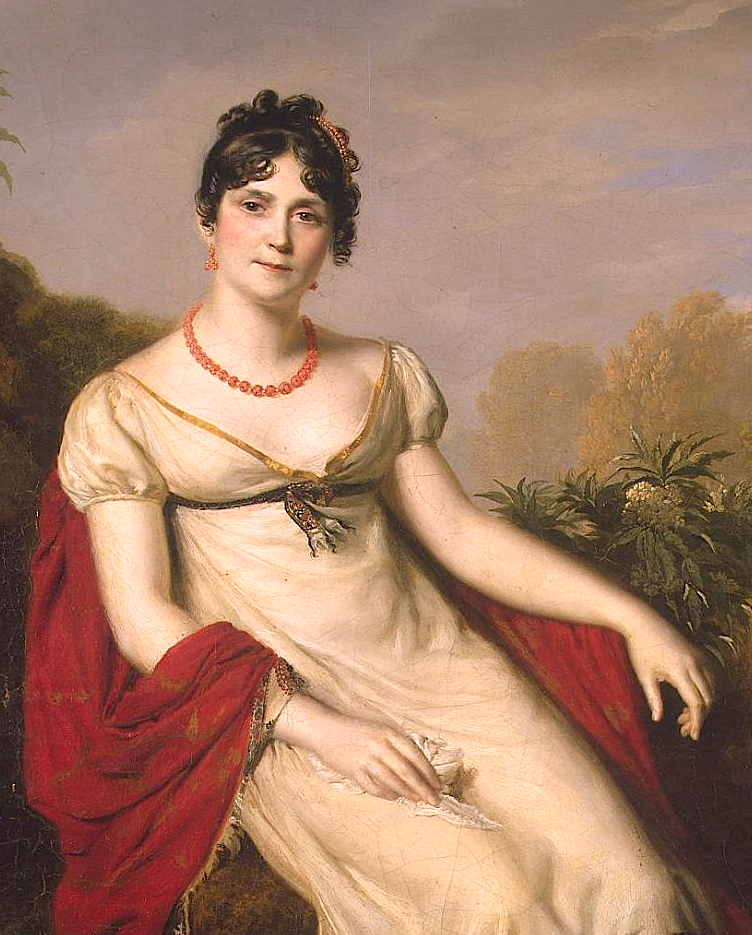
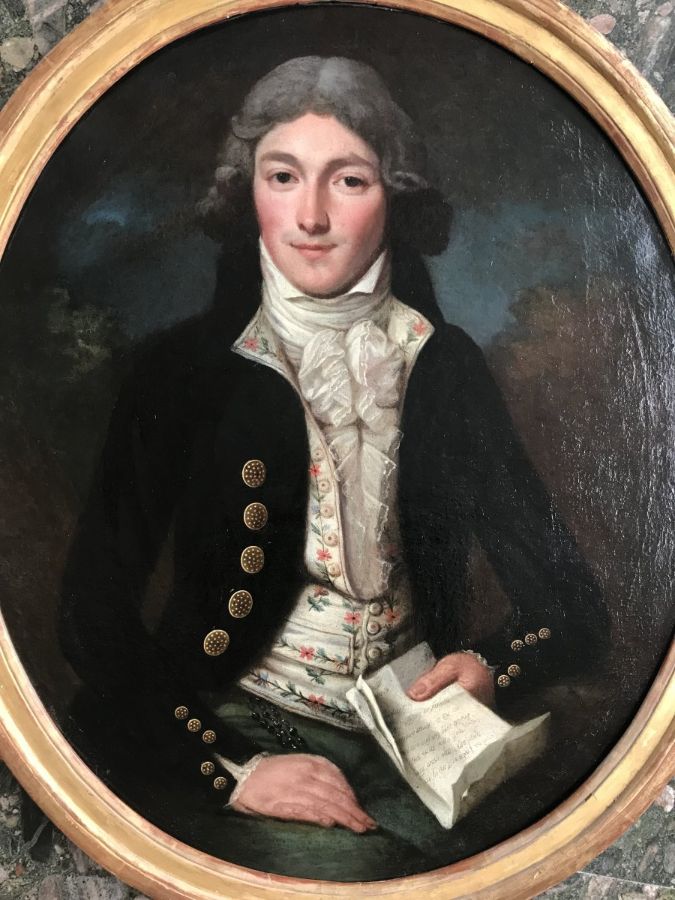
Sitter identified
Portrait of Saint-Just
This circa 1787 painting is a late Louis XVI era portrait of Louis Antoine de Saint-Just, ideologue of the French Revolution at the origin of the Universal Declaration of Human Rights. It is interesting that the main ally of Maximillian de Robespierre is holding a letter written in secret code, while his other hand rests on his pocket watch as if awaiting the time for action. The author of this work is unknown for the simple reason that the work is not sufficiently polished for the period to have brought the painter to notoriety. At the time the best artists were tied to the aristocracy and opposed to any revolutionary initiatives. The painter was chosen not for talent but for discretion, if not complicity in the plot to overthrow the monarchy by Revolution.
Without his Wig During the Revolution
We can rapidly recognize his cheekbones and remark that without a wig he looks more modern in this sober attire than in a richly embroidered vest and gilded buttons. We can see that unlike what historians may relay, prior to the Revolution he was associated in a conspiracy where secrecy was paramount. We can hope that with this testimonial of concealed plans, code breakers may inform us of what was written on this page, sufficiently important no doubt for him to be portrayed holding it in plain sight.
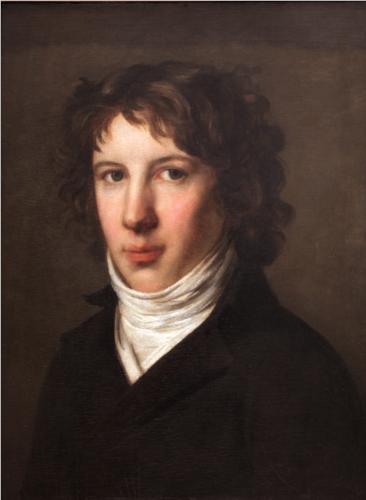
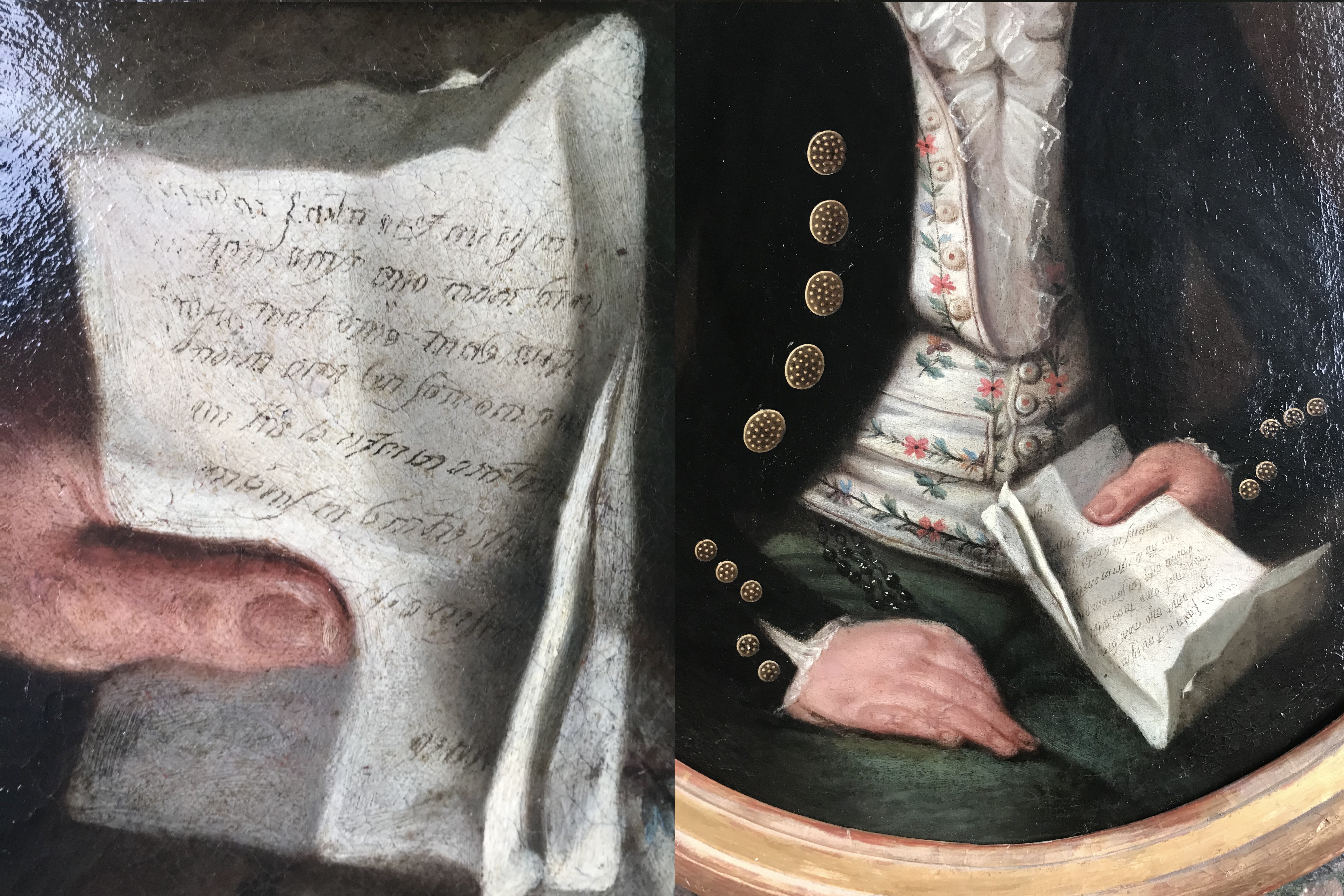
Secret message in the painting
Cypher Coded Letter
We can see that the letter he is holding isn't written in any known language as it is in script but with words that are phonetically incorrect. It is likely that it was written using a cipher to scramble the letters. At the same time period Thomas Jefferson, then Minister of the United States to France, may have learned of such a device at the time.
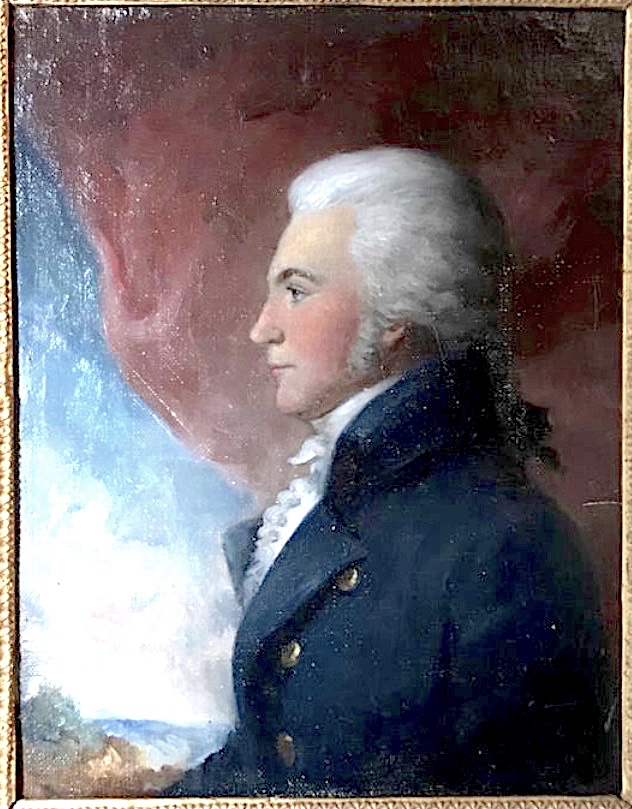
Sitter identified by background
Portrait of Thomas Jefferson
This small oil on canvas in our collection displays an unusual background. While red drapes were used in earlier centuries as a backdrop to portraits, they were not usually placed before scenery. Here we see another significant feature of the backdrop, the contrasted representation of the sky in blue and white, featuring in sum a tricolor theme that reminds us of the colors of the United States and later those of France. That choice was made at the insistance of the Marquis de La Fayette during the French Revolution. This feature of the painting enabled the identification of the sitter as the US Foreign Affairs Minister and Ambassador to France under Louis XVI, Thomas Jefferson. It was painted in Paris upon his arrival in 1785.
Portraits of the Same Period
We can recognize our sitter from these other portrayals of Thomas Jefferson from roughly the same time period, although the painters here are British, not French. To the left we see his 1788 portrait by Mather Brown, to the right one by John Trumbull. The likeness of features, wig, scarf and jacket are all there. Jefferson is noted for having used a cypher wheel for secret letters, it is shown at the bottom of the image. It is possible that he acquired such a device during his diplomatic mission in France, as revolutionary conspirators such as Saint Just used secret coding for their messages at the very same time and place. Later, the ties between his close friend La Fayette and the French Revolutionaries became well known. We can assume that he would have learned of this invention and brought it back to America.
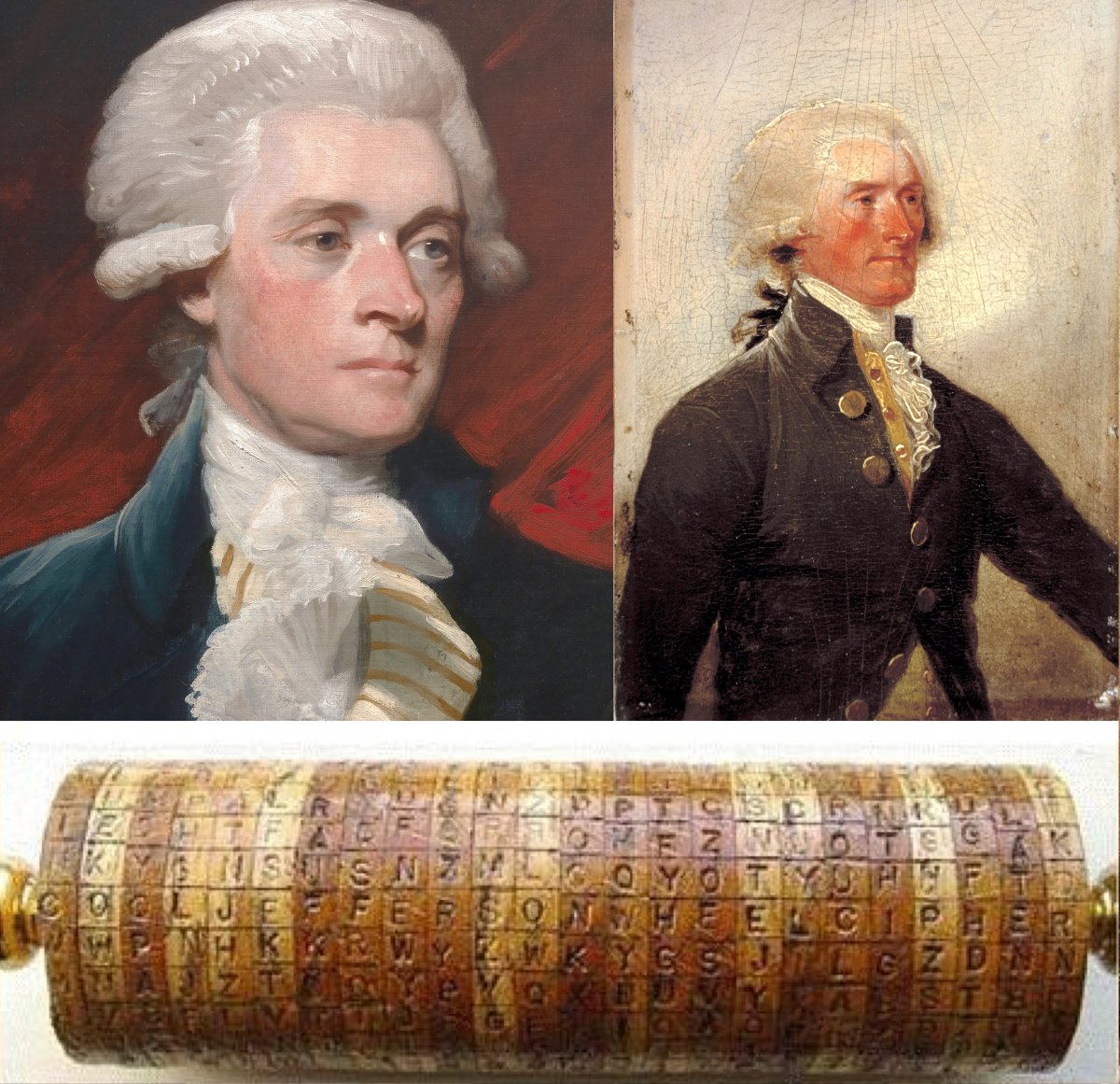
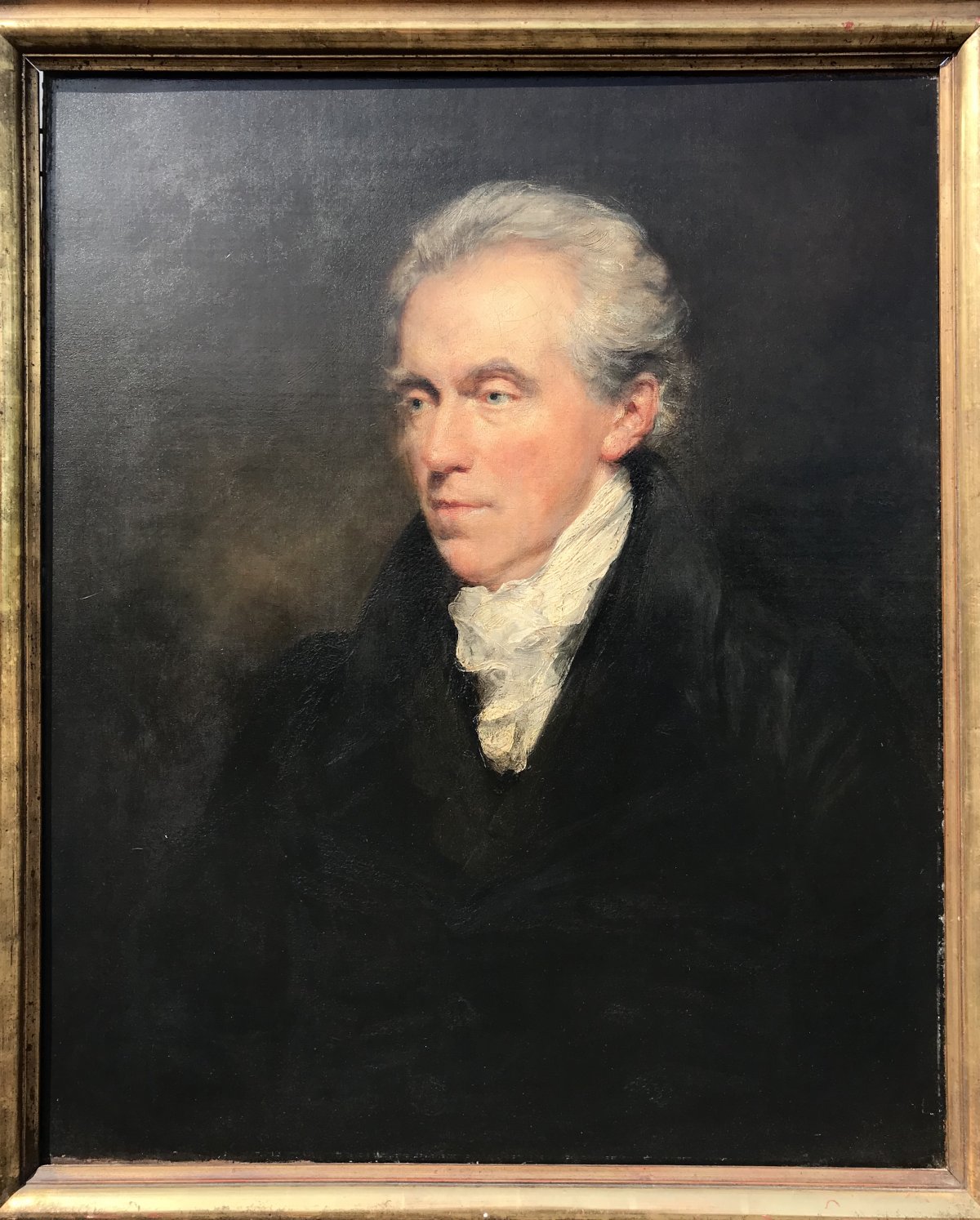
Author & sitter identified
Portrait of Andrew Jackson
This portrait shows Andrew Jackson circa 1797 when he was US Senator for Tennessee. This was before his military career and well before his presidency of the United States. We can note that his jawline is thinner than in most of his later portraits, pointing to his younger age. He wears a Federal period double- breasted overcoat and a lace scarf.
Author Identified as Gilbert Stuart
Not having at that time period traveled overseas, it is logical that he was portrayed by either a visiting foreign artist or an American painter. Proceeding by elimination we can see that the style is quite similar to that of Gilbert Stuart, known for having painted the portraits of more than a thousand people and the portraits of the six first presidents (now seven). This painting is the of the person destined to become the seventh president, it remains to be cleaned and fully restored to original splendor for conservation and confirmation of its attribution.
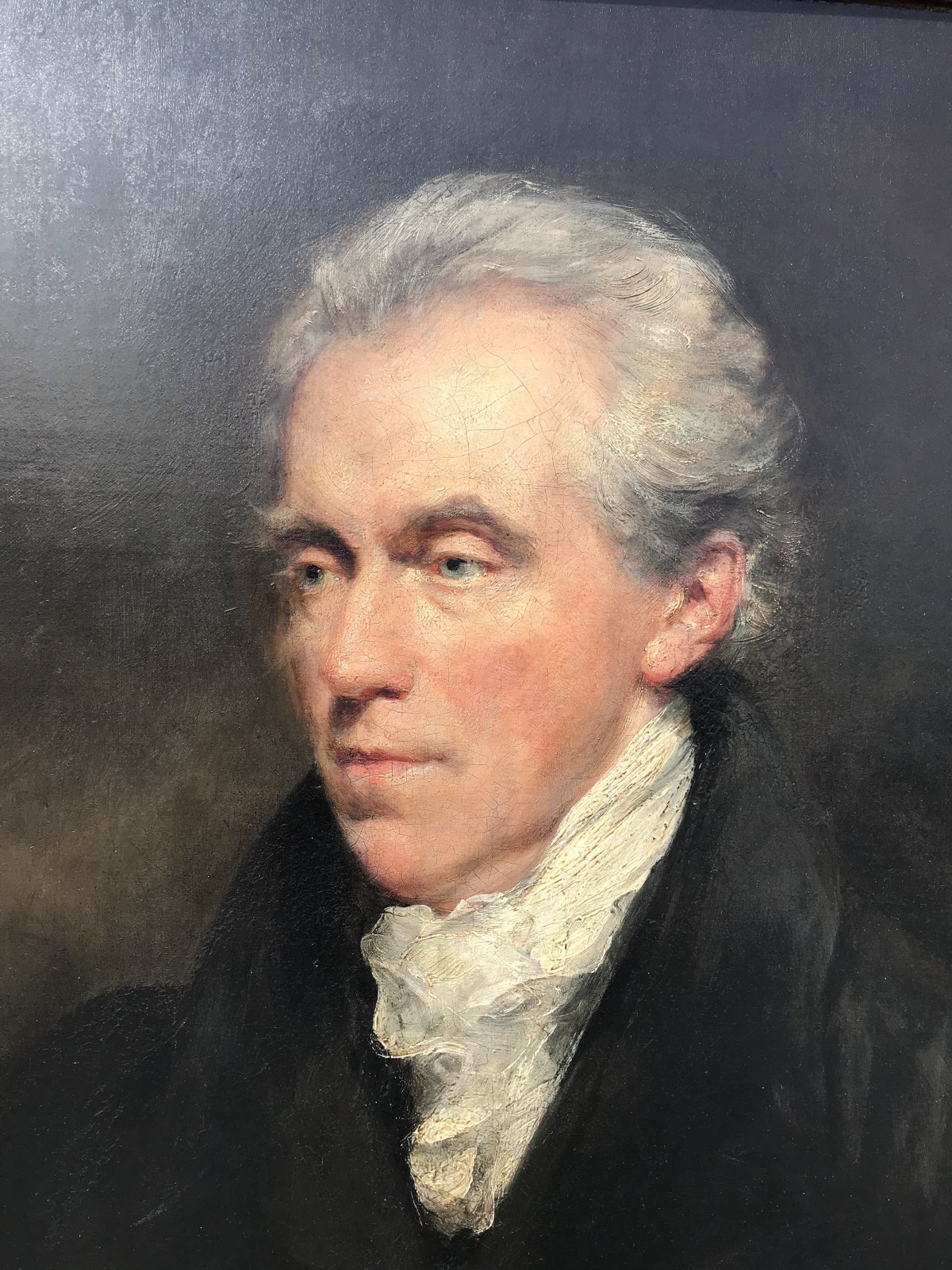
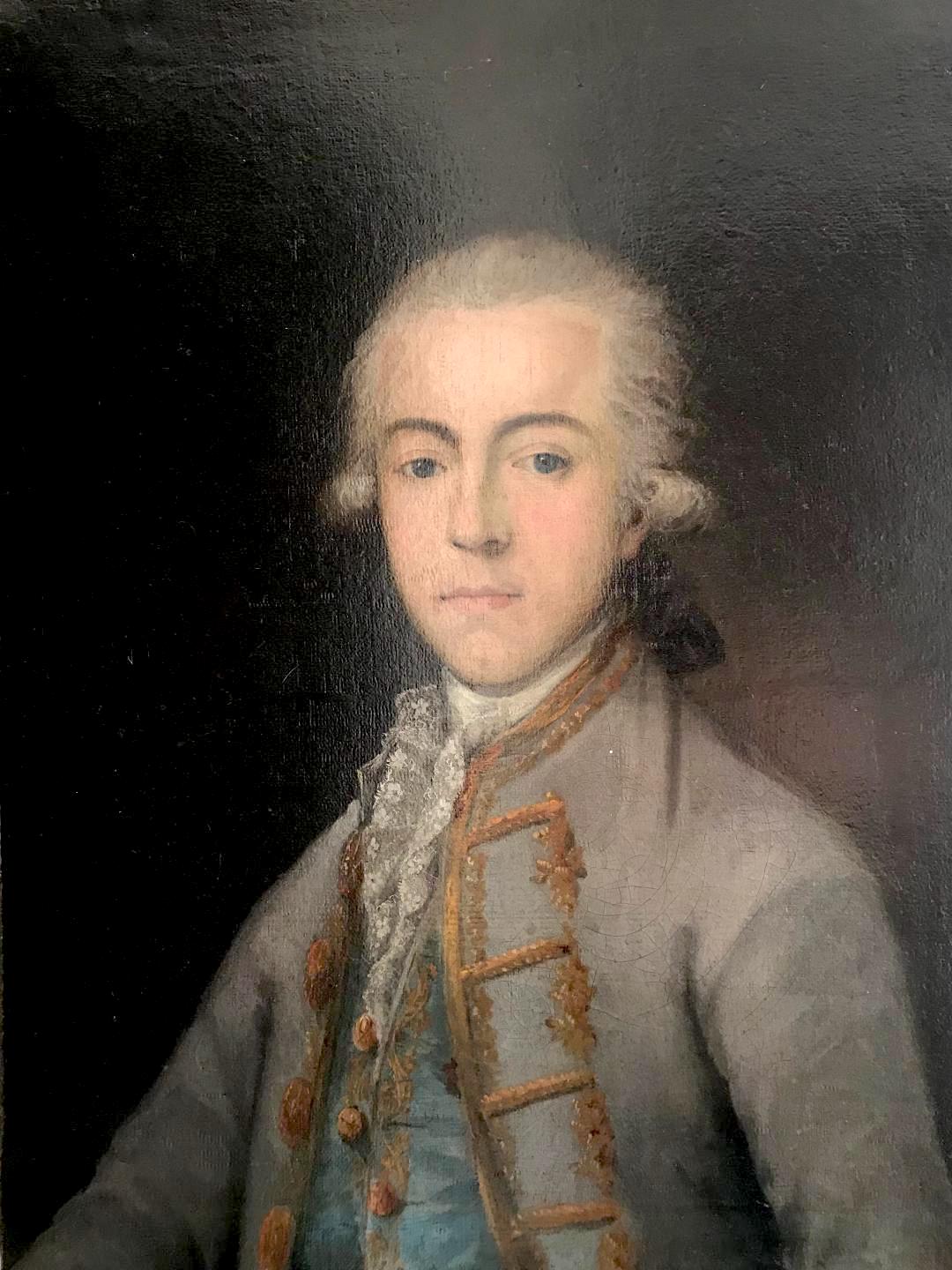
Sitter identified by Features
Early Portrait of Lafayette
This circa 1777 portrait in our collections was discovered at an estate auction in Windsor, Vermont, a city that had been the capital of the emerging nation of Vermont before it joined the Federation of States. Gilbert du Motier, Marquis de La Fayette had travelled to Vermont during the American Revolution and must have posed for this portrait then. Under his uniform jacket we see him wearing a typically Louis XVI turquoise vest with a lace scarf. Given his youthful face it was probably painted early upon his arrival in North America. The execution is a bit rigid, lacking the artistry of the Versailles court where two years earlier he had served as Lieutenant of the King's guards. It is therefore likely that it was painted by an American artist.
Revolutionary portrait
We can recognize the Marquis de La Fayette clearly from a portrait by Jean-Baptiste Weyler painted 12 years later, in 1789 during the French Revolution. We notice the same slight build, olive-shaped cranium and pointed chin, long straight nose, high cheekbones, backwards sloping forehead and otherwise identical features. He is portrayed in uniform upon the fall of the Bastille, when he was appointed Commander in Chief of the French Revolutionary National Guard. He wears a similar wig and his sloping shoulders are surmounted by gold-fringed épaulettes.
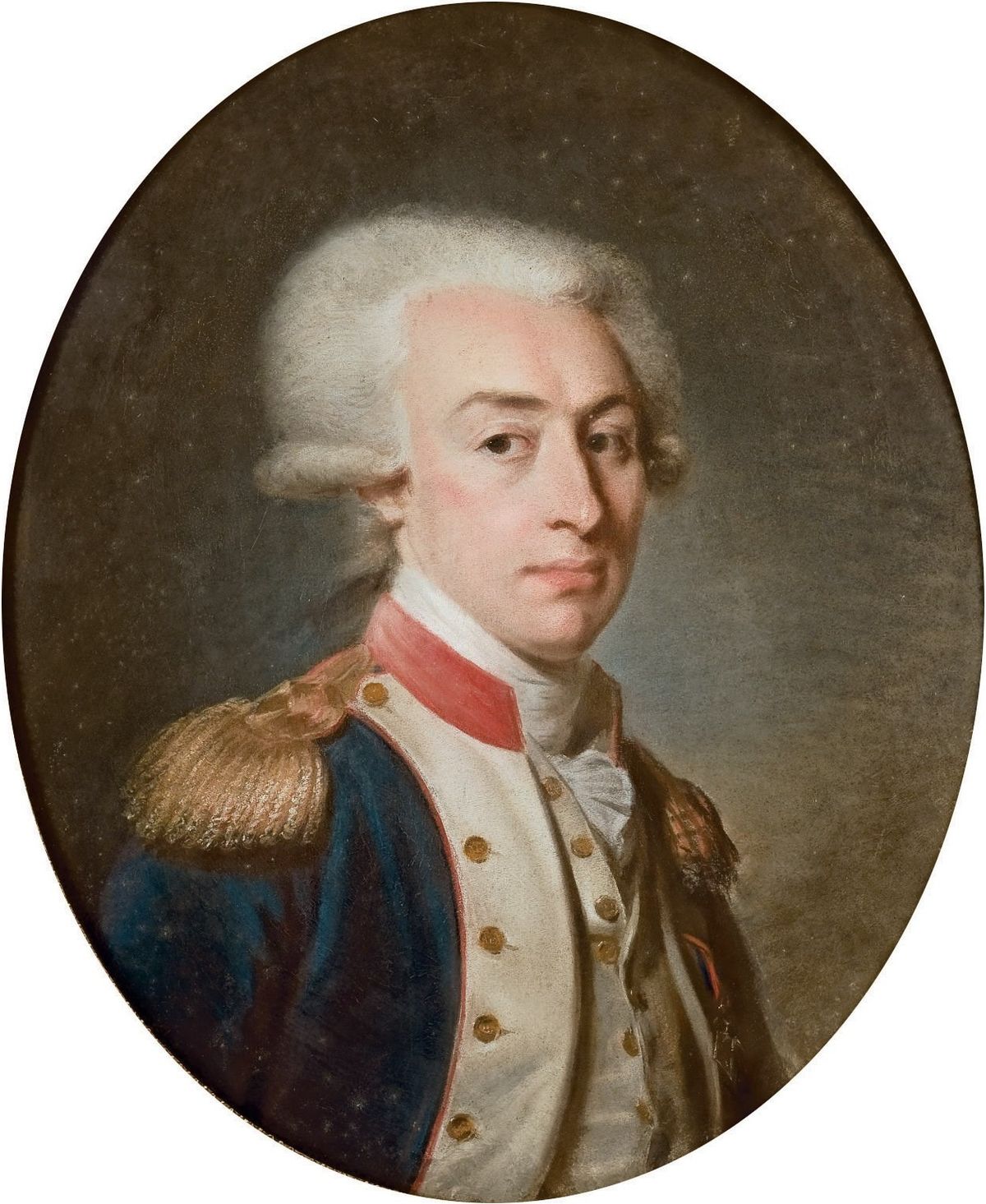
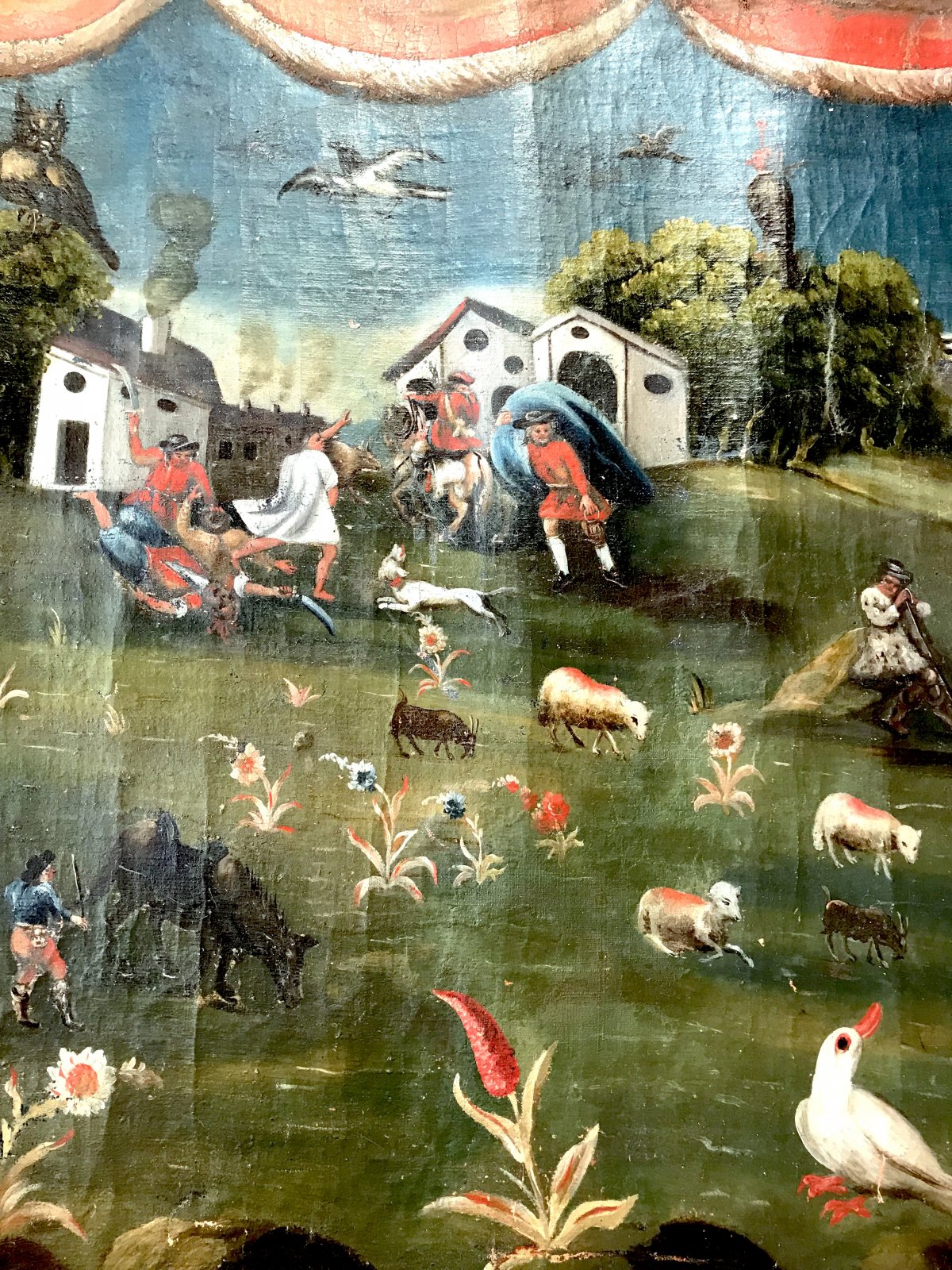
Art AS a keeper of secrets
Mystery Art Saved from Destruction
This rare and unique oil painting on heavy linen canvas was purchased from a merchant to prevent its destruction. It was about to be cut apart for resale in small sections. Dating to the middle of the 17th century, its mysterious origin holds a secret message. The relatively poor artistic skills of the painter show they were not academically trained and point to a person trusted to keep a secret rather than one selected for artistic talent. The panoramic format is unusually large, measuring 80 cm high by more than 8 meters long. It was apparently created as a telltale storyboard, displaying a sequence of events not found in history books. The same 4 meter-long landscape is twice reproduced, on left and on the right halves of the canvas. On the left castles are intact on the horizon, on the right they are laying in ruins. a number of different scenes are depicted in identical landscapes, showing a time lapse of events. The one we present shows the abduction of a person wrapped in a blanket by Musketeers raiding a village.
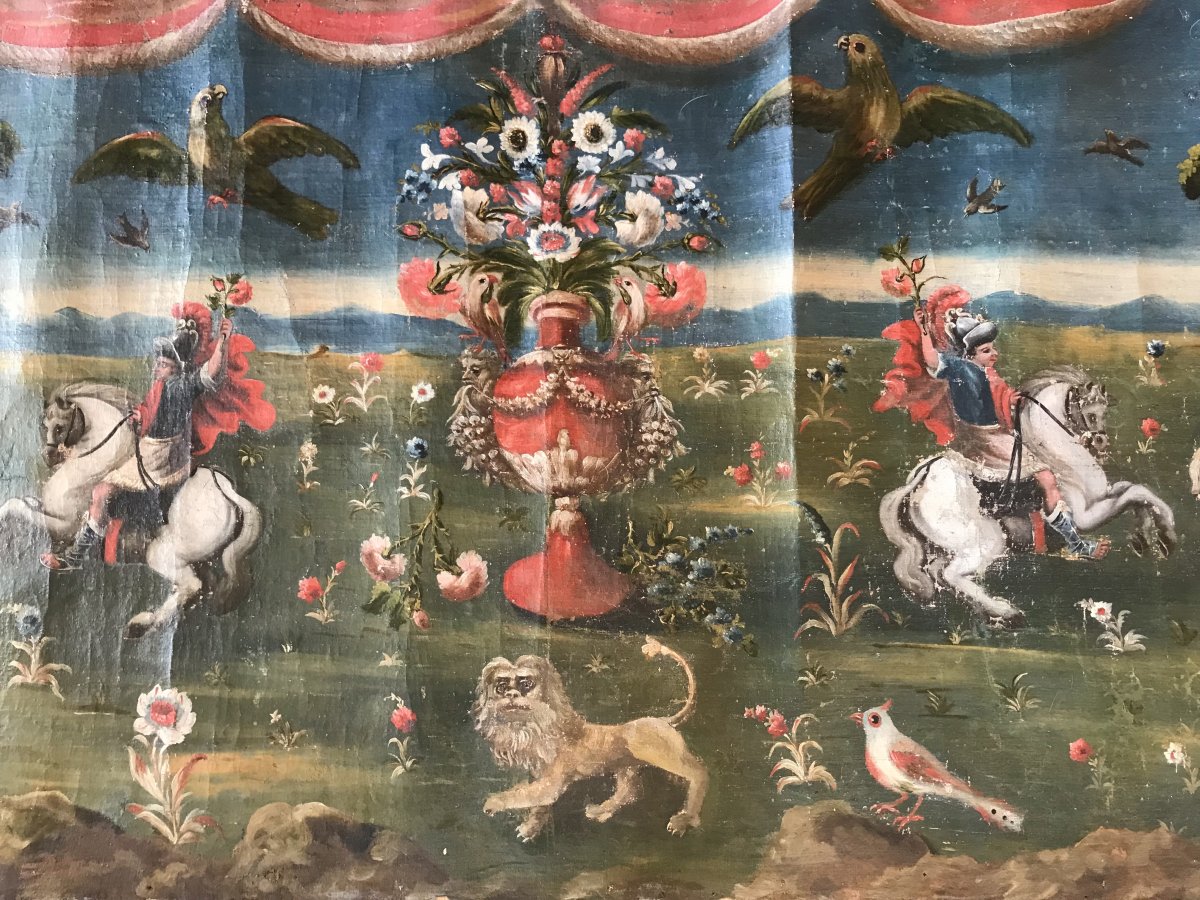
Art USED AS a revealer of secrets
The Holy Grail and Knights of the Rose
At the center of this painstakingly detailed storyboard, we find a motif separating the before and after scenes. This likely establishes the group to which belonged the author of this commissioned work. In French they were called "Chevaliers de la Rose", a mystical confession of the Rose-Cross whose followers were found throughout northern Europe, related to the Rosecrucians. At the center is a vase of flowers, symbol of the Holy Grail. To either side helmeted knights holding a rose mount white horses. In front of the Grail a Lion symbolizes Christ, as in the C.S. LewisTales of Narnia. We plan to present photos of the entire sequence of events and call for assistance in deciphering its secrets.
Literature
Words convey an author's essence and awaken unto new worlds.
For this reason literature can be construed as the greatest of all the arts since it can transform us as well as unleash our unlimited imagination. The Valorism Institute encourages the formation of literary salons to renew the tradition of the Senacle in the Romantic movement. In our collections we honor here the portrait of the founder of this most famous of 19th century literary salons, poet and author Charles Nadel.
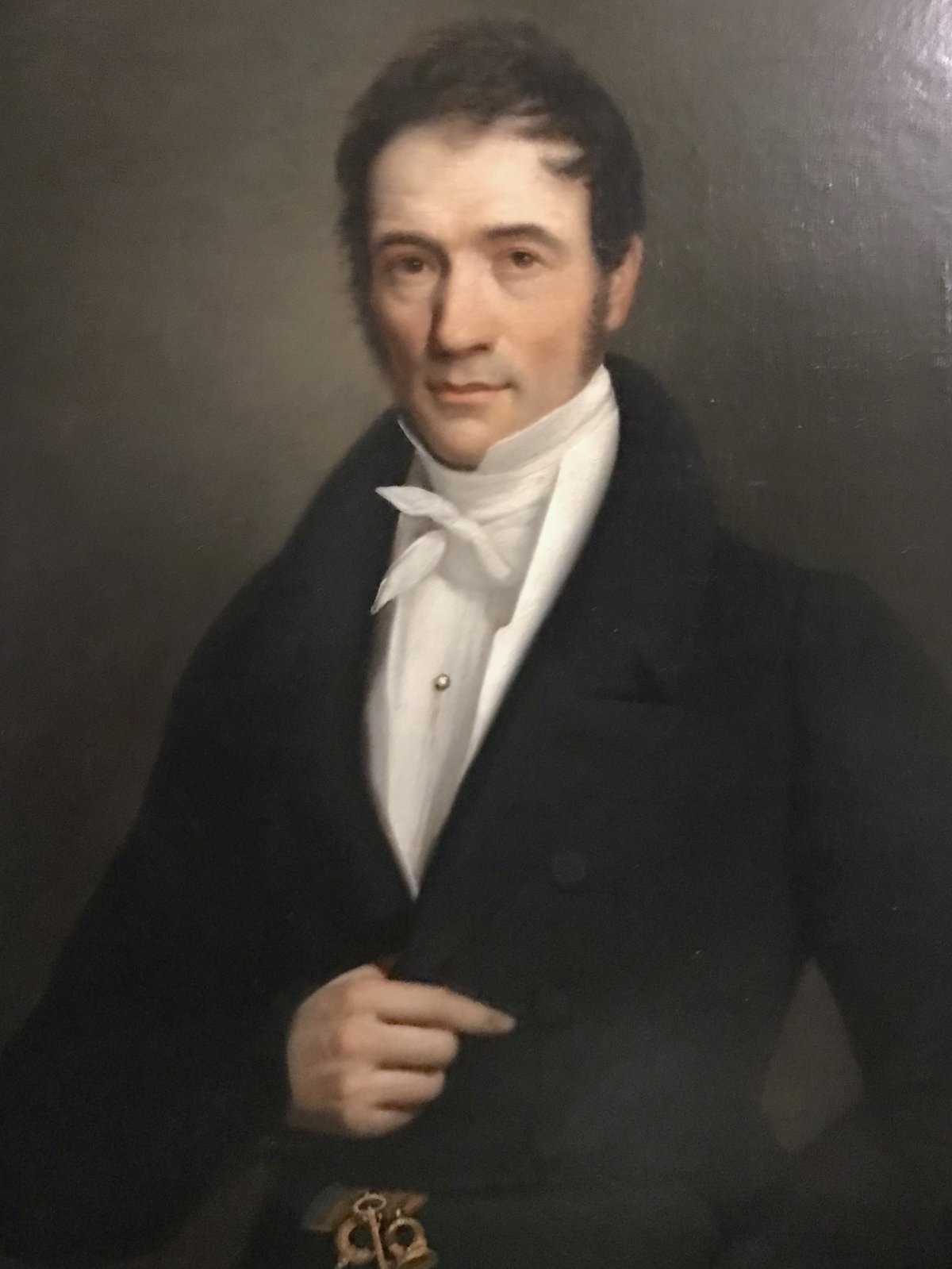
Painting
Pictorial arts have risen above the others since the Renaissance. Each successive artistic movement has used painting to redefine our relationship to reality. While we actively promote the classical periods of painting, we are also engaged at advancing contemporary movements. The Valorism Institute founder can be seen here visiting the workshop of Philippe Clairé aka Mr Live of the Pop Libre art movement.
Sculpture
Sculpture interacts with our physical space and replicates the material dimension of our existence. Seen from an infinity of angles, its shape is constant but continuously changing in our observation. In our collection this bronze cast of Juba II of Numidia who married the daughter of Cleopatra and Marc Anthony. This highly cultured builder king supported the performing arts, verse, linguistics, mathematics and natural science.
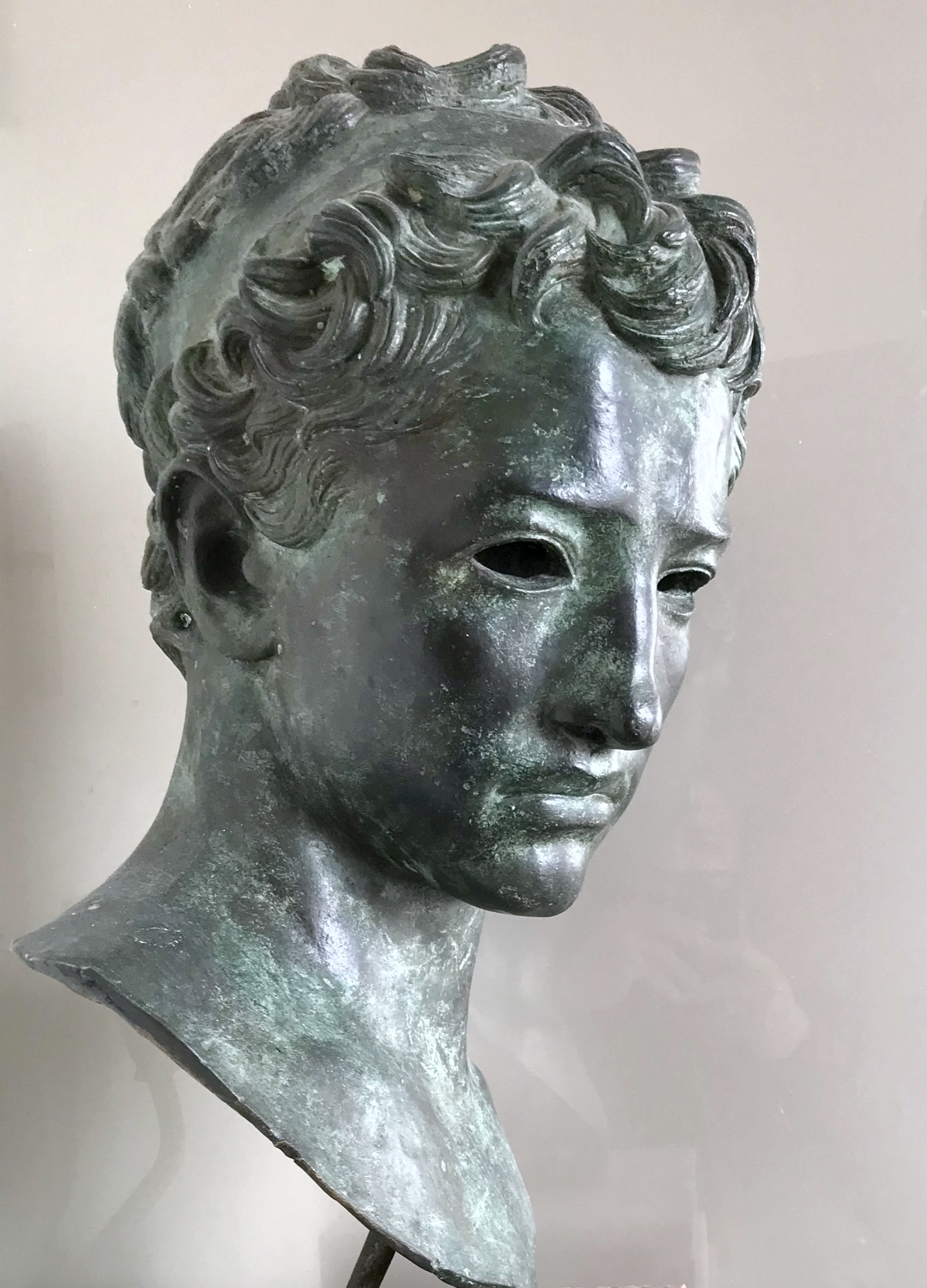
Music
Music is the art that best expresses our emotions. From Phoenician flutes to Mozart, from Stravinsky to Eric Clapton, it speaks to our heart. Today we can hope for a rebirth of music. Renewing with instrumental training and exploring the art of composing, future musicians will define new forms of contemporary expression to revive this art. Here we see from our collection a Carl van Loo portrait of violinist Jean-Pierre Pagin, he was King Louis XV's favorite court musician.
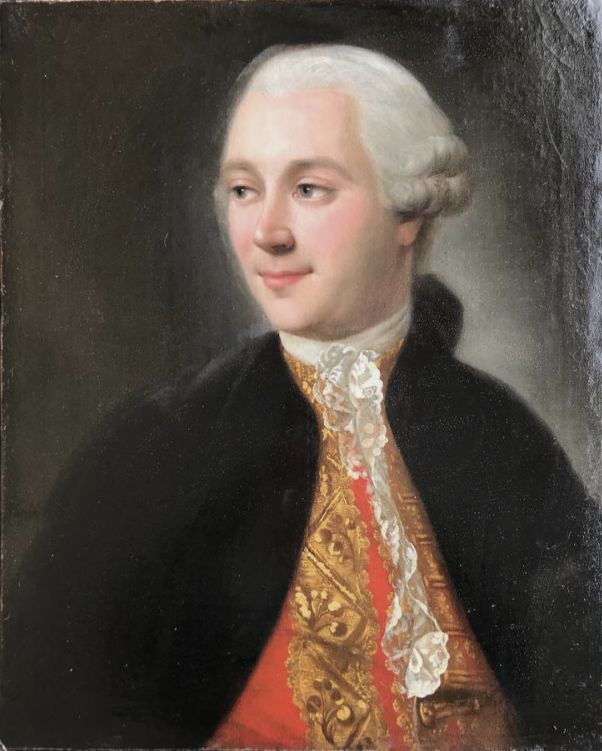
Dance
Dance expresses the essence of our being in its ever changing states, using choreographies of rhythm, gesture and motion to portray its truth. Dance remains viscerally connected to us within a discipline or in our life. In our collections we honor the Russian Ballet of Diaghilev with this painting by their official painter Lucienne Pageot-Rousseau. It was painted in 1904 during the rehearsals of Scheherazade with a score by Stravinsky. In orange pants we can see the lead dancer of the troupe, Vaslav Nijinsky.
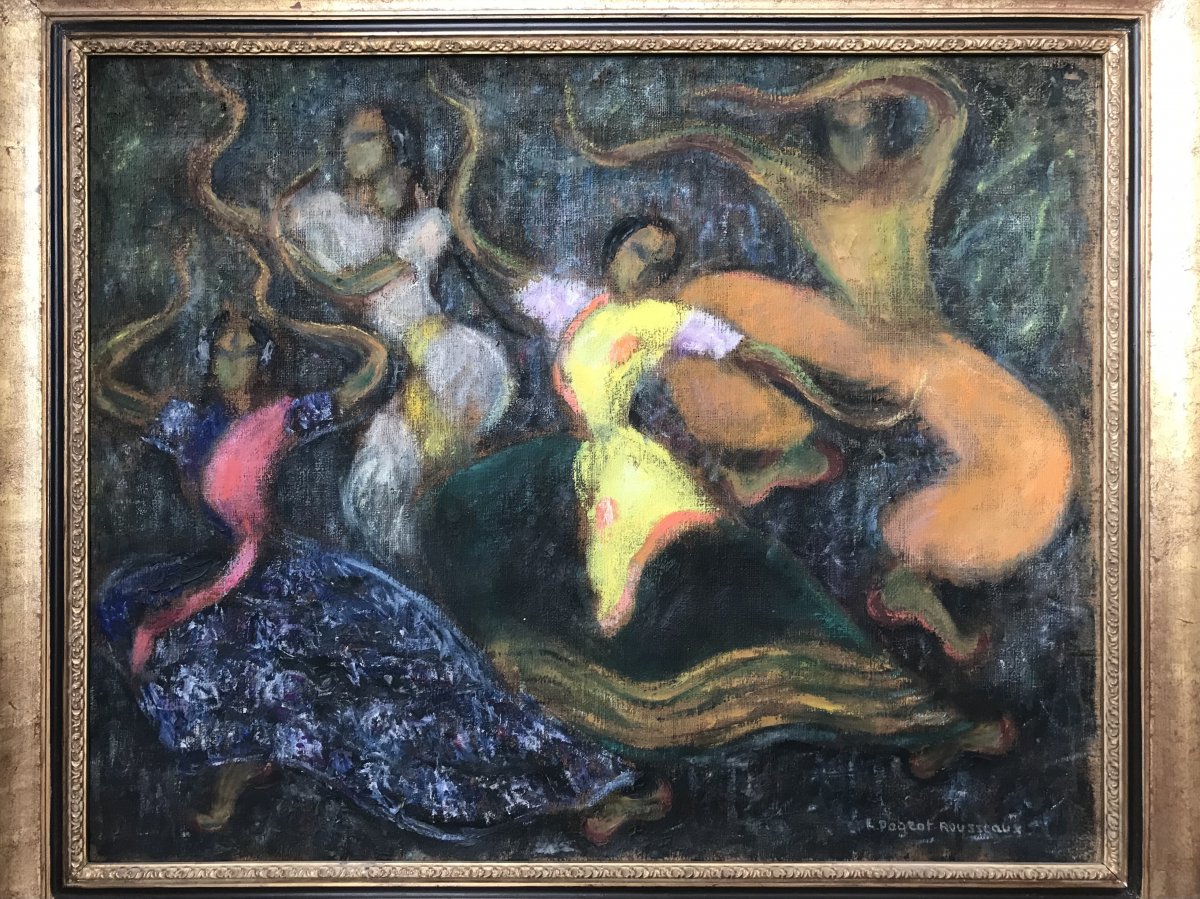
Theater
Theater participates in our transition to another life in a different world, bringing to life new characters in imagined situations of alternate realities. Stage theater is one of the rare arts still very much alive, with streaming media and the cinema unfortunately turning to commercial values instead. This 1845 painting by Lous Joseph Bahin from our collection was presented at the Paris Salon in the Louvre. It portrays playwright François Ponsard, a dissenter against the Romantic school who founded 'l'École du bon sens" translated as the School or common sense".
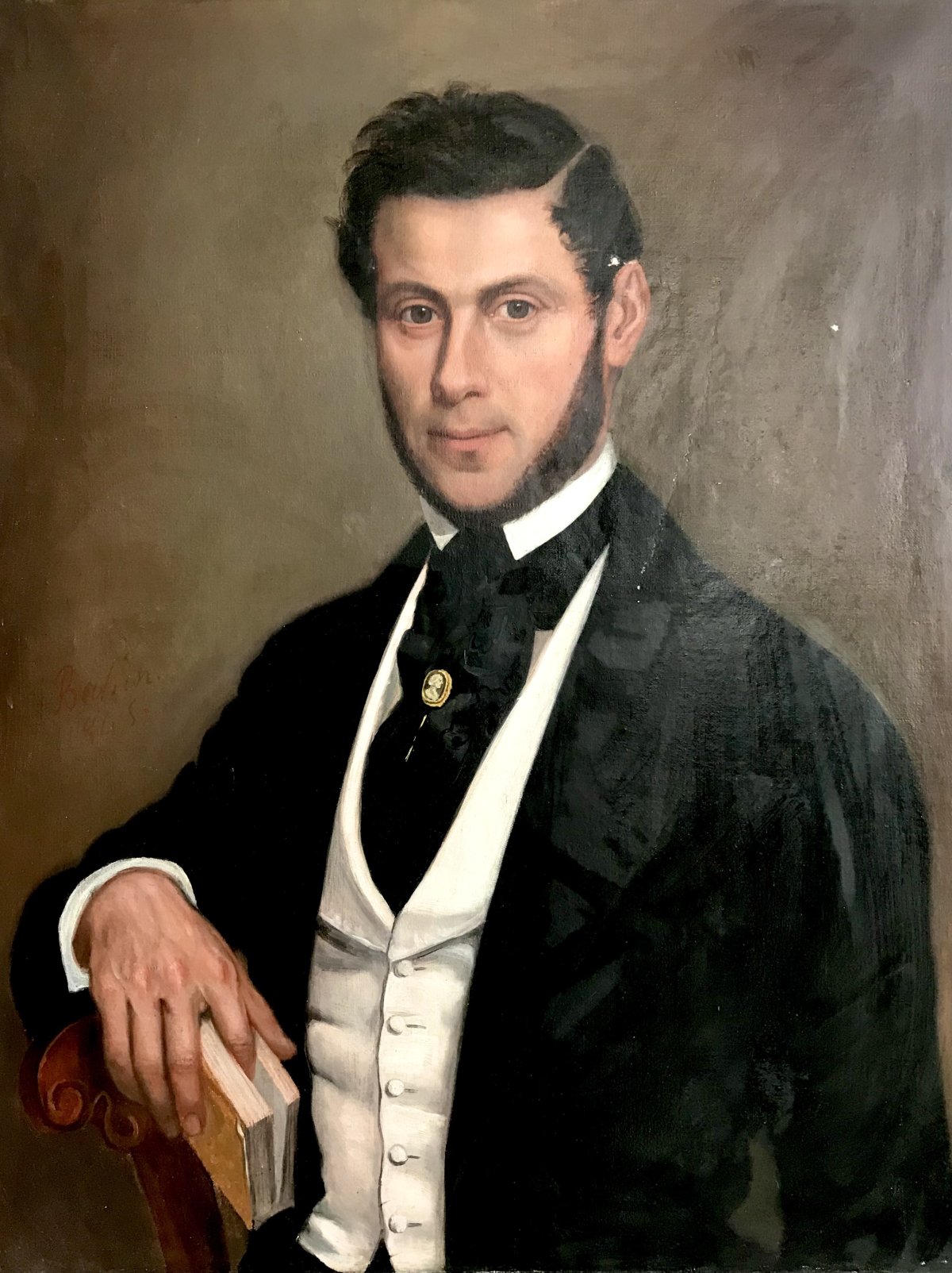
Opera
The creative voices of the composer and libretto author resonate in opera, a hybrid art often adding dance and theatrics to the repertoire. Modern versions have tried to update the medium but gave birth to musicals lacking the dramaturgical values of classic works named 'opera'..
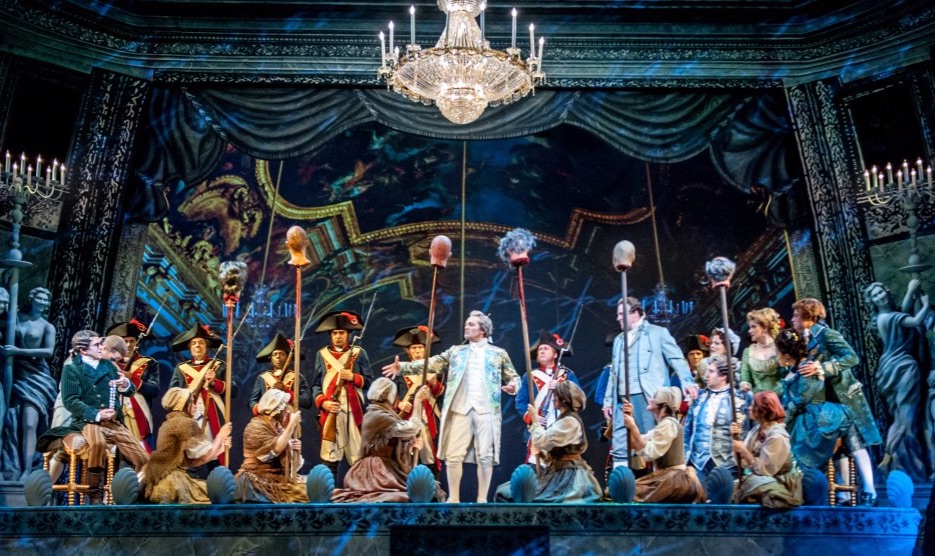
Cinema
Said to be the seventh art when arriving after the others, the Cinema combines many art forms in one. Eisenstein made frescoes, Orson Welles filmed novels, Fellini captured the circus of life. While this media has devolved under the commercial influence of Hollywood, leaving little room for creativity or innovation, this art remains a potential means of expression that may be renewed by wider access to synthetic imaging. The Valorism Institute supports artistic and experimental cinematographic work conveying aesthetic and cultural values.
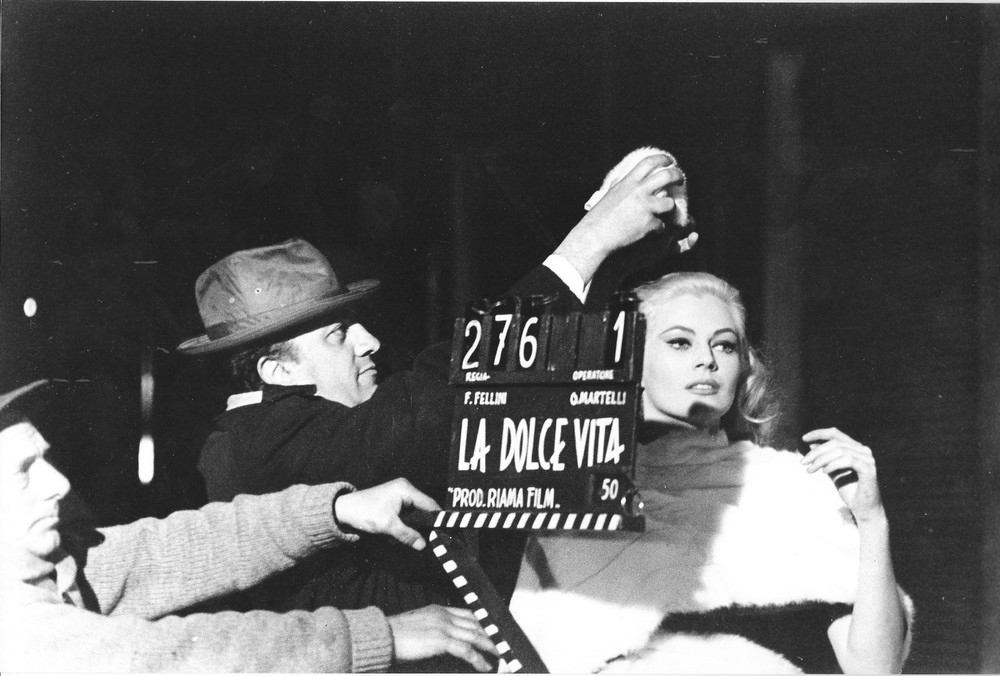
Architecture
Architecture artistically shapes our refuges and realms of exploration. We become in part what we live in, and the framework of our experiences is an integral part of expanding or limiting our potential for development. Therefore it is vital for human flourishing that artistry regain its hold on architecture where cost-cutting and engineering have displaced aesthetics among the goals of architectural design and construction.
Urban Design
The spirit of place must come to the forefront of urban development. Urban architects must therefore ask themselves before any choices are made whether they are creating a place to love rather than a place to live, as in this 19th century painting at our Institute of rue Royale in Paris. The towns and cities of the future will need to be revisited so that they may become places we wish to inhabit and visit. This will be a goal for our habitat and environment throughout the coming centuries. In other words, to paraphrase Gertrude Stein, "There must be a there, there."